A-Z activities

A-Z countries

What's this blog all about?

Hi, I'm Nicola - welcome to a blog begun in 2012 about family travel around the world, without leaving the UK.

I love travel adventures, but to save cash and keep my family's carbon footprint lower, I dreamt up a unique stay-at-home travel experience. So far I've visited 110 countries... without leaving the UK. Join me exploring the next 86! Or have a look at the "countries" you can discover within the UK by scrolling the labels (below right). Here's to happy travel from our doorsteps.

Around 2018 I tried a new way of writing my family's and my own UK travel adventures. Britain is a brilliant place for a staycation, mini-break and day trips. It's also a fantastic place to explore so I've begun to write up reports of places that are easy to reach by public transport. And when they are not that easy to reach I'll offer some tips on how to get there.

See www.nicolabaird.com for info about the seven books I've written, a link to my other blog on thrifty, creative childcare (homemadekids.wordpress.com) or to contact me.
Showing posts with label history. Show all posts

Wednesday, 19 September 2018

This changes everything: history makers

Is there a bit of England you are passionate about and why? Looking at the new Historic England publication, A History of England in 100 Places, is a wonderful way to explore. Words by Nicola Baird (see www.nicolabaird.com for more info about my books and blogs).

Recommended: new book from Historic England.
Growing up in a rural corner of east Hertfordshire has left me with a sentimental longing for an undulating patchwork of wheat and barley fields criss-crossed by footpaths and bridleways. In the valleys are small rivers, though another county might write them off as streams. On the top of long slow inclines are mixed hornbeam woods and they're there in the valleys too. Thinking back to the 1970s (when the golf course hadn't been built) I can see again the gamekeeper, who lived next door. He was both hero - whistling his young pheasants up for corn - and agent of horror, hanging his most recent kill on the animal gibbet in a very dark part of home wood. But thanks to him I learnt how to whistle, and confidently ID any larder of dead moles, kestrel, vixen, stoats. Two valleys away there were sheep - you could hear them bleating on the wind, In the opposite direction there were smaller turfed fields and several dairy herds.

Wandering the hedgerows you could have been in the 19th century, or 18th maybe. It wasn't hard to move far further back in time and imagine the Romans' kilns on the valley the other side of Caley Wood, as so many bit of pottery turned up in the autumn plough. Nearby was an old beamed farm house with a tower that the gentry used to watch the hunt where a 20th century bit of redecorating helped uncover Tudor wall paintings.

Another neighbour found a Saxon arrow head on his plot, then brought it to the pub for everyone to see.

Mine was an outdoors childhood in a very small corner of England which many generations have clearly lived in and loved. It's amazing how certain places just tug at your heart.

As an adult I've opted to live in London, because the city is far easier to get around and easier to find paid work. But holidays have mostly been spent exploring Britain, thinking as much about who used to live there back in the day, as what's on offer to enjoy now. That's why I love this new publication by Historic England, A History of England in 100 Places, which cherry picks 100 fascinating places where "irreplaceable" history has happened. Not so much the growing up, more the changes that move life forward.

In all 4,000 people nominated a swathe of the places they love best and then 10 experts  (TV history gurus/celebs including Baroness Tanni Grey-Thompson and Mary Beard) whittled down a short list. Lists are meant to spark conversation, but for once this isn't a bucket list of places you must see, which would obviously include Stonehenge and Windsor Castle (as the book does). Instead it's picking out places where momentous things happened which changed the way we live.

At the book launch guests could also look around the
V&A sculpture court. An amazing place for a party.
At the very glam launch party - held in the V&A - one of English Heritage's researchers told me his favourite entry was the Brown Firth research laboratories in Sheffield where stainless steel was accidentally invented. Key note speaker included Tristtam Hunt, the former Labour MP, who now runs the V&A. He was shameless in loving the Middleport potteries entry from his old constituency in Stoke-on-Trent.

I was fascinated by the story of the Euston Arch (the entrance to Euston station) which was pulled down in an act of vandalism in 1961, and is now rubble in a bit of River Lea infill. But it was a wake up call to conservationists about the need to organise better.

And because it's a people's choice, there are chapters which retell the things that working people have had to endure, instead of the super rich. That's how I found out that sad-looking, boarded up Farfield Inn was blasted by the Great Sheffield Flood of 1864, a failed reservoir which killed 240+ people and flattened 600 houses. Ultimately this changed the way reservoirs were built and began a debate about corporate responsibility, but it's not yet a well-known story. 

Also find out about the first railway bridge, built in 1825 for Stockton & Darlington railway which was founded to serve the coal industry. Skerne Bridge is just  a single stone arch in the centre of Darlington, but it's so beloved by locals that they nominated it for every single category.

I sense that this book is going to work hard in my family. It will sit on the kitchen table and be something we argue over deciding on which places to visit, ideally without crowds. Virtual travel is always fun, but I think this book's focus on people and place may even inspire us to actually go to see what the fuss is about. All in all a perfect book with its mix of tourism, English heritage and populist vote. My only regret is that Hertfordshire gets such poor coverage - it's really a beautiful county with more stories in the landscape than even the Brothers Grimm could recall.

Tuesday, 7 August 2018

Searching for English Civil War sites of 1642

A quest to find more info about the first battle of the English Civil War at Edge Hill in Warwickshire is thwarted. Or is it? Words by Nicola Baird (see www.nicolabaird.com for more info about my books and blogs).

It’s lucky I didn’t do home schooling for the whole of my daughters’ educational life. I say this because me and Nell, who has just finished lower sixth, have just spent a whole day trying to find the site of probably one of Britain’s best known civil war battle sites at Edge Hill in Warwickshire. By the end of our hunt we weren’t sure we’d actually seen it… 

Part of the reason Edge Hill – which I know from the internet is big and obvious – is hard to spot is because it’s Ministry of Defence land.  And from experience anyone who is looking for a battlefield will know that years later they are just fields, often with zero clues about the terrible things that happened there. 

Ok, so I couldn’t find a battle site. But it was only because my daughter was studying the English civil war (Roundheads v Cavaliers) that I even heard about Edge Hill. Just in case you didn’t know either it was fought on 23 October in 1642. That’s the sort of easy to memorise date that people use for padlock codes and burglar alarms, but still I didn’t know it!


From the roof at Broughton Castle looking over the
knot garden and moat. What a view. Imagine it with
the Cavalier army coming to get you...
Anyway, Edge Hill was the first of the civil war battles. The Royalists (fighting for Charles 1) won and then headed to the moated Broughton Castle, outside Banbury, in Oxfordshire, to deal with the Parliamentarians living there.  

Over the next four years, fighting was up and down the country with significant battles at Marston Moor in Yorkshire (2 July, 1644) and Naesby, Northamptonshire (14 June, 1645). 

Edge Hill is meant to have a sign commemorating the battle and there’s a four mile walk around it and a 15 mile drive… but we don’t have access to a car and we got rather lost on our walk from the nearby National Trust big house, Upton House.

A key place to visit might have been the Castle Inn (built 100 years after the battle so Prince Rupert did not stay there) which is on the 6 bus route from Stratford-upon-Avon… but the extremely helpful bus driver urged us to hop off at Ratley, just before Castle Inn so we’d be more easily able to find Upton House. And so we missed that commemorative spot.

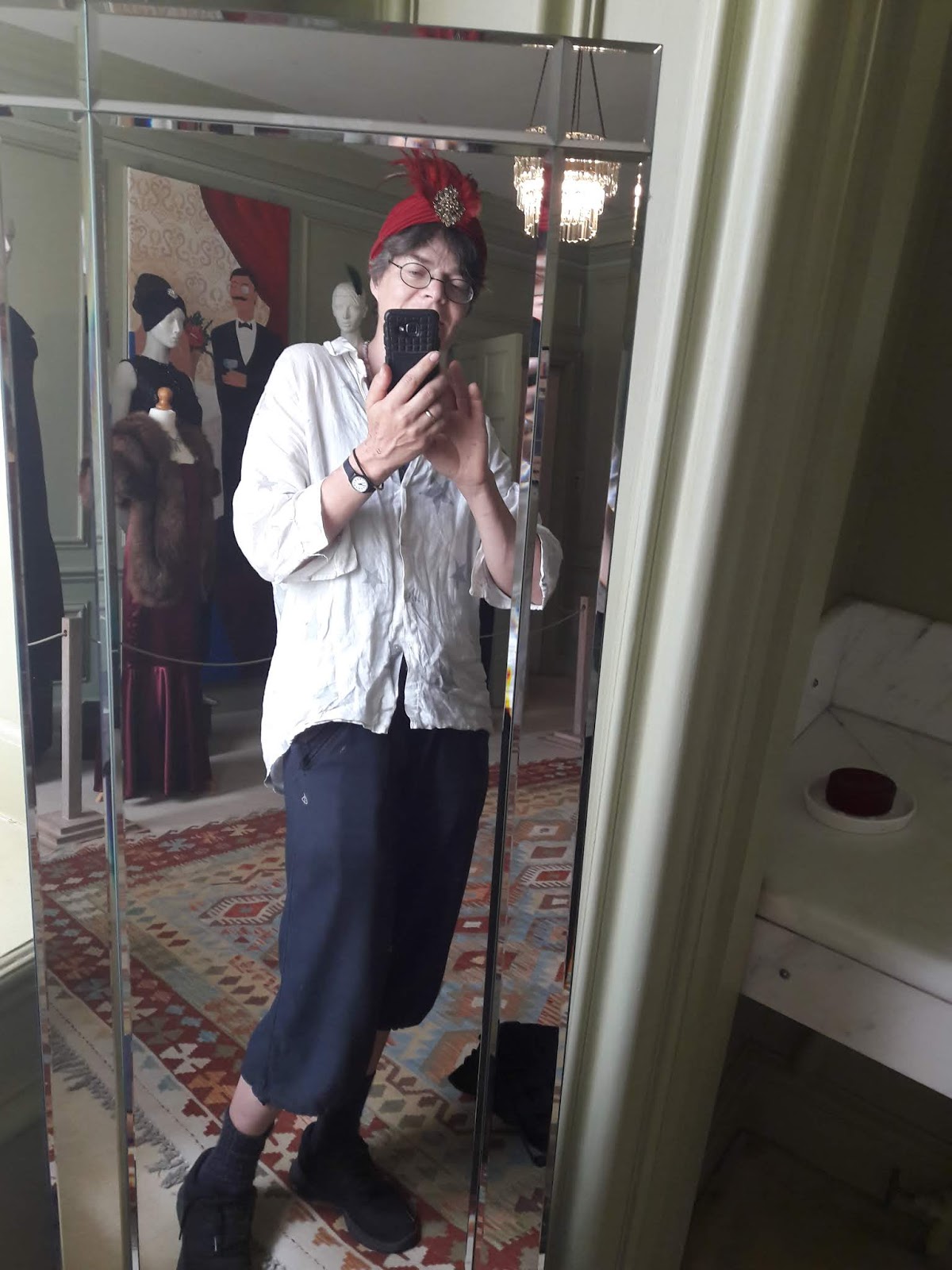
Distracted from our civil war mission by 1920s
dressing up glamour at Upton House.
On the plus side, Upton House is an easy place to get distracted. Bought by a family with money in 1927 there’s no link to the civil war but plenty of show and tell about the ways soaking an English country house with cash and employing a famous architect (Percy Morely Horder) can make a drafty set of bricks utterly gorgeous. For a few hours we were living in the 1920s imagining invites to a sporting winter weekend with cocktails and chat about art, followed by billiards, squash and maybe a ride out towards that elusive Edge Hill.  

Lord Bearsted made his money as chairman of Shell. Most National Trust houses are filled with bits and bobs from old aristocracy, this one really isn’t. Instead there’s an incredible art collection (the old squash court ended up becoming a gallery) and the most amazing red and silver 1920s jazz bathroom. Along one corridor, which has several rooms of Country Lifecover displays and holidaying on the Riveria, there’s also an impressive collection of Shell posters.

The guides at Upton House do a clever job of keeping their visitors busy. Nell and I were offered a free half hour intro to the house at 12.10pm (which was fab) and then a self-guided tour at 1.10pm. That gave us just enough time to visit the coffee shop, buy a few nick knacks and try to figure out how to get to Edge Hill.

This proved tricky. The heat was one thing (this is the summer of 2018 and relentless 28+ degree days). Figuring out where the bus stopped was another. The National Trust staff/vols, bless them, tried to help but had an old timetable (we knew this because we’d been on the 6 on our journey to the house) which no longer offered a bus at the end of the driveway.  We tried asking for a lift (the cheeky version of hitching) but it was always going to be random if we’d strike lucky or not. We didn’t although several people kindly offered us lifts to Banbury.

Tysoe church in the middle distance. I'm teaching my daughter to find
rural bus stops by following steeples. She thinks I'm very strange.
Optimists to the end, we figured we could walk, see the battlefield, and catch our bus at the village of Tysoe taking us back to AirBnb in Stratford-upon-Avon.

And that’s what we did. It’s just that we think we missed the battlefield and we found the NT map didn’t seem to match the walkers’ footpath signs in the fields. One wheat field was being harvested which was fascinating for my city-living daughter to see the size of modern bales. Under our feet were huge cracks thanks to this summer’s drought. We found a bridleway hugging the top of a hanging wood which gave us glimpses through the trees of a panoramic Warwickshire and then left us a bit confused. 

Looking back towards the wood edge and beyond that
Upton House.
Luckily a lovely woman on a private road stopped her car, sorted us out by pointing towards the Tysoe village church spire and we managed to make it. I can’t correct the map we took off the NT website (which did at least give me some idea about a possible route) as we used instinct relying on the knowledge that as the British landscape was worked in previous centuries by 40 per cent of the workforce, there are always a lot of footpaths that take you in the direction of a village, pub or farm.  Not that this is clear these days as local parishes/counties change the signs to numbers without any clue as to what these numbers mean. What crazy person would give a footpath the name of a bus route? Clearly not one (like me) who hopes to reach a particular point but doesn’t necessarily bring a compass, up to date OS map and 4G.

There are times when the countryside feels like it’s been taken over by men. There’s the ever-faster roads, the obsession with driving, the numerical routes (actually not obvious here in Warwickshire), the computerised/mechanised farming, the vast scale of every field, the super-size kit (tractors, balers, combine harvesters). In short a lack of human scale and – dare I say it a slight obsession with guns, as per the Game Show held the previous weekend nearby at Ragley Hall, Worcestershire.

But for us, thankful to find the 7 at Tysoe (a huge thank you to that bus driver) enjoying the view as we are driven through villages of Tudor-built houses, thatched cottages, pretty front gardens and optimistically-advertised church teas and dog shows at the weekend and suddenly the world is less gender-segregated again. It’s Oh Comely andSimple Thingsversus Dog and Gun.

The Civil War would make a great tour for the thousands of Y12 and Y13 students who study it. It would be interesting for its own sake, but I struggled to find either a tour or a simple way to make this happen. Instead we tourists get passed from visitor honey trap to honey trap. For me and Nell this was beautiful big old houses and the story of Shakespeare’s life and work in Stratford upon Avon – a market town with a lot of shops, cafes, the RSC theatre and 2-3 million visitors annually. 

Beautiful Warwickshire panorama - Edge Hill possibly away
in the far distance on the right.
Maybe I’m bitter because I couldn’t find Edge Hill. But I do wish tourism could be less expensive in the UK and involve far less hours checking bus timetables. I’m not even sure that buying or renting a car would resolve the challenge of getting to know a place properly. My dream is for 1000+ years of history and the characters who lived there to be brought alive by locals explaining the ways that national obsessions (eg, the civil war, banning slavery, London gossip, workable wifi) have impacted on life.  I know the info just hangs on – Tysoe is a corruption of old English and probably refers to a figure of a horse cut into the hill, hence the current area’s name Vale of the Red Horse. It was there in 1607 but is now long lost.  Wikipedia was my learned friend, but where else I could find this info I’m not sure. Villages move with the time, but so much detail is lost that tourists/historynoughts might well enjoy.

To be fair you could say the same about where I live in London. The difference is that no one goes on holiday to Finsbury Park. At least I don’t think they do…

  • Broughton Castle, Oxon (near Banbury) is open Wednesday and Sunday afternoons Fantastic place, privately owned. We used a taxi from Banbury station (cost approx £10 one way).
  • Upton House and gardens, Warwickshire, run by the National Trust As I've got a NT card it's always fun visiting big houses. This one has many stand out features. Reach it be bus 6 or 7 from either Banbury or Stratford upon Avon. But you will have to walk about half a mile along the road from Radway. it was a nice walk! Or find a way across the fields from Castle Inn (we didn't try this but we should have done).
  • Buses 6 7 & from Banbury to Stratford-Upon-Avon are run by Stagecoach (but will be switching to Johnsons later 2018)
  • More about the village of Tysoe, Warwickshire.

Monday, 23 July 2018

Getting to know Hughenden Manor, near High Wycombe

National Trust membership is a brilliant way to explore and get some basic history, access to lovely gardens and treat yourself to delicious tea and cake. Most recent trip was to Hughenden Manor, two miles from High Wycombe in Buckinghamshire. Words by Nicola Baird (see www.nicolabaird.com for more info about my books and blogs).

The monument for Disraeli at Hughenden Manor built by his wife.
On this trip Pete (my husband), our daughter Nell and our dog.
Before I had children I promised myself I would never send my kids to a boarding school, unless I hated them. I was 11 when I made this promise! Now that my daughters are 20 and 17 I can admit that my views did change. Of course there's a right time and right reasons to send children to boarding school, but I'm so glad that mine didn't go and were able to use state schools locally. And those kids I know who've been to boarding school (or private schools) seem less like they live in a privileged bubble.

When I was 11 I was sent to a girls boarding school, Wycombe Abbey in Buckinghamshire. I'd never visited it before I arrived with my boater and trunk. Thankfully there was one girl in the same year (still a friend) who'd come from the same old school as me, but I don't remember much else about this school that suited me. In fact my memory is that it was a self-satisfied place that prided itself on producing clever young women which it had picked thanks to their high marks in the 11+. Given that we were a generation who probably were all going to want to (and even have to) work it was strange that marriage was seen as a high priority too. A careers advisor in my fifth form year suggested I should be a farm secretary and learn to do accounts so I could marry a farmer with horses! The lack of ambition offered was pathetic. The lack of pastoral care was close to criminal.

With so many clever, parent-pleaser girls the students were miserably competitive about their grades and anorexia was rife.

My mum talks about her horrible boarding school (a different one) with real affection and humour. It was the girls against rather grim staff. My experience at Wycombe Abbey was a strange deprivation of life's good things - love, humour, food and freedom.  The saving grace was its astonishing Buckinghamshire location. It is still there, one of the country's top girls' private schools, right in the middle of High Wycombe, dominating one hillside of this valley town with its parkland. The boarding house I lived in was located a half mile steep walk from the school buildings reached by a path that took us through a mature beech wood. You couldn't hear traffic and yet it was obvious that on the other side of the wall there was a real world happening.

I left after O levels to attend a different sixth form and really didn't take any friends with me (eg, those intense letter writing, lots of visiting friends). I did at least get removed from an environment I found toxic and went to a sixth form I much preferred which had far less rules and unkindnesses.

It's a shame about the friendships as I remember my Dad promising that he was sending me to boarding school so I would meet lots of people who'd be lifelong friends. I'm sure my own personality had plenty to do with that friendship gap, but when I see the tightness of my teenage daughters' friendships I can see how harmful that must have been. No surprise that for years the words High Wycombe made me shudder. I'd have panic attacks seeing the signs if I was driven past the turn-off on the M40.

No wonder I didn't go and visit the lovely countryside in the area... and then in 2017 we joined the National Trust. It was one of those, OK, "I should just do this" decisions and it's been great. Sutton Hoo in Suffolk was a two day explore. But around High Wycombe, which is just 30 minutes train ride from London, there are some breathtaking Chiltern days out.

Dogs aren't allowed into NT properties so we went for a walk
in the shady woods while Pete viewed the inside of Hughenden Manor.
Hughenden Manor was owned by Benjamin Disraeli (who became the Earl of Beaconsfield), who for some reason was my favourite Victorian PM (actually Queen Victoria's favourite too). The National Trust runs the house now. Visitors can also enjoy the walled veg garden, a formal garden you can play croquet on, a picnic orchard (lovey!) and endless signposted walks in the woods. At the viewpoint over the valley two red kites were circling. It was magical.

When I was incarcerated in Buckinghamshire there were no red kites - they were reintroduced to the Chilterns between 1989 and 1994. Nowadays it is hard to avoid spotting red kites in this area and sobering to think that it was during Disraeli's time they were driven to extinction.

Disraeli was born in 1804, made a love-match marriage (with a widow) and had no children. Politically he was a Conservative (his rival Gladstone a Whig). He was the one who likened politics to climbing a greasy pole. Disraeli is wrongly known as Britain's first Jewish PM, conveniently forgetting that his father had converted his family to Christianity when Benjamin was about 11 years. In many ways Disraeli was similar to Boris Johnson - an outsider (who'd done all the insider things), multi-talented and a politician known for wit and writing (Sybil: or the two nations  by Disraeli, looks at the contrasting lives of rich and poor Victorians).

Even now his Buckinghamshire house feels like a home with its generous entrance hall, modest-sized rooms (compared to a stately home) and a cosy upstairs study which Disraeli allegedly preferred to work in than the formal library crammed with books.

Amazing viewpoint plus two red kites circling (though my camera didn't pick
this up, sorry!).
After a good look at the rooms and a top floor packed with the gifts Queen Victoria gave Disraeli, which weren't always that nice but he was clearly flattered, as intended, we walked up to the memorial Disraeli's wife, Mary Anne, created on the estate, one hill from the house. Goodness knows how she kept the building of it a secret, but the memorial now does offer a fabulous view towards his house and the couple's bedroom with its big picture of Victoria and Albert over the fireplace. On the walk to the memorial there were 11 red kites circling the bailer machines which was both amazing, and slightly sinister - they are of course looking for the many animals that get killed when farmers' harvest.

During this super hot weather it was lovely to be out of London on a Saturday, enjoying a lazy look around a very beautiful place. At the tea shop (in the stable courtyard) our dog seemed to attract the attention of lots of other families, many of whom had driven over to Hughenden Manor from London. It was certainly a change to be in a place that's not a knock-em out destination (like Churchill's home or historically significant like Sutton Hoo) nor on a tourist route so there were less visitors, which meant it was easier to have a really good look around the building.

We bought a BBC series about Disraeli's premiership in the gift shop because... well, I still spend a significant amount of time (and money) thinking about ways to educate my children without them realising film night is actually a crash course in history. And that just might be an unexpected - and happy - legacy from my own unhappy school days.


======
BASICS: High Wycombe area
One hour from London, with a railway station on a hill and a massive fortress (girls's school, Wycombe Abbey formerly owned by the Carrington family) dominating one hilly side of the town. Apart from this aberration (the screamingly obvious rich/poor divide) the town is very dull but the countryside around is amazing. Buckinghamshire is wealthy commuter belt as you'll notice - everyone seems to drive.
Easy journey? Yes. High Wycombe 30 mins from London Marylebone
Ticket - weekend Network South East off peak
Highlight? this is the Chilterns an area of outstanding natural beauty, there's lots to see and discover. A National Trust membership is a bonus.
Wish list? Take a bike and explore the nearby beech woods.

Tuesday, 15 May 2018

Winchester pleasures: cathedral, pubs and easy to use guided maps

Ways to enjoy Winchester - one time capital of Britain - by foot or bike. Words by Nicola Baird (see www.nicolabaird.com for more info about my books and blogs).

Sun, sunglasses and the great Winchester Cathedral
to explore. (c) aroundbritainnoplane
===
BASICS: Winchester
One hour from London, heaps of museums and green space. It's already popular with tourists, the University of Southampton has a campus here and it's a good place to wander.
Easy journey? Yes. Winchester - 60 mins from London Waterloo (train has trolley service)
Ticket - weekday off peak £36.40 return
History? Knock out from the train station
Highlight? Head to the High Street (pedestrianised) then right towards Cathedral close. Or down to King Alfred's statue and the ruins of Wolvesey Castle.
Wish list? Rent a bike and explore the Viaduct Way.
===

It’s Monday and I’m in Winchester on business. It doesn’t feel right: the sun is beating down and every other shop seems to be a café or pub with tempting outdoor sitting. Soon we are drawn into Greens Bar, 4 Jewry Street, with the pretty floor tiles reminding us that this used to be the Matisse Café, where the staff are fabulously friendly. Then during the search for cheap sunglasses I meet a man cheerfully selling Royal Wedding editions of the Big Issue, near the Buttercross who promises that he’ll be over to Windsor for the big day. It's a friendly city.

I’ve only been to Winchester once before – crazy, as it is just one hour by train from London – and that was a December mini-break when the Winchester shoppers were again distracted by eateries, but these were pop ups around an ice rink in the gardens by the cathedral.

But now that Winchester Tourism Information Centre has sent me a new link to all the things you can do here, I’ll be exploring it again. One lovely idea is to take a self-guided walk around various Winchester locations. The sunset tour, approx one and a quarter miles, looks a lovely route passing St Giles Hill, The Weirs and the Abbey Gardens. 

Memorial to Jane Austen in Winchester
Cathedral. (c) aroundbritainnoplane
There are also routes for church lovers, history watchers and the literati with Winchester links. I like the look of the tour for Jane Austen fans which takes you to her old home, now a museum, in Chawton, Hampshire. 

You can also find Jane Austen's grave stone and a memorial brass in the cathedral without leaving Winchester. Forgotten what she looks like? Then scrutinise a tenner.

Winchester is famous for being one of England’s former capitals and home of King Alfred the Great (who burnt the cakes). It’s a medieval city which has plenty of green space and is dominated by the amazing cathedral built around the time of Henry VII. Inside, as well as Jane Austen’s grave, you can find a tomb to a fly fisherman - little known fact fly fishing was developed on the River Itchen which flows through the city. 

My favourite spot was the hole in the wall where pilgrims queued up, then crawled into so they could see St Swithin, the former Bishop renowned for curing boils, various nasties and even making dropped eggs whole again. And that was before his posthumous miracle working reputation.

Entry to the cathedral is £8.50 (adult no discount). It’s a breathtaking building inside (and you can always go in for free if you join one of the many daily services). Once you've paid for your ticket, you can get value for money simply by joining an hour-long guided tour, possibly climb the tower stairs for a huge view of Winchester, or just wander with a floorplan until one of the many cathedral guides take pity on you and give you a guided insight to their little patch. We struck lucky and saw the alter screen in a way that turned exquisite carvings into the stories of the saints - all pointed out with a torch beam of green intensity. 

I really should have known by now that St Peter carries the keys of heaven and St Paul carries a sword. But I got the chance to learn that St Swithin’s special object is a bridge.  It gets you thinking about what object symbolises your lifestyle – reusable bag? Coffee mug? Pen? Or more likely mobile phone which certainly achieves miracles. For example, you can ping on to this link and explore more of Winchester’s great outdoors at bit.ly/2jKkRYy 
(supplied by the Tourist Info Centre).

WHAT’S ON10 June: Cycle at Winchester Criterium & CycleFest
Winchester’s city centre streets will close for cycling, racing, and family activities. The 1 km circuit race weaves through Winchester's city centre. First event is the Family Cycle Ride at 9.45am (Registration).  Cyclists start at the top of the High Street, wind their way past the cathedral, then climb the long uphill to the finishing line.

Anytime tour Viaduct Way
Once a freight and passenger railway, Viaduct Way is now part of the National Cycle Route Network Route 23. It passes the Victorian Guildhall, City Mill, Bishop's Palace, and old railway embankment then continues along the River Itchen, famous for its trout, moorhens, and wild flowers.  You can rent bikes from Bespoke Biking, a social enterprise set up to get more people cycling in Winchester, see https://bespokebiking.com or call 01962 441962 which is on the lower floor of the Brook’s Shopping Centre. All sorts available including tagalongs (good for kids) and tandems (good for stories).

Let me know your tips for Winchester visits.

Sunday, 23 July 2017

Seeing what Beowulf might have seen

This blog looks at ways of learning about the world without having to get on a plane. Turns out the Dark Ages were a time of amazing metal work, beauty and phenomenal funeral ceremonies.  Words from Nicola Baird.

Sutton Hoo: walking from the Anglo Saxon burial mounds towards
Mrs Pretty's home, Tranmer House. On the right of the picture the NT has
sold the land which is used for pig farming and removing grass to sell as lawn.
So. At last I've been to Sutton Hoo which is a National Trust run property in Suffolk. It's very well-known because the actual treasure dug up in 1939 is on show at the British Museum. But at Sutton Hoo, which isn't too far from Woodbridge, you can see copies of the Sutton Hoo hoard (helmets, garnet-encrusted weapons, massive pots, jewellery) in a well-designed interpretative exhibition centre; visit benefactor Mrs Pretty's home and walk besides Royal Anglo Saxon burial mounds.

The place to frame your shot at Sutton Hoo.
There were three of us in our party - me, my husband Pete and our exhausted post GCSE daughter. Even so we all enjoyed our first long day spent at Sutton Hoo so much, partly because the NT also offers brilliant talks about the objects and because we took a well signposted trail around the grounds towards the River Deben, that we returned for a second visit the next day.

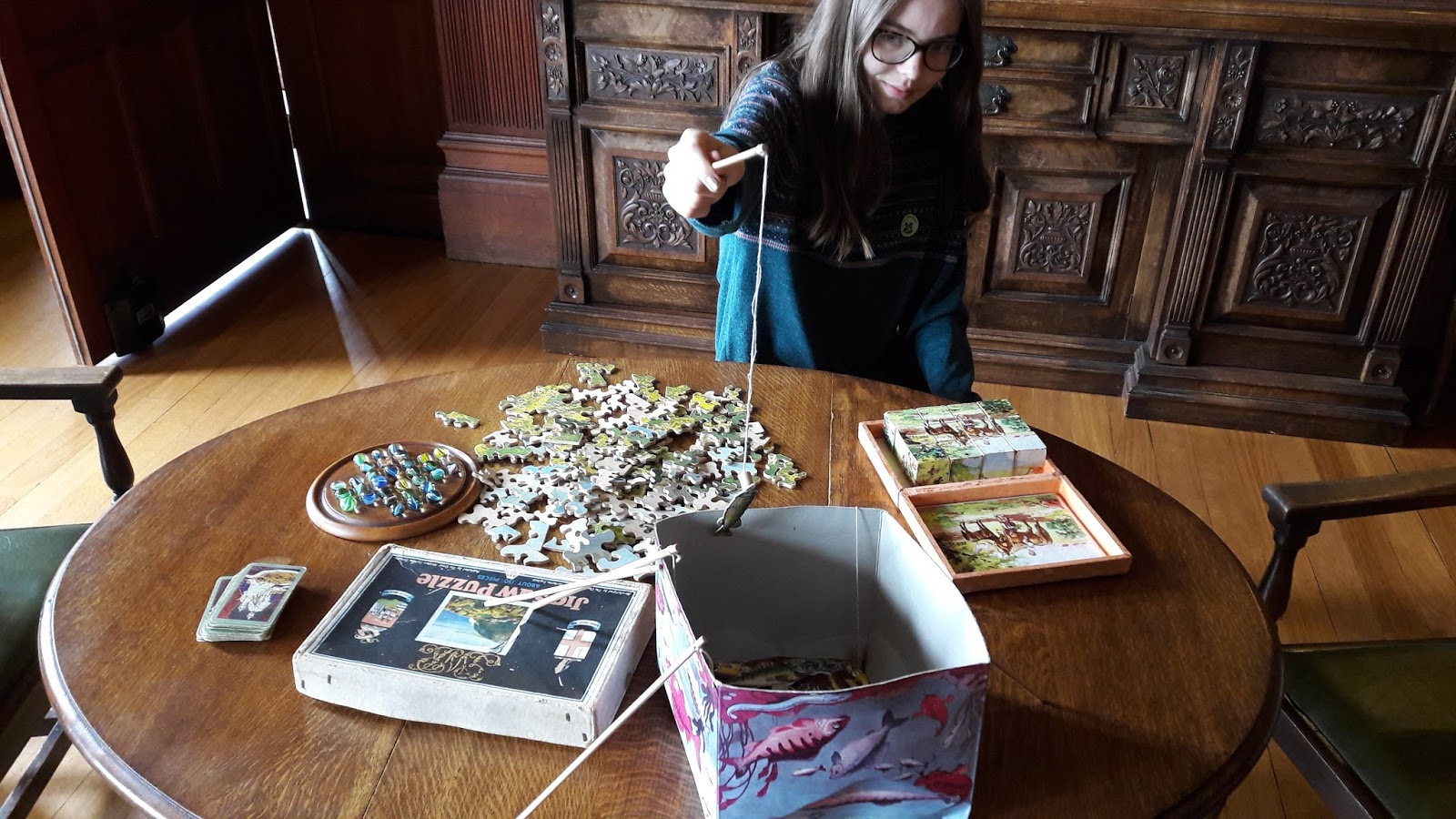
Sutton Hoo: inside the drawing room at Tranmer House which was built in the 1930s
It was laid out informally with toys I recognised, my mum would have played
with and my 16yo enjoyed trying out. Living history!
Sutton Hoo is where King of East Anglia was buried in about AD625 with astonishing pomp.  There are two ship burials mentioned in Beowulf - at the start and end of the story - but as this was originally a tale told aloud and the only surviving copy was from AD1000 it's possible King Radwald's funeral was modelled on the story... Well, it's a nice thought.

King Radwald is a real person. We know this because he is mentioned in the Venerable Bede's book and clearly an extremely important person in the UK's history. It's a shame at school that the starting point was 1066, skipping all this.

The grave robbers missed his astonishingly filled grave by about three feet. But Mrs Pretty, by then a widow, had a dream about where a local amateur archaeologist, Basil Brown, should dig. The first summer Basil (who left school at 12 years!) worked for her he disagreed, and got scant rewards from digging the burial mound nearest her home. His next dig, and what Sutton Hoo is famous for, was in 1939 - ominous because everyone visiting now knows the second world war was about to kick off.

One of Sutton Hoo's amazing guides. Definitely join
a talk. On the days we went talks and tours
were at 11am and 2.30pm
But Basil, with the aid of Mrs Pretty's gardener and gamekeeper, lucked out on this 2nd dig. It was such an important find for the nation that poor Basil got replaced by the professionals. However Mrs Pretty insisted he stayed on the site, and in the team. The result is that at this NT interpretation of the great dig Basil gets a suitably heroic role.

It's odd that the National Trust runs this site - usually the older ones are organised by English Heritage. But that aside (and actually Mrs Pretty gave them her estate in her will) it was a most wonderful way to learn about a history so few of us know. As an added bonus a Beowulf specialist talked us through the links between the poem and the boat burials so we came home with a copy - translated by poet Seamus Heaney - and it is quite magical.

I have a hunch I'd have liked being an Anglo Saxon!

Worth a visit?
I hadn't been away much this year - but in July my family managed two consecutive weekends away from London, camping on each occasion. Re-reading this review it's clear that I'm still rather over-excited about having escaped my home. But i think even if I was travel weary, the information that's on display and the way it's been interpreted makes Sutton Hoo a brilliant visit. If you've got National Trust membership then definitely head there, and have a wonderful time.

Bonus
There's a nice cafe, a second hand bookshop, loads of outdoor seating for picnics and a really great outdoor playground with zip wire and imaginative ship burial style mounds to play on.

https://www.nationaltrust.org.uk/sutton-hoo

Monday, 17 August 2015

10 reasons to go to Ambleside now

This blog is about family travel around the world without leaving the UK. We do this in a bid to be less polluting and tackle climate change while at the same time keeping a global outlook. The Lake District is addictive: once you've gone there it's hard not to want to go again, and that's despite being soaked and/or sunburnt or leaving with blisters. Whatever the weather I always think about how the Roman legions must have felt marching this way along High Street in their sandals. The rest of my party were immersed in dog spotting, deciphering bus timetables or trying out taster chocolate at the sweet shops. What will you do? Words from Nicola Baird (see www.nicolabaird.com for more info about my books and blogs).
Stock Ghyll Force - lovely waterfall in the beech woods behind Ambleside.

Ambleside is a bus ride from Windermere rail station. It's been a holiday spot for years - helped along by William Wordsworth's guide to the Lake District and Beatrix Potter's books - Peter  Rabbit was first published in 1902. Facebook at this time of the year is filled with people's fab holidays taken overseas but the Lake District is a great place to visit. Here's some reasons why I'm hoping to go back to Ambleside.

1) DOG FRIENDLY - you can take your pet along.... Audrey Hepburn may have taken her deer to American supermarkets (did you know that?) but in the Lake District the pet of the day is a dog, so we took our border terrier. We even went to the Rydal Hound Show which was packed with country folk moving between the hound rings and the beer tent. At Ambleside there are water bowls at loads of cafes and pubs. Even on the way to the Lake District (if you travel by train) you may find that Virgin trains sometimes gives out pet snack bags and at Oxenholme station there is a huge water bowl. My favourite is Bilbo Cafe which has towels for you to dry your dog plus sofas for humans to loll on and delicious, hearty walkers' cakes.

  • Take poo bags for the dog and then carry it home (in a tuppeware)? Public loos are 20p.


2) BUS PASSES SAVE YOU MONEY - and mean you don't have to carry cash. You can hop on and off around the south Lakes and expect to strike up conversations with travellers as well as locals. People are friendly. We used the 555 and 599 buses and were so impressed by how friendly - and thoughtful - the bus drivers were. Big shout out for Stagecoach staff!

  • Other cheap pleasures: feeding ducks, a long walk, watching boats, lounging by the lake, watching sunsset, watching people on holiday, spot the dog, finding cafes to hang out in.


3) SHOPS STAY OPEN A BIT LATER THAN THEY DO IN NON HOLIDAY COUNTRY TOWNS - tor example the Spa & Co-op, only a few doors away from each other, are open 7am-10pm. There's also a Tesco Express in the centre of town.

  • Many of the Ambleside pubs and restaurants have regular theme events so if you love live music or quiz nights you can be sure to find plenty.


4) EASY TO HIRE A KAYAK - Lake Windermere is fun to splash around on. We used the sit on kayaks at Low Wood Watersports Centre (an easy 20 min walk along a pavement out of town) and also Windermere Canoe & Kayak. It's cheaper if you book in advance on the internet & you can because the wifi reception is  pretty good. At Winderemere Canoe & Kayak we also hired wetsuits and were given a dry bag and a map so we could explore for a day. It was wonderful to do this with two 14-year-olds.

  • Worth hiring a wetsuit (£3-4) especially for kids, whatever the sunshine level as it means they might be able to swim all day without turning blue with cold.


5) BEST BASE FOR EXPLORING - a few miles past Rydal Water (just take a bus) is Grasmere which boasts wonderful Dove Cottage where William Wordsworth's career as a poet kicked off - if you go be sure to let your kids do the organised treasure trail so they  will find out the name of Wellington's horse and where to get dentures after the battle of Waterloo. There's also the famous Grasmere Ginger Bread Shop - six pieces for £3.60 (sold in an old-fashioned shop so popular and small you have to queue to get to the counter). Grasmere is quite small and so feels more crowded with tourists but if you pop into the Grasmere Post Office you'll find a treasure trove of local Lake District goodies. I bought muscle & joint rub (for walkers' aches), soap and a rug. But there were also scarves, tweeds, bobble hats and handbags.

  • At Waterhead you can take a boat around the lake. There are all sorts of tickets and deals so just queue up and ask. Lake Winderemere is 1o miles long so there is plenty to see. Try disembarking at Wray Castle to enjoy a folly (now run by the National Trust) or the lovely grassy beaches nearby. Another good spot is Brockhole, especially if being outdoors is a bit new to you as here there are loads of activities to try including a treetop trek.


6) SLATE GETS EXCITING - so many cottages and businesses have their name or number carved on a bit of slate. You'll find you might want one too. If you live in a house with a lowish number 1-100 they are easy to find.


Stunning menu from Lake Road Kitchen with Herdwick lamb and foraged hen-in-the-wood (a plant).

7) DELICIOUS NEW TASTES - during a week we tried Lancaster sauce crisps, Kendal mint cake and Grasmere ginger bread, The beer drinker in our party enjoyed many different pints at the pub.


View from Wansfell over Lake Windermere.

8) FABULOUS WALKS - of course you'll want to walk the big mountains, but the ones that aren't so big can be fantastic. Red Screes is my new favourite with amazing views across the Lake District mountains and a gorgeous walk up to the summit and non-knee killing descent. And if you think walking is too slow then try wild running.

  • All the Lake District towns, especially Ambleside & Keswick are over-run with outdoor wear shops. A great place to get bargains, essentials and treats.


9) IT'S AN EXCUSE TO REMINISCE - not just the times you've visited and the mountains you've climbed, but also to look again at films like Withnail & I (1987) and The Trip (2011) with Steve Coogan and Rob Byrdon. 
At the Unicorn pub the staff were betting on when the
rain would start with money on 8.17pm. It did rain, but an
hour later... Earlier in the day it was scorching. This
photo is from three days earlier when wet and windy.

10) THERE'S A LOT OF WEATHER - whatever you get it'll be a talking point. Bring all the kit you can carry so that you can get outside and have fun. Strong shoes and a waterproof are essential. But my luggage also contained stuff for swimming and boating - and the things the teens and the dog couldn't carry. I guess this is why so many people drive to the Lake District and need vehicles big enough to take everyone in the family's bike, but you can hire kit easily. You can even learn to waterski, or sail...

  • Doing stuff in the great outdoors is a simple way to understand geography - be sure to share maps, Wainwright guides and the mountain weather report. There you are, GCSE geography in the bag!

Thursday, 30 July 2015

9 reasons to go to Melton Mowbray - food and fabulous views

This blog is about family travel around the world without leaving the UK. We do this in a bid to be less polluting and tackle climate change while at the same time keeping a global outlook. Leicestershire is a place my family haven’t visited much despite it's fascinating battlegrounds, role in the industrial revolution and upkeep of traditional rural crafts – partly because it seems hard to get around, or at least it did until I found these travel tips On my most recent get-to-know Leicester trip I took a train from London-Grantham and a friend picked me up, but there’s a station in Melton Mowbray and some buses. Words from Nicola Baird (see www.nicolabaird.com for more info about my books and blogs).

The Midland cities may have a certain grimness, eg Birmingham, Derby, Leicester and Grantham, but they are surrounded by heart-achingly beautiful shires. The town of Melton Mowbray is in a part of Leicestershire that is especially lovely and you may find your way there enjoying views of the dramatic escarpment-sited Belvoir Castle. But almost any of the vales give you a huge view as if you are looking down on the landscape from a glider. 

I also love the wide and often uncut verges around Melton Mowbray, which during the summer are blanketed in wild flowers. The grass verge offers an escape route for cyclists and walkers if you are squeezed by a speeding car. In fact these verges are giant-sized compared to verges in other bits of England because the Leicestershire lanes were busy sheep drove roads - used to ensure passing flocks were able to graze as they travelled to the markets.

Eye spy Leicestershire: for your journey to Melton Mowbray
  • Food: Stilton cheese, Red Leicester cheese, Pork pie
  • Spot: Belvoir Castle
  
1) Melton Mowbray's got a great museum & it needs saving
The Melton Carnegie Museum is a complete gem, but like so many in the UK it is in great danger of having its funding cut. The exhibits introduce the rural crafts that Leicestershire excelled in – and in some cases, eg, stilton making, still does. You can see some of the old cheese making equipment at the museum. Or try sitting at a traditional pub table and have a go at dominoes.

Suggestions to keep this museum going – don’t cut its funding and add a café! There’s plenty of space near the two-headed calf. The museum is already really child-friendly but with a café it would be brilliant.

2) The two-headed calf at the Melton Mowbray museum
If you haven’t yet seen a two-headed (and two-tailed) calf then you need to go and see this ginger beauty ASAP. It’s a sad story, as the calf died very soon after being born, but a great way to get kids interested in the exhibits.

3) It’s got great cheese, pies & food festivals
Melton Mowbray is one of the five homes of Stilton cheese as well as Melton Mowbray pork pies. The old bootmakers, saddlers and horse livery yards may be gone, but cheese is still in the town’s DNA. 

You can try Stilton cheese any time, but a real treat should be the Artisan Cheese Fair from 30 April-1 May 2016. This claims to be Europe’s largest cheese fair, who’d have thought the UK did the biggest and best cheese fairs? You can also go to Melton Mowbray and buy local specialities from the Melton Cheeseboard. 

Every autumn there's also the Melton Mowbray Food Festival from 3-4 October 2015 showcasing around 150 local producers’ tasty products including cheese, pies, gold-infused bubbly and steamed puddings.

4) Find out about foxhunting
The Melton Carnegie Museum specialises in rural crafts including the trades that support foxhunting. Melton Mowbray became the epi-centre of foxhuting after Hugo Meynell popularised riding after hounds in the 18th century. For the next 150 years, from winter to spring, the area was packed with the bold and rich who would rent local houses in order to hunt with the Belvoir, Cottesmore and Quorn. Many of the town’s trades developed to cater for the winter guests including numerous livery stables which kept at least 1,000 horses.

Hunting raises very mixed emotions now, but at the start of the 20th century locals crowded to see the hunt set off. As many as 4,000 people on foot plus 300 riders turned up at the Quorn Hunt opening meet in November 1912, see for yourself on this short clip from Media Archive for Central England.  

Don't worry if foxhunting is not your thing: the Museum also has a showcase of items from the League Against Cruel Sports.

5) Paint the town red
Melton Mowbray is the town that got painted red (though not necessarily the town that gave the world the phrase “paint the town red”). 

On 6 April 1837 after a rowdy day at nearby Croxton Park races the Marquis of Waterford and his friends rode to town for yet another drink. When the toll keeper refused them entrance he was barricaded into his toll house and the toll gates painted red. The so-called gentlemen then ran riot, painting everything red including house doors, a model swan on the roof of Swan Porch, and even a policeman who tried to stop them.

It’d be fun to repeat the Mad Marquis’s crazy antics, perhaps the next time South Asians celebrate Mela there could be a historic mash-up? More detail about what the man who painted the town red actually did is here. 

6) It’s not all posh history
This is the place where the dense Melton cloth was created and gets its name. Melton cloth is what donkey jackets are made from (remember the infamous scruffy coat worn by Michael Foot?).

7) Let’s go to Melton Mowbray for a proper country market, how about next Tuesday?
This is market heaaven: Tuesday and Friday are market day with fruit and veg stalls, plus the usual. There is also an antiques/bric-a-brac market every Wednesday. Livestock markets (fur and feathers) are also on Tuesdays. And there is a farmers’ market (produce) on Tuesday and Friday. Plus a car boot sale on Sunday. Check opening and closing times here.

8) Use your feet
Take a walk around Melton Mowbray to spot key historic sites including Anne of Cleeves house (part of her divorce settlement) and the impressively large St Mary’s Church, using this map. 

9) Stay a while

There are loads of things to do in Leicestershire, have a look at the stay, play, explore offers at www.goleicestershire.com 

  • This post isn’t sponsored, however I have been to Leicester on a previous press trip -you can see more Leicestershire day out and travel ideas here at Conkers (just over the border in Derbyshire) and Richard III Visitor Centre and the National Space Centre in Leicester.