A-Z activities

A-Z countries

What's this blog all about?

Hi, I'm Nicola - welcome to a blog begun in 2012 about family travel around the world, without leaving the UK.

I love travel adventures, but to save cash and keep my family's carbon footprint lower, I dreamt up a unique stay-at-home travel experience. So far I've visited 110 countries... without leaving the UK. Join me exploring the next 86! Or have a look at the "countries" you can discover within the UK by scrolling the labels (below right). Here's to happy travel from our doorsteps.

Around 2018 I tried a new way of writing my family's and my own UK travel adventures. Britain is a brilliant place for a staycation, mini-break and day trips. It's also a fantastic place to explore so I've begun to write up reports of places that are easy to reach by public transport. And when they are not that easy to reach I'll offer some tips on how to get there.

See www.nicolabaird.com for info about the seven books I've written, a link to my other blog on thrifty, creative childcare (homemadekids.wordpress.com) or to contact me.

Monday, 25 June 2012

Arab horses are stars

This blog is about family travel around the world without leaving the UK. Impossible? No. This post is in praise of horses - especially from the Arabian Peninsula. Words from Nicola Baird (see www.nicolabaird.com for more info about my books and blogs).  

If people hadn't worked out how to tame and ride horses warfare might never have advanced. That's because donkeys just aren't so obliging. This is the rather upsetting conclusion I picked up from the British Museum's free exhibition, Horses: from Arabia to Royal Ascot, being run (free admission) until 30 September 2012 to celebrate the Queen's Diamond Jubilee - and her love for all things horse.

Turns out the swift Arab horses - the ones that eventually are crossed with British native mares to develop the Thoroughbred - come from the area around today's Kazakhstan and Iraq. The exhibition is fascinating - with some items rarely seen that normally reside in Saudi Arabia. There is also an engraving from Mesopotamia (the first image of a horse from 1BC), lots of early chariot bits and buckles; then armour used during the Crusades (c1190) and on to art and racing. many of the objects are tremendously old.


As a horse lover it gives me intense pleasure thinking about how many generations of people have had special relationships with their horses.


Talking horses
I took my 11-year-old Nell, who likes riding (see her in the photo above, cantering Twinkle). Even so she was fascinated by the videos of mares and foals grazing, horses horsing around in paddocks and racing shots. I really enjoyed discovering more:
From Herodotus (484-425BC)The Persians teach their sons, between the ages of 5 and 20, only three things - to ride a horse, use a bow and speak the truth.  Not bad life skills! 
From the Quran, surah 100:1-6"The snorting steeds, which shake first with their hoofs as they gallop to the raid at dawn and with a trail of dust split their foe in two." Terrifying, but astonishing poetry.
FurusiyyaThis is an Arabic term covering horsemanship skills (fighting knights, riding and horse care). Here's a blog that links it's glorious past with newer disciplines (eg, dressage). Looking forward to finding out more about this.

Galloping reads
If you want to find out more about Muslim and Christian horse breeding without just looking at pictures, try:
King of the Wind by Marguerite Henry. It's an old book, which I read as a child, captivated because it is so very different to the "Jill goes to a gymkhana" style of pony tales. King of the Wind starts during Ramadam and takes this famous bay stallion (accompanied by a dumb horse boy and a cat) to the UK where he becomes better known as The Godolphin Arabian, one of the three founders of the Thoroughbred stud book. The others are the Byerley Turk (1684-1706) and the Darley Arabian (born in Syria). My great grandfather Frank Forester who loved horses and racing had a picture of each of these three horses in his bedroom/dressing room. Only two of these pictures are with my family now.

Blood Red Horse by K M Grant - This is the fabulous first in a planned triology that tracks the journey of chestnut Hosanna first as he goes out with Richard 1 (the lionheart) in a bid to capture Jerusalem during the Crusades. But Hosanna is captured and ends up in the stables of the famous military general Saladin, Sultan of the Saracens.

Tuesday, 19 June 2012

Tasty Congo meal

Hamburger and hot chocolate, Greek pitta, Congo veggie meal with raw salad, yellow rice and cassava leaf stew.
This blog is about family travel around the world without leaving the UK. Impossible? No. This post offers delicious tastes from Congo, Rwanda and Liberia - all served up at a London park festival in June. Words from Nicola Baird (see www.nicolabaird.com for more info about my books and blogs).    


At the Green Fair in Regents Park, London (June 2012) it's obvious that people who like green stuff also seem to love international flavours - especially music and food.

Top of the food stall choices Lola, Nell and I picked out was the Congo veggie meal - a huge pot of cassava leaves cooked slowly with coconut and cauliflower then served with saffron-coloured rice and a raw salad. It was not what I expected Congalese food to be like. The raw salad was gorgeous including plantain, fruits and grated carrot with a moreish sauce. The woman serving it said you can find packets of dried cassava leaf in markets that specialise in African food, for Londoners Brixton would be a good choice. In Africa cassava leaf (fresh and dry) is also used as animal fodder and to fatten up tilapia (fish).

Here is a recipe I found on the web for a similar dish (from Liberia).

Dried Cassava Leaf Soup: This is a traditional Liberian recipe for a classic stew of meat and fish with cassava leaves that's flavoured with red palm oil. In West African markets you can buy big 500g packs of finely-chopped dried or semi-dried cassava leaves. My wife often buys these as a base for soups or as an addition to palm butter soups or palm oil soups. This is a fairly simple dish that focuses on the cassava leaves themselves and is characteristic of Liberian cuisine. 
Ingredients: 500g ground or chopped dried cassava leaf 4 bonnies (or any firm white fish, cut into steaks) 3 dried bonnies (or any dried fish or smoked and dried fish) 500g meat, cubed 4 whole hot chillies (eg Scotch bonnet) 2 onions, chopped 2 tomatoes, chopped half chicken, cut into serving pieces 2 Maggi (or bouillon) cubes 1 tbsp black pepper 1/8 tsp baking soda salt 400ml red palm oil (or groundnut oil with 1 tbsp paprika) oil for frying (groundnut oil or soy oil) 
Method: Begin with the pepper paste. Add the hot chillies to a pestle and mortar along with a handful of onion and pound to a paste then add the tomatoes and pound in. Wash the dried fish thoroughly then break into pieces, removing as many bones as you can. Add the oil to a pan and use to brown the meat and chicken then set aside. Add the fish steaks and fry until coloured then set these aside. Add the onions and fry for about 5 minutes, or until soft then add half the chilli mix and fry in. Now add the meat back to the pan along with the dried fish, the pepper and Maggi cubes and cover with water. Bring to a boil, reduce to a simmer then cook for about 40 minutes, or until the meat is tender. Now add the cassava leaf, the remainder of the chilli paste and the baking soda and bring the mixture back to a boil. Cook, uncovered until almost all of the liquid has evaporated. Pour the palm oil into the soup, stir to combine then return to a boil, reduce to a low simmer and continue cooking for about 10 minutes. Serve hot with rice.
Read more at Celtnet: http://www.celtnet.org.uk/recipes/miscellaneous/fetch-recipe.php?rid=misc-dried-cassava-leaf-soupCopyright © celtnet

Until trying this dish I'd assumed food in the Congo was either meaty, or extremely plain like this recipe for Mikate (donuts) which are also served in Rwanda (taken from a school cookbook, downloadable).

Congo donuts (mikate)
Mix together enough self-raising flour, eggs, milk, sugar and oil to make a thick porridge. You should be able to cut it with a spoon, then fry donut-sized chunks in hot oil. Repeat until all the mixture is used.

Tip: if you want to spark this up a little a trick VSO volunteers used when on trips in rural areas (in Solomn Islands) was to use the syringe supplied by the British Council to shoot store bought jam into our homemade doughnut. It made them taste delectable!

Over to you
Have you tried dried cassava leaf? Where did you find it, and what did you cook with it?

Sunday, 10 June 2012

What's so special about the ExCeL venue?


Landed, SS Robin and the final view of Tate & Lyle  from the Docklands Light Railway.
This blog is about family travel around the world without leaving the UK. Impossible? No. This post has a look at the area around the ExCeL centre, one of the Olympic venues - which offers a mishmash of world experience. Words from Nicola Baird (see www.nicolabaird.com for more info about my books and blogs).    

Perhaps this title is misleading? At the weekend we stumbled on the ExCeL as a result of joining a madcap musical improvising jam set up by the team at SS Robin. SS Robin is a wonderful, old steam ship built in this area at the old Thames Ironworks (at the top of the River Lea) - and the birthplace of West Ham football club. Robin is now on a vast pontoon in Royal Victoria Dock awaiting some interesting changes to make her into an exhibition space before she is relocated a little way upstream.

Royal Victoria Dock is opposite the ExCeL Centre (a company with direct links to Abu Dhabi as in ExCeL: ADNEC). We thought we were going to hear the Grand Union Orchestra - but it turned out we were to be part of the orchestra which is famous for it's rhythms and diaspora players. At the SS Robin workshop there was Claude from South Africa who used a violent whistle to keep all the percussion players in time. He was phenomenal and managed to help both Pete and I (absolute tuneless wonders) find some kind of musical mojo through beating out a rhythm of "co-ca, co-la" and for 3:2 "we are the cham-pions". Seeing Pete perform a triangle solo was quite something! Although I was unable to laugh seeing as I'd tried to hide myself - and my bell and stick - behind a pillar in a bid to avoid such scarey attention... Other music trainers included Yusuf from Bangladesh and the very talented, friendly Lily from Bulgaria.

It's big
After the music jamboree we clambered up the stairs that take you over the Victoria Dock footbridge to the Western Gateway Dock (with the ExCeL, Ibis hotel etc). It has a remarkable view across to the Thames/Emirates cable car one way - and the good ship SS Robin the other way. Everything is on such a scale in this area - the old warehouses, the much-reduced Tate & Lyle factory with it's iconic Golden Syrup can on one side of the building, the new builds, the old cranes along the dock, even the water - that it's hard not to make a big thing look small. Or to feel like a dwarf.

Opposite - or over the footbridge - is the Excel centre where some of the Olympic Games will take place including tae kwondo (to which my family has tickets!). Beside ExCeL are restaurants that aim to cater for huge crowds - although there were only a few people around during our visit. There are two Indians, one Italian and a pub called Fox@excel. We ended up at the Fox which is strewn with TV screens and has a sports ambience to it. It's a vast brick space which is clearly going to fill up during the Olympics - the Ladies had a row of 10 loos which felt profligate given the smallish collection of Saturday night pub goers.

All change
Obviously this part of London, a dock sandwiched between Canning Town and west Silvertown - is all the old East End. But it feels so strange compared to the crampedness of up town living.

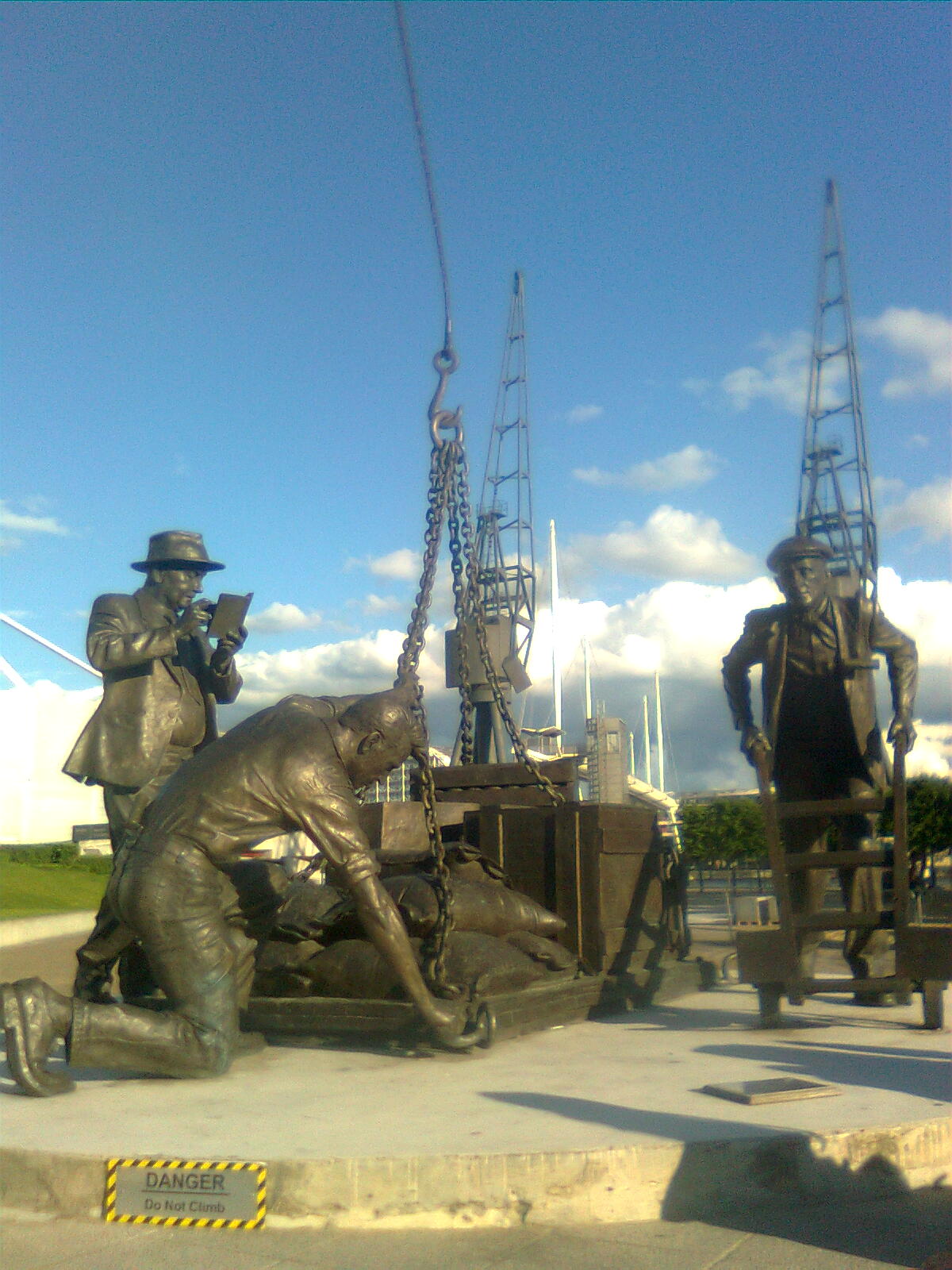
There are surprising clues to the extraordinary story of how this area has gone from marsh to dockland to bombsite, to sport and leisure venue over the centuries thanks to a life-size sculpture. In Brisbane we were much impressed by the street sculptures that brought history right into the shopping centres. The same's been done by the ExCeL at this once crazily-busy dockside. There's a bronze sculpture by Les Johnson, unveiled in 2009, called Landed with three portraits of workers - one young man, one fatter manger reading a docket slip beside a large package just unloaded from the spice (and slavery) island of Zanzibar, and the other older with a flat cap and a sack hook over his shoulder. Above them is a large hook, who knows how it stays up, but clearly representing the cranes used to unload all the cargo in what was then known as the Royal Docks. I believe there's a crate labelled Hong Kong too, but I managed to miss this... The problem with round the world travel is it's not long before your brain is over-loaded with information, and that's even when you are pacing a 500m route across a dock!

See the Grand Union Orchestra perform on 18 July 2012 at the Hackney Empire.


Over to you
Just two questions: what do you know about the Olympic venues? Do you think music or food is a better route into new cultures?

Monday, 28 May 2012

Doing battle in St Albans


Top: 50 people on a Wars of the Roses tour in St Albans; At the White Hart Tap;  UK's oldest pub Ye Olde Fighting Cocks - the Lancastrians were camped at the very top of this hill on the other side of the Abbey; Don't forget the Romans' influence; Nell by a Wars of the Roses sign, which was mistakenly put up on the wrong side of the road.
This blog is about family travel around the world without leaving the UK. Impossible? No. This post takes a tour of St Albans, and finds quarrelsome ghosts refighting the Wars of the Roses. Words from Nicola Baird (see www.nicolabaird.com for more info about my books and blogs).    


2012
It's St Albans and Saturday shoppers are battle weary from the unseasonal May heat - dodging the crowds to find a shop stocking an outfit that fits or a welcoming inn. In queues, dressing rooms, near shade there's someone on the mobile doing battle. How can you tell that on this day five hundred plus years ago history was being made? Well the road layout is pretty much the same...

1455
The York (white rose) and King Henry VI's Lancaster (red rose) troops meet up at St Albans about 7am. Both have had a long march. York is allegedly ever so contrite, trying to get a guarantee that the man who wants to be king, Richard, Duke of York, isn't about to be put to death. But King Henry's (or his advisers) are not in a trusting mood. They don't accept any grovelling note, but rather foolishly delay putting on their armour... So when York gives up suing for peace and decides to fight it out the Lancastrians aren't battle fit and are polished off by archers.

Those arrows came at 100mph, with armor on it was an arrow in the eye that was the danger. Without the full protective metal kit you hadn't a hope - especially if there were enough arrows "to block out the sun" shot at you by the York's force. I'm pretty certain this super successful part of the battle was organised by Warwick (who had to break through the walls of a pub, now a building society) to join the fight. Warwick goes on to have extreme influence in the Wars of the Roses - except crucially who his boss Richard's son Edward marries.

Back on 22 May, 1455 it was a straight York-Lancaster fight. The residents scatter. The villagers coming into town for market day get windy about St Albans (a fear rightly borne out as some years later in 1461 at the 2nd battle of St Albans, also during the Wars of the Roses), which seems a place where trouble is always brewing. For the next 400 years those villagers market in Harpenden, in the opposite direction...

Winner takes all, almost
The first battle of the Wars of the Roses is over in less than two hours with York the winner. As it turns out the Duke of York doesn't ever get crowned, but two of his sons do - Edward VI and his brother Richard III. His great grandaughter goes on to marry Richard III's successor, Henry VII and thus becomes the mother of Henry VIII.

And we know all about it because the abbot at St Albans wrote an eye-witness account of the battle. An early blogger?

History's so simple when you walk around the streets with a guide like Peter Burley (ex York) who knows exactly what happened - where the Duke of York's horse was killed (just by the traffic lights), which pubs and shops the two sides made their HQs (The White Horse Tap for York and Boots the Chemist for Lancaster).

As I'm an alumnus of York it seemed like a fun idea to join this tour for former York or Lancaster uni students, not least because Pete (my husband) graduated from Lancaster so we can do our own Wars of the Roses re-enactment if we want.... Our 11 and 13 year old daughters came too and to their suprise enjoyed seeing the narrow streets where you could only fit three abreast in a fight. Everyone else had to queue up behind. We were soon imagining the misery of the Duke of Somerset (a king's man) who'd avoided castles for years thanks to a prophecy in his youth from a sorcerer, Roger Bolingbroke who said (paraphrased!) "Stay away from castles," but then discovered he'd taken sanctuary in The Castle Inn. Once discovered he was killed by York men.

Ice cream top ups and a punnet of the first strawberries of the year, off a market stall near the clock tower, kept the kids going when horrible histories and stupid deaths can't.

Good job we had such an expert guide as there is still no signage, or even a battlefield tour despite this fascinating battle taking place in the centre of St Albans in streets we know and use today. But you can self-guide yourself using the book, The Battles of St Albans, co-authored by Peter Burley, who is also national co-ordinator for the UK Battlefields Trust.

Verdict: great day out
Where did you go: St Albans, Herts - for a histronaut walk to the Wars of the Roses 1455.
USP - Britain's oldest pub, Ye Olde Fighting Cocks - building been there since 14th century, and a pub been on the site, just by the river, since the 8th century.
Too busy to mention: the Romans! St Albans is also all about the hypercourse, Verulamium etc.
Learn anything else: Yes Shakespeare, he really gave the York side a bad time in his history plays. For instance it's unlikely that the three year old infant Richard (who would become "evil" Richard III who we know as the one who manages to kill his cousins, the two little princes in the tower) would have been at the battle, let alone killed the full-grown castle-fearing Duke of Somerset.

Over to you
Where's your favourite place to go to get a sense of history?

Monday, 21 May 2012

Travel tips from travel writers

This blog is about family travel around the world without leaving the UK. Impossible? No. This post has a look at the way travel has changed - from adventure to grim necessity. Seems like a shame to all of us who still feel that travelling is a joy, and it is often better to travel than to arrive. Words from Nicola Baird (see www.nicolabaird.com for more info about my books and blogs).   


The photo above is of a gorgeous certificate my Great Aunt Aline was given for gamely taking a flight on 1 August 1949 across the Atlantic Ocean from London to Boston. It's an "overseas flight certificate" from the "captain of the flagship, Scotland" which states, "may all your journeys be pleasant ones". Ahh. Nowadays getting on a plane is so often the worst part of the journey - not just for you, but for the planet. So how did well-known travellers face up to the burden of getting there?


What the Dickens
I'd have loved to talk to Charles Dickens about his travel snaps.
If he wasn't listening intently, ready to nick your lifestory then he was getting slightly over excited about how to get around, say taking the train to France (and remember he had no Channel Tunnel so had to use a boat too). Later, in 1865, he survived a train crash coming back from France close to Stapleton, Kent - it'd be interesting to find out what mental revisions he made to train travel then, although he comes close in this letter.
"There is a dreamy pleasure in this flying. I wonder where it was, and when it was, that we exploded, blew into space somehow a parliamentary train, with a crowd of heads and faces looking at us out of cages, and some hats waving... What do I care? 
Bang! We have let another station off, and fly away regardless. Everything is flying. The hop gardens turn gracefully towards me, presenting regular avenues of hops in rapid flight, then whirl away. So do the pools and rushes, haystacks, sheep, clover in full bloom delicious to the sight and smell, corn sheaves, cherry orchards, apple orchards, reapers, gleaners, hedges, gates, fields that taper off into little angular corners, cottages, gardens, now and then a church. Bang. Bang! A double-barrelled station! Now a wood, now a bridge, now a landscape, now a cutting, now a - Bang! a single-barrelled station - there was a cricket match somewhere with two white tents and then four flying cows, then turnips - now the wires of the electric telegraph are all alive, and spin, and blur their eges and go up and down, and make the intervals between each other most irregular, contracting and expanding in the strangest manner."
Charles Dickens on Travel (Hesperus Press, edited essays, 2009 from The Flight, 1851, p55)
Orwellian
What a contrast to George Orwell.

"So long as a machine is there, one is always obliged to use it. No one draws water from the well when he can turn on the tap. One sees a good illustration of this in the matter of travel. Everyone who has travelled by primitive methods in an undeveloped country knows that the difference between that kind of travel and modern travel in trains, cars, etc, is the difference between life and death. The nomad who walks or rides, with his luggage stowed on a came or an ox-cart, may suffer every kind of discomfort, but at least he is living while his is travelling; whereas for the passenger in an express train or a luxury liner his journey is an interregnum, a kind of temporary death. And yet so long as the railways exist, one has got to travel by train - or by cr or areoplane. When i want to go up to London why do I not pack my luggage on to a mule and set out on foot, making a two days of it? Becasue, with teh Green Line buses whizzing past me every ten minutes, such a journey would be intolerably irksome. In order that one may enjoy primitive methods of travel, it is necessary that no other method should be available."
The Road to Wigan Pier (Penguin, original edition 1937) p175

Backseat driving
See how jaded poor Bill Bryson, writing in the early 1990s, had got.

"If you mention in the pub that you intend to drive from, say, Surrey to Cornwall, a distance that most Americans would happily go to get a taco, your companions will puff their cheeks, look knowingly at each other, and blow out air as if to say, "Well now that's a bit of a tall order," and then they'll launch into a lively and protracted discussion of whether it's better to take the A30 to Stockbridge and then the A303 to Ilchester or the A361 to Glastonbury via Shepton Mallet. Within minutes the conversation will plunge off into a level of detail that leaves you, as a foreginer, swivelling your head in quiet wonderment."
Notes from Small Island (Black Swan, 1999 this edition specially for World Book Night p31)

Over to you
In contrast I tend to love where I go - else why leave? Let me know where you hope to go this year without using a plane.

Thursday, 17 May 2012

Blogs that deserve awards

This blog is about family travel around the world without leaving the UK. Impossible? No. This post is a little different, all about great blogs. Words from Nicola Baird (see www.nicolabaird.com for more info about my books and blogs).   

Rosettes, certificates, prizes - I love them! But of course they are such a rare part of life, so it was a real pleasure to be given a Liebster Blog award from Karin at Notes on a Garden who said: "Nicola [gets a Liebster] for her interesting view of life without a car, in Around Britain without a Plane, which often gives me food for thought. Thank you Karin, a definite English sparkling wine moment.

Acceptance of the award is conditional on the following: 
  1. Copy and paste the award on your blog.
  2. Thank the person who gave you the award and link back to them.
  3. Choose five other blogs to award with less than 200 followers and leave a comment for them.
Drumroll
I'd like to present a Liebster Blog award (which I think is the German for favourite) to the very deserving:


http://myzerowaste.com - all about cutting waste from a real genius. Blackened bananas go into crumble, all fruit and veg is bought naked (ie, without wrapping on) and she has loads of genius ideas. She probably also has more than 200 followers, but maybe not. Love her stuff.

http://loveoutdoorplay.net - constant guest posts all about giving children a lot more freedom. Essential blog fodder.

http://greenmummy.blogspot.co.uk - full of info and joy, written by my former colleague Rita.

http://londinimum.wordpress.com/ - written by a journalist with two young children.

http://sophieminchilliinlondon.blogspot.co.uk/ - fantastic photos, plus an interesting take on where and what to eat by one of my former students who I have to forgive for her carbon-heavy travel as it allows me and other readers virtual travel. Go Sophie!

Over to you
Obviously you can't give an award to yourself, but if you are interested in thrifty, creative and eco-friendly ways to raise children (or yourself for that matter), or fancy the current SUPER SIMPLE COMPETITION FOR A FAIR TRADE TOY PRIZE, then do have a look at http://homemadekids.wordpress.com


Monday, 14 May 2012

Greek flame, UK route

It's all Greek to me.
This blog is about family travel around the world without leaving the UK. Impossible? No. Here's how to join in the Greek-lit Olympic flame on its journey around the UK.  This post is by Nicola Baird (see www.nicolabaird.com for more info about my books and blogs).   

The 2012 Olympic flame was lit in Greece  - the original home of the games - using sun rays as they met a parabolic mirror on 10 May. Sounds like a super efficient way of creating fire to me.  And now  - whatever the weather throws at it - the flame is on its journey travelling up the UK from Cornwall. The route aims to take the Olympic flame no further than 10 miles from 95 per cent of the population. Quite an amazing piece of planning!

Look here to see where it passes you, and when.

As a little tribute to the moment the Olympic flame was lit I popped into a Greek bakery in Enfield (just by Oakwood tube) and bought a sesame seed loaf plus a box of olive paste-filled pastries as a gift for friends (see pic above). For £4 I got nearly 20 little snacks (rather different finances are used at the French bakery Paul where you generally spend an arm and a leg on daily bread). Yum.

Over to you
Will you see the Olympic flame pass? And have you ever used a parabolic mirror?
For anyone interested in trying out a parabolic mirror for cooking, rather than just lighting a runner's torch, have a look at this video from the US. Or buy one for home cooking (assuming you are in the US) at http://www.greenpowerscience.com/SHOPARABLOICHOME.html