A-Z activities

A-Z countries

What's this blog all about?

Hi, I'm Nicola - welcome to a blog begun in 2012 about family travel around the world, without leaving the UK.

I love travel adventures, but to save cash and keep my family's carbon footprint lower, I dreamt up a unique stay-at-home travel experience. So far I've visited 110 countries... without leaving the UK. Join me exploring the next 86! Or have a look at the "countries" you can discover within the UK by scrolling the labels (below right). Here's to happy travel from our doorsteps.

Around 2018 I tried a new way of writing my family's and my own UK travel adventures. Britain is a brilliant place for a staycation, mini-break and day trips. It's also a fantastic place to explore so I've begun to write up reports of places that are easy to reach by public transport. And when they are not that easy to reach I'll offer some tips on how to get there.

See www.nicolabaird.com for info about the seven books I've written, a link to my other blog on thrifty, creative childcare (homemadekids.wordpress.com) or to contact me.

Monday, 22 November 2010

E-reading treat

Nicola, Pete, Lola and Nell love to travel, but want to find ways that are as low carbon as possible. This post is from Nicola Baird


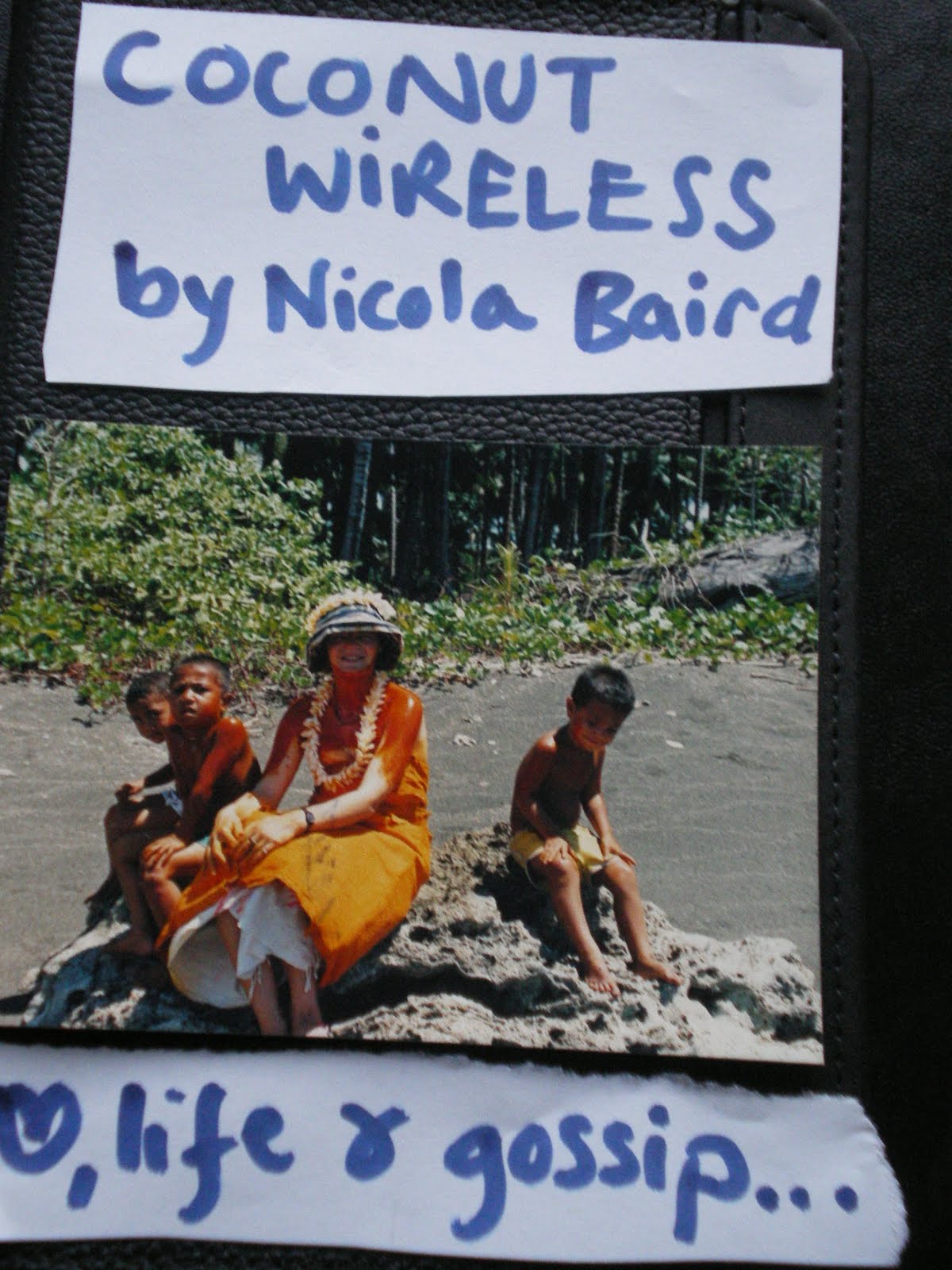
Nearly 21 years ago I was living in the South Pacific. The pic on the left is me posing in a small Solomon Islands village, on the island of Makira, dressed up in frangipani lei (flower garland), tapa cloth (made from bark) and painted in tumeric. I was on a journalism trip for Solomon Islands Development Trust rather ruined by the villagers - unusually in this part of the Solomons all Polynesians - asking me not to reveal the detail of their astonishing tumeric harvest. And of course I didn't.


But during my two years as a VSO journalist trainer in the region I collected so many stories, ideas, experiences that had no choice but to merge, fizz and revamp them as a story which anyone could enjoy - and especially people who love to travel or who live in Solomon Islands.


Read Coconut Wireless
Hopefully this will tempt you to look at the new e-novel I've just published. It's called Coconut Wireless and is about life, love and gossip in the country's capital, Honiara. Enjoy downloading some free sample chapters by clicking here or buy for a couple of US dollars from Smashwords as a pdf here.


Half of any money generated by this book will be donated to projects supporting women and children in Solomon Islands.

Friday, 5 November 2010

Chernobyl makes me mad

Pete, Nicola and their kids, Lola and Nell, like to travel the world but are trying to do with as low a carbon footprint as possible. This Mrs Angry post is written by Nicola

It's rare that I use TV to travel but I made an exception when a friend (who'd done some of the filming on What the Green Movement Got Wrong) urged me to watch BBC 4, thursday november 4, which is available at catch up for a while here. The programme enraged me, mostly because it dismissed the idea that here in the West we all have to learn to live with a bit less. As the population keeps on growing - and poorer people expect to share more of the good things of this world, such as electricity - this means we need more and cleaner fuels. In the film, using a couple of turncoat Greens it was suggested this could only be nuclear. (btw No, it does not). But Mark Lynas thinks it is, both talking from his office and on a surprising trip to still-uninhabitable-since-April 1986- Chernobyl.

Two summers ago in Yorkshire I met two Belarus girls, young teenagers - so 2nd generation "Chernobyl" children (around 60 per cent of the radiation spread into neighbouring Belarus with long-term devastating effects). The girls were on a month's holiday organised by the Chernobyl Children's charity, see more here.

You'll die anyway
Last night on TV a scientist told us that not many people died after the 4th reactor went into meltdown, but lots died from alcoholism and stress from fear of radiation! How I laughed (in an ironic way). The host mum of these two girls told me how the Belarus children's exposure to Chernobyl gifts them with a lifetime of chronic ill-health. They are unusually tired, many end up with thyroid problems. It may not be a stark death under a blood-stained blanket, but it's a dreadful legacy. And one we could blight many other people with if we turn again to nuclear as a magic bullet for tackling climate change.

Obviously lots of watchers (it's the first thing most Greens have watched since the news of the failure of Copenhagen's climate talks last December...) were unhappy with the show. I like this calm comment from Craig Bennett at Friends of the Earth. That NGO has also published a briefing about what they thought was wrong with the film, see here.

Go girls
I have an extra complaint about the way "What The Greens Got Wrong" is that it reflects its own premise - Greens are too conservative - by almost exclusively relying on white men in suits. Where are the women who'd talk a lot more sense?

I know so many mothers who are doing their absolute best to help their children become the adults who will be coping with climate change. They are teaching their kids to think and learn real life skills, plus rewarding tolerance and co-operativeness, etc. But they seem to be a missing species in decision making. Probably because they're back home putting the kids to bed. If you're interested in more thoughts on this see this piece in the Guardian (from 2009).

Monday, 25 October 2010

It's a pyrrhic Victory

Pete, Nicola, Lola and Nell love to travel the world but are finding ways to do so without racking up their carbon footprint. This post is by Nicola

Just taken Lola and friends down to Portsmouth to catch a ferry to France. To avoid hanging around the ferry terminal we also visited Portsmouth's historic dockyard. An expensive trip (£55 for a family ticket) but full of amazing history lessons. For instance we were forced to whizz around the Mary Rose Museum which shows how Tudor seamen wore jerkins, measured the sea bed and plotted their routes, etc, just so we could have the guided tour of the navy's first ever commissioned battleship the HMS Victory at 3.35pm.

Because we made this trip the day after Trafalgar Day (October 21) there were wreaths marking the spot Nelson died while fighting the French. (Although the nearby Lady Hamilton pub seemed to have ignored this particular landmark moment). It was also a few days after the big spending review by Cons/Lib-Dem so felt strange seeing the about-to-be scrapped HMS Ark Royal tied up in a nearby dock.

Monday, 13 September 2010

Ethiopian bread and coffee

Pete, Nicola, Lola and Nell love to travel with the lightest of carbon footprints. Here's one way to get to Ethiopia. Post by Nicola (for more of her writing also see http://www.homemadekids.co.uk/)


Bread and coffee are my staples. But if I tweak the ingredients so it's a flat bread - injera - and add a bit of ceremony to the coffee, maybe with frankincense then it's easy to be transported to Ethiopia. It certainly helps if you add in the wonderful music of singer Honey Solomon at the 24th Gillespie Festival (held the 2nd Sunday every September) Ethiopia came to a pocket park in the shadow of Arsenal's football stadium.


The Gillespie Festival is a large fete with a cultural spin that reflects the area's unique mix of peoples. While the stalls are piled with secondhand or homemade creations. There's usually also a fast trade in homecooked or home grown produce (I bought rhubarb and plum tomatoes from the Quill Street Allotments and damson jam from Olden Community Garden's stall). Defying categories - a pedal bike that powered up a fruit smoothie maker being run by Finsbury Park Transition Town.


But the real pleasure of attending Gillespie Festival is its amazing multicultural mix of music and people.


Get up and dance
Honey Solomon
specialises in Ethiopian songs - and during her set a tower block version of the flatbread injera was passed around for sharing to everyone in the audience. This bread was delicious tasting (and is ideally eaten with the right hand).


To one side of the stage a coffee ceremony had been set up, beans roasted, frankincense flavoured the air. The hypnotic effect of Honey's music, food and scented smoke soon had the crowd dancing.


Today I was back in this little park walking my dog and there's barely a trace of the Magic Carpet trip the people of London, N4 and N5 took yesterday to Ethiopia. But it's not one I'm likely to forget if I can turn my coffee love into something with more ceremony and less addictive-behaviour.

Saturday, 11 September 2010

Street grazing

Pete, Nicola, Lola and Nell love to travel. Here are ways they keep their carbon footprint light simply by exploring as they stay put. Post by Nicola


Years ago in Zanzibar Town when I was new to travel, I went to the famous Stone Town night market where loads of stalls serve supper - or bitings - with the most basic of equipment. Fingers for forks, stars for parafin lights.


It was magic picking the best things to eat in the blue-black, super-scented dark. Perhaps because night markets lead to sensory overload - try the salt tang of the Indian ocean, bright Southern Hemisphere stars, crash of surf on reef, charcoal fires, the spit of grilling chilli fish, sweet taint of rubbish piles, ladies' perfume, sweat, mosquito buzz - the food at the original spice island tasted delicious. Just remembering has got my mouth watering.


Fast forward 23 years and I've just raided my own neighbourhood for food. Near my home the street trees that produce fruit (eg, rowans, crab apple, plums, elderberry, pear, sweet chestnut) are dropping their load. Inspired by Finsbury Park Transition Town's fair/fete (where I bought a jar of N4 crab apple and greengage jelly for £2), I decided to harvest what was left of the non-stomped on crab apples in my nearest street.


My first attempt - a half pound of mushy mini apples mixed with my homegrown redcurrants - produced two delicious jars of jelly. Later in the day I zipped around on my bike to pick up the very last of the edible fruit starting to rot along the pavement. Whilst doing this - bike parked by the side of the road, fruit popped into my upturned bike helmet - I had the strangest sensation of what it's like to know food poverty. Two guys in shalwar kameez walked past, oblivious to the rubbish picker (me). One woman plugged into an i-pod attempted to turn off my flashing back bike light (to save money she said!), a dog walker crossed the road. And then a friendly man, Rex, came out with his young son to hand me an orange plastic bag.


"It's alright, " I said quickly, "I know there's a shop just round the corner, but I want to pick these apples to make some really local jam." Rex did his best to humour the mad woman outside his house, promising me empty jam jars next time he saw me...


Really it's me who should feel smug. I now have five lovely pots of old-fashioned crab apple jam sourced spitting distance from my home.


But I'm still disturbed by that out of 21st century experience. It feels very rural - even in a city - to sort through and reject fallen fruit. Secondly I had a taste of what it is like to be absolutely invisible, how I guess a refugee might feel. People tried as hard as they could to ignore a street gleaner. Most looked faintly disgusted as if my parsimony might force them to drop to their knees and fill their own Tesco bags with unpackaged food.


The obvious third thought was how lucky we all are here in the UK with this profligate glut of food that no one fights over. If this was the flooded parts of Pakistan how different our approach to food would be.


The shocking media quiet about how our climate is changing - as highlighted by Bill McKibben who set up http://www.350.org/ - makes chilling reading about the speed our planet is warming, see here. For example Russia, Iraq, Saudia Arabia, Sudan and Pakistan have all set their all-time temperature records during 2010. Big changes like this change how things grow.


I won't be setting up a food stall outside my house yet. Which is lucky as goodness knows what health and safety would make of run over, chewing gum flecked, dog poo avoided fruit jams? But I still think these experiences are going to inspire me to make more produce I can store. What I hope this means is that if climate changes mean I actually have to do foraging for real I won't be an absolute beginner...
Wednesday, 8 September 2010

World food

Pete, Nicola, Lola and Nell love to travel with as small a carbon footprint as they can. Here's how they will enjoy world food this September. Post by Nicola

It's nearly the end of Ramadan and some of the mums (many with connections to Bangladesh, Somalia, Tukey and Nigeria) at my younger daughter's school are clearly looking forward to their long month of fasting to finish. There should be a big party in many homes for Eid Marabuk sometime this week - maybe wednesday, or thursday - definitely Friday (it all depends on the moon, and no doubt other details). I just wish someone would ask me to one of these celebratory parties as this will be a brilliant celebration feast.


Harvest festivals - and this year Ramadan - show that religions are clever at using our love of food as a spritual in, and an opportunity to thank too. But the UK has genius (often secular) food traditions - not just our fried breakfasts - and despite all our supermarket addictions it is hard not to miss the best autumn seasonal treats. Right now I'm loving blackberries, Conference pears, damsons, greengages, plums, cobnuts and the few grapes my one-year old vine kindly produced.


Obviously you can enjoy these treats on your own, but another way is to go to a food festival like Brighton and Hove which promises a chance to "taste the world" between 1 September and 7 October, neatly including the nationally celebrated local food week with a celebratory picnic at Preston Park on 25 September, from 11am-4pm. There's even a Regency Banquet - with dresses as sumptuous as the dishes, perhaps with even a few Indian courses given the look-East outlook of the time.


A quick look at the fascinating website of Common Ground (art merged with local distincitiveness) shows that 3 September was the opening of the oyster fisheries in Colchester, a tradition dating back to the 13th century. As you probably know tradition decrees that oysters can only be fished/eaten when there is an R in the month. This year Colchester's Mayor - a confirmed landlubber - caused outcry by doing the gin and gingerbread ceremony (yes, I know it sounds strange...) on dry land rather than a boat. She seems to have done it well though and the oysters can now be served up again.


More worryingly all blackberries are meant to be picked by St Michaelmas Day which this year is 29 September - after that the Devil has either spat on them or done something unspeakably horrible - so you have been warned. I have an Italian friend who says blackberries are considered unlucky throughout Italy making it a brilliant place to pick these delectable fruits. (And if you've got kids they are also a brilliant non-toxic face paint!).


But cutting back on your jam and blackberry and apple crumble supplies (assuming you've stocked up the freezer) does give you time to enjoy apple day and all the picking, preserving and juicing that goes with it on 21 October.


I am sure every nation has moments of food glut - the season of mangoes in the Caribbean, sardines in the Mediterranean, rich cream from Swiss cows, tumeric wherever spices grow - which you learn to love as a child and anticipate as an adult. Enjoy your autumn tastebuds and if you can't make it to a festival like Brighton's (or somewhere more local to you) you can always create your own special nature's larder celebration at home. Cheers!

Thursday, 26 August 2010

Best of Bristol

One family's tips on how to travel the world without leaving home, much. This post is a local's guide to the best of green Bristol (thank you Helen!). Cobbled together by Nicola Baird, also see http://homemadekids.co.uk/


Bristol has 2 million people, two vast open spaces, loads of green lungs (parks, play space, Sustrans routes) and it's not far from Wales, Devon or the Cotswolds. What's not to like? Well my friends keep moving there... when I'd prefer them to live nearer me. But the result is great insider knowledge: so here's insights from a local on how to enjoy yourself on a walking tour of the city, even during rain. Most are free, and certainly interesting.

And if you go on a Wednesday you can choose a picnic at Bristol Farmers' Market (approx 9.30am-2pm) or just enjoy the markets at St Nicholas in the old town running from monday to Saturday the whole day, see details here.


Around the Harbourside/Waterfront area there's plenty to see. also look out for the Arnolfini gallery (next to the YHA) see here.


Behind the Watershed/Bordeaux Quay is Millennium Square - good place to hang if sunny - and home to @Bristol (science museum).


Slightly up the hill from there is the Cathedral, Council House and College Green (which I've taken to my family once for a picnic to Stop Bristol Airport expansion...).


Going over the river you can head out to SS Great Britain (ferry boats also an option), see here.


If you go a bit further along the river, you get a view of the Clifton Suspension Bridge and you can visit an eco house at the Create Centre. It's a big red warehouse building on the left hand bank where the river splits (this is about 20 mins walk from Anolfini). May be possible to take the tourist bus from Create up to the Downs for views of the bridge, gorge etc.


Or stay down near the centre, Red Lodge is interesting and free, see here.


No Banksy
Further up the hill (just carry on up Park Street from Council House/ Park Row from Red Lodge) to Bristol City Museum and Art Gallery - also free. No Banksy on show now but plenty of quirky items, see here.


Or over in Stokes Croft - Bristol's (alternative) cultural quarter, the People's Republic of Stokes Croft (PRSC) has just opened the Stokes Croft Museum. Admission costs £1 and it's tiny - but entertaining. Open Wednesday 11am-3pm. See here.


Given the stress on all things green and alternative culture, it could be said that visiting Bristol could get you thinking you are in a time warped, left bank France - the city has got Montpellier after all. But it's also got a big Caribbean community and in Stokes Croft you can find nearly 50 artists working at Jamaica Street artists, here.


Trendy offices
Opposite the museum is Hamilton House, now home to Coexist and interesting shared office space (there's a rumour about a soon-to-be-built green roof and a wood fired hot tub), and The Canteen - which is the ground floor bar/cafe with nice coffee and a big terrace for outdoor lounging. This is also where Bristol Green Doors office is based (about 20 mins from Red Lodge, you just follow Park Row past the hopsital and then go left along to Jamaica Street and you come out on Stokes Croft just below the museum).


Solar swim
There's also the solar-heated Bristol Lido - edge of Clifton, up the hill fromt he musuem, near the BBC. But it's expensive to swim (£15 afternoons only). There is a cafe bar too which is open to the public.