A-Z activities

A-Z countries

What's this blog all about?

Hi, I'm Nicola - welcome to a blog begun in 2012 about family travel around the world, without leaving the UK.

I love travel adventures, but to save cash and keep my family's carbon footprint lower, I dreamt up a unique stay-at-home travel experience. So far I've visited 110 countries... without leaving the UK. Join me exploring the next 86! Or have a look at the "countries" you can discover within the UK by scrolling the labels (below right). Here's to happy travel from our doorsteps.

Around 2018 I tried a new way of writing my family's and my own UK travel adventures. Britain is a brilliant place for a staycation, mini-break and day trips. It's also a fantastic place to explore so I've begun to write up reports of places that are easy to reach by public transport. And when they are not that easy to reach I'll offer some tips on how to get there.

See www.nicolabaird.com for info about the seven books I've written, a link to my other blog on thrifty, creative childcare (homemadekids.wordpress.com) or to contact me.

Monday, 11 September 2017

Neighbours bring the taste of Bangladesh

This blog is about family travel around the world without leaving the UK. Impossible? No. This post looks at ways neighbourhood swaps bring the taste of other places into your kitchen - perhaps this will give you inspiration about what to plant or how to deal with the gluts? What feasts could you share with your neighbours? Words from Nicola Baird (see www.nicolabaird.com for more info about my books and blogs).


My windfall apples went to one family; bantam eggs to another couple. While the snake
bean and cucumber were very pleasing gifts received by my family.
This was originally written in May 2016 about autumn 2015. It's now September 2017 and I've just had a knock on the door with a lovely neighbour presenting me with a bag of green and purple runner beans. Not long after another came with some books to share at the secondary school... and a few days earlier another offered to take anything I wanted to the dump (recycling centre). Thank you so much to all of you.

Where I live, and like so many London streets, there are many people who are now Londoners but who were born elsewhere - Essex, Yorkshire, Bangladesh. So when it's harvest time (September)  there's a real buzz in our street as people share things that remind them of home recipes often using things they've grown over the summer.
For Essex this could be jam from the street tree pears - an echo of Tiptree jam perhaps? For Yorkshire it's the size of your marrows that counts. And in Bangladesh many families are expert gourd and bean growers.
While giving away a few of my windfall apples I met a Bangladeshi lady and her daughter coming back from their allotment with the most amazingly long fat beans. I know them as snake beans (or serpent gourds) that are hard to get fresh in London - unless you know a skilled gardener. I probably admired too much because the pair then gave me a chunk of their bean which had broken on the way back from the veg plot.  In return I gave them a couple of bantam eggs as my lovely new bantams are doing some great egg production at the moment (ie, one a day, so not very prolific).

This is the blackbird that pecks a hole into most of my apples. However his
lady friend is a fine snail eater and he is the best singer in town...
Snake bean in breadcrumbs for four.
I lightly peeled the snake bean and was able to use it in two meals. First lightly coated in bantam egg and breadcrumbs, which I then fried and added to the top of a noodle dish I was reheating (see photo). This turned out to be a really successful meal, partly because it was something different. The following day I made a spicy ratatouille using the last portion of snake bean instead of courgettes.

The snake bean peel was also enjoyed by my two bantams. No surprise, except that they can be ridiculously fussy thanks to being in such a small flock.

How lovely it is to share things you've grown with green-fingered neighbours who share their garden deliciousness too.

Places to find snake gourd and Asian veg seeds, as quoted in the Guardian newspaper are:

Over to you?
What goodies have you been swapping or sharing with neighbours?

Thursday, 31 August 2017

Liverpool: the place to get you thinking about ships and slavery & the Beatles

This blog looks at ways of learning about the world without having to get on a plane (in a bid to reduce our carbon footprint). While a friend sails from Liverpool to cross the Atlantic twice (respect!!) mum and daughter explore a city where travel can be a force for good or very, very bad. Words from Nicola Baird.

Clipper Race 2017 - 12 boats lined up for
display and tours at Albert Dock.
(c) aroundbritainnoplane.blogspot.com
1 “Thousands of ships must have left from this dock,” said the man taking photos of the Clipper Race as the first of the 12 boats headed out of the Albert Dock and towards the start line in the Mersey. As the 20 crew members, including my friend Nicky, waved excitedly to their landlubber friends and family, I found the site of the Sanya Serenity beginning her first leg of the around-the-world leg made me cry. It wasn’t just saying goodbye to Nicky, but also the thought of all those goodbyes that had happened here on the Liverpool docks.

There’s something about waving off a ship that is potent with the past. Of course some ships made their fortune in a good way, although Nicky’s goddaughter, Nell, and I had already seen a display at the Museum of Liverpool about the way hundreds of Chinese sailors, many with Liverpool families, had been compulsorily repatriated – with no warning – in October 1945. And of course we knew something about Liverpool’s slave trade history. But going to sea has the potential to be a make or break move… we know our friend is really looking forward to the challenge, but as her boat put up its sails and turned into a tiny, sleek dot on the River Mersey it felt very sad.

The bigger story
Liverpool played a key part in the trans-Atlantic slave trade. But because the enslaved were taken from Africa to the Caribbean slave markets and plantations – what’s now known as the Middle Passage – it was, at first, easy to avoid, ignore or even justify. At the Museum of Slavery there’s a huge amount of information about the slavery and forced transportation of Africans, a voyage that invariably saw many people die thanks to the terrible and cramped conditions they were kept in for the 30+ day passage.

Slavery implicated so many people. Even the foods that today we are either struggling to avoid, or may even claim we are addicted to, such as coffee, tea, sugar, chocolate (and possibly rum) were all brought to the home market from the Caribbean because of the work the slaves did. What we did was sickening but I really only heard the term “middle passage” earlier this year. A short film from the poet Benjamin Zephaniah shows him calling it a “holocaust”, which seems exactly the right term.

The exhibition also contains a section about modern day slavery, which is thankfully becoming better reported than it was, and thus easier to tackle. During the summer I’ve read about the Filipino mother abused by her employers who over worked her and refused to give her pay or her passport; the Vietnamese girls sold to be Chinese brides; the East Europeans trafficked into prostitution; the Nigerian teenagers tricked into bondage. Modern day slavery is under our British noses too: in August 2017 a UK family was convicted of keeping at least 18 people as slaves for around 26 years. 

Tip: There’s a lot to see in Liverpool but the Museum of Slavery is a must visit, and it’s free. At it’s conjoined with the Merseyside MaritimeMuseum do go and see the exhibition about the work of the Border Agency which plays a big role in identifying trafficked people – as well as tracking the illegal movement of rare animals, ivory, alcohol etc. 

2 Liverpool always seems a long, long way from my home. But once I booked a train ticket I discovered it’s really not far at all, just two hours from Euston station. As this was part of my holiday Nell and I went there via Bangor and all those Welsh tourist resorts.

Tip: Liverpool Lime Street station has baggage storage. It gets full up quickly, especially when the football is on. Solution: get there early, be super polite or pick another time to visit…

3 Liverpool is still in a building frenzy. I last visited about 10 years ago and I doubt I’d be able to recognise that Liverpool from now – although the iconic Liver birds are still atop the Liver Building near the Mersey. It’s a useful landmark if you don’t know the area well, as it’s roughly where you’ll find the Albert Dock.

Tip: Go to the Museum of Liverpool and see pictures of what Liverpool used to look like. Even when the Beatles were playing in The Cavern it was grey and positively run down. 

Classic Liverpool, there's even the Liver Building in the pic.
(c) aroundbritainnoplane.blogspot.com
4 Zillions of visitors head to the Albert Dock and waterfront area for the festivals, food stalls, galleries and restaurants. A taxi driver told me that three cruise ships had pitched up a week or so ago, each with 1,000 people, but still managed to be absorbed without overwhelming the city. The absolute best part of Liverpool for visitors is the incredible signposting to all the places you might want to go – The Beatles Story, the Tate Liverpool, the Maritime Museum, bus station, train station and shopping streets – and a huge number of traffic free shopping streets. Somehow this doesn’t seem to have put off drivers as they’ve been provided with 4,000+ parking spaces in the city centre. 

Tip: The only downside I came across on my 2-day Liverpool adventure is that different companies won’t accept return or all day rovers on their buses if you’d booked the initial ticket with another bus company.

5 You’ve got to find out something about the Beatles. We booked the Beatles Story (on line to ensure we didn’t have to queue), which is a fantastic exhibition. It’s pricey – but everything else on the docks to look at was free. It’s also valid for 48 hours so if you’ve only made it up to The Yellow Submarine phase you can take a break and then re-visit the following day. Like so many of the places we went to at Liverpool the staff were super-friendly. They also all seemed to have Liverpool accents, which we loved because it made us feel as if we were really travelling. Long live regional distinctions.  By the end of the exhibition I was an unexpected fan of George Harrison (his involvement in Handmade Films helped get my favourite film Withnail & I funded and he had a cameo role in Monty Python). I also learnt that Ringo Starr had narrated Thomas The Tank Engine for TV and that Paul met John Lennon at Woolton Fete; oh yes and that Eleanor Rigby was a real person, dead in a Liverpool Graveyard. 

Tip: The Beatles Story is totally recommended. It’s pricey – but everything else on the docks to look at was free (and pints are cheaper than down south which eased some of the pain). The entry ticket is also valid for 48 hours, so if you’ve only made it up to The Yellow Submarine phase you can take a break and then re-visit the following day.

6 On a two-day break we also had time to visit the Tate Liverpool and the Walker Art Gallery, both with fantastic art displays in huge, beautiful buildings. I particularly loved the Walker Art Gallery as it reveals much about how Liverpool tradesmen saw themselves and it’s also been curated to make clear why this picture is here in this Liverpool gallery. 

Nicky's godchildren Nell and Max (with Zimbabwe flag) pose in Liverpool.
(c) aroundbritainnoplane.blogspot.com
Summing up: in 2008 Liverpool was nominated as a European cultural capital, alongside Stavanger, Norway and it has the bonus of having several city centre areas designated as World Heritage sites. It’s an old city and a busy one with a long industrial record which has kept its pride thanks to the Mersey Beat (especially the Beatles). Slavery was a hideous part of its history, but one - as the Liverpool museums make clear - that wasn’t very obvious thanks to the dirty work of shipping people across the Middle Passage so many miles from where the ship originally set sail, or returned home. We know more now and it is important not just to see the historical evidence, but to understand why that’s created an imbalance of power between the status quo and black African and Caribbean-heritage families here in the UK.

-->
There are many heroes who made efforts to bring slavery to an end from Wilberforce to Plimsoll, but it is quite shocking to learn how the slave owners were the ones to get compensation when their “property” was begrudgingly freed. In a just world it would have been the people given their freedom who’d have been offered additional financial compensation to help them find their feet. But it isn’t a just world, still.

In today's Liverpool the obvious signs of great wealth (fabulous public architecture for example), and the people able to have fun without watching their wallets, are never far from the homeless or families in very rundown homes. It's not slavery, of course, but it ought to make us all think about ways we as individuals can help the people who have a great need.  

Nicky, my sailing friend  who was the reason we all went to Liverpool in August has set up a fundraising page to raise money for Migrants Organise, which works with refugees. If you'd like to donate that would be fantastic, here's the link. Thank you.

Tuesday, 22 August 2017

Lake District – so like Romanian mountains

This blog looks at ways of learning about the world without having to get on a plane. A family holiday to the Lake District was wonderful - and a way to get a little taste of Romania. Words from Nicola Baird.

Adventure on the paddleboards with Adrian from Ullswater Paddleboarding.
It's a wonderful way to travel.
“It’s so like Romania.” That’s the verdict of my friend who we’ve managed to tempt to the Lake District for a weekend. The Lakes may not have brown bears, but already we’ve had an evening watching a buzzard hunting on the way to the Travellers Rest pub; a morning paddleboarding on Ullswater (the most beautiful of the lakes in the Lake District), where her daughter impressed us all with headstands, handstands and cartwheels on her board. 
Now we’re soaking in the view at Lanty’s Tarn, an idyllic spot surrounded by a small pine wood at the top of a peculiarly picturesque walk from Glenridding through woodlands, bracken and heather that made us all think of Beatrix Potter’s Mrs Tiggywinkle.

>Enjoy more Beatrix Potter watching the film/DVD Mrs Potter or by visiting The World of Beatrix Potter in Ambleside which houses a large collection of models based on Beatrix Potter's stories of Peter Rabbit, Benjamin Bunny and friends. It's ideal for little children and people who like bonsai-style figures. There's also a Chelsea Garden exhibit which makes good use of moss and bracken.

Our teenagers are throwing a ball into the tarn for a walker’s dog that still isn’t ready to lie down despite having been up the mountain towards Helvellyn. Helvellyn is the gorgeous 950m mountain that involves a scramble up Striding Edge to the summit and then down Swirral Edge, plus an eight mile round trip but the swimming dog could go on forever. Let that be a lesson to all border collie owners – they literally cannot stop herding things, even tennis balls in tarns. In contrast my border terrier is happy to take in the view (see photo).

>When my 16yo and I got to the top of Helvellyn we suddenly had a mobile signal (there really isn't one in the village below), so I rang my mum who'd just had an operation. She laughed when she heard that we had to climb a mountain to call her, saying that the signal had been good at the top of mountains in Romania too!

Nell at the very top of Striding Edge. Red Tarn below and far away Ullswater.
Eventually the walkers head on and Julie and I turn away from the pond for a new view. And
Looking up to Striding Edge.
that’s when her Romania comparison arrives. People spend good money to go to the Carpathian Mountains, when they could find similarly wild and glorious views, plus challenging mountains to climb all over the north west . That's what I say to myself, smugly looking at the early evening sunshine lighting up the fells.


-->
There are also quite a few eastern Europeans working in this area, so if you were determined to get the Romania experience you could add in views, mountains, wildlife and some language earwigging on the bus.

VERDICT: The Lake District is a big area with lots of good places to stay. We wanted to feel rural but have a few pubs and at least two coffee shops with wifi so we stayed in Glenridding which we reached via Virgin train (London to Penrith and then took the bus to Glenridding).

Sunday, 23 July 2017

Seeing what Beowulf might have seen

This blog looks at ways of learning about the world without having to get on a plane. Turns out the Dark Ages were a time of amazing metal work, beauty and phenomenal funeral ceremonies.  Words from Nicola Baird.

Sutton Hoo: walking from the Anglo Saxon burial mounds towards
Mrs Pretty's home, Tranmer House. On the right of the picture the NT has
sold the land which is used for pig farming and removing grass to sell as lawn.
So. At last I've been to Sutton Hoo which is a National Trust run property in Suffolk. It's very well-known because the actual treasure dug up in 1939 is on show at the British Museum. But at Sutton Hoo, which isn't too far from Woodbridge, you can see copies of the Sutton Hoo hoard (helmets, garnet-encrusted weapons, massive pots, jewellery) in a well-designed interpretative exhibition centre; visit benefactor Mrs Pretty's home and walk besides Royal Anglo Saxon burial mounds.

The place to frame your shot at Sutton Hoo.
There were three of us in our party - me, my husband Pete and our exhausted post GCSE daughter. Even so we all enjoyed our first long day spent at Sutton Hoo so much, partly because the NT also offers brilliant talks about the objects and because we took a well signposted trail around the grounds towards the River Deben, that we returned for a second visit the next day.

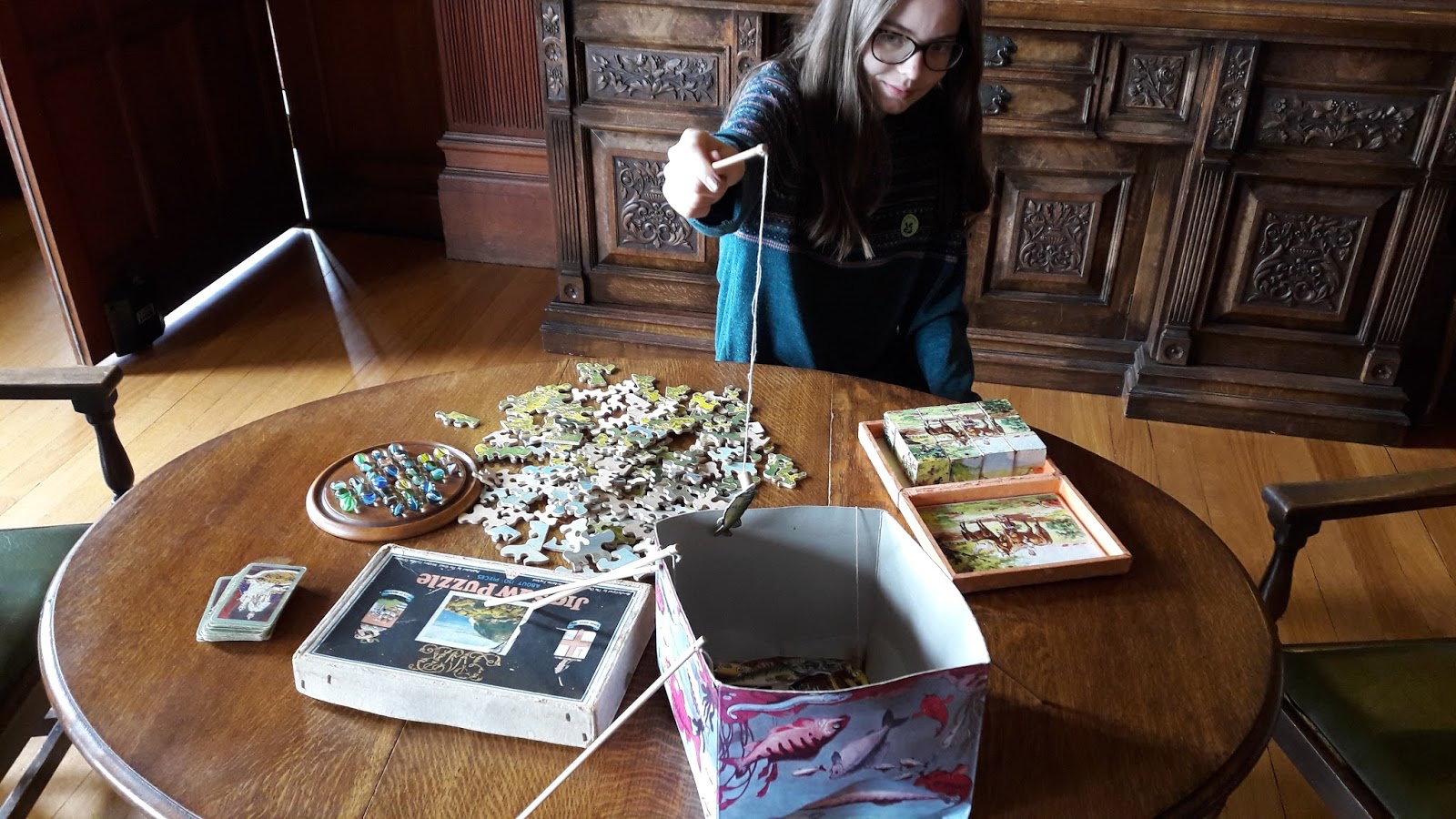
Sutton Hoo: inside the drawing room at Tranmer House which was built in the 1930s
It was laid out informally with toys I recognised, my mum would have played
with and my 16yo enjoyed trying out. Living history!
Sutton Hoo is where King of East Anglia was buried in about AD625 with astonishing pomp.  There are two ship burials mentioned in Beowulf - at the start and end of the story - but as this was originally a tale told aloud and the only surviving copy was from AD1000 it's possible King Radwald's funeral was modelled on the story... Well, it's a nice thought.

King Radwald is a real person. We know this because he is mentioned in the Venerable Bede's book and clearly an extremely important person in the UK's history. It's a shame at school that the starting point was 1066, skipping all this.

The grave robbers missed his astonishingly filled grave by about three feet. But Mrs Pretty, by then a widow, had a dream about where a local amateur archaeologist, Basil Brown, should dig. The first summer Basil (who left school at 12 years!) worked for her he disagreed, and got scant rewards from digging the burial mound nearest her home. His next dig, and what Sutton Hoo is famous for, was in 1939 - ominous because everyone visiting now knows the second world war was about to kick off.

One of Sutton Hoo's amazing guides. Definitely join
a talk. On the days we went talks and tours
were at 11am and 2.30pm
But Basil, with the aid of Mrs Pretty's gardener and gamekeeper, lucked out on this 2nd dig. It was such an important find for the nation that poor Basil got replaced by the professionals. However Mrs Pretty insisted he stayed on the site, and in the team. The result is that at this NT interpretation of the great dig Basil gets a suitably heroic role.

It's odd that the National Trust runs this site - usually the older ones are organised by English Heritage. But that aside (and actually Mrs Pretty gave them her estate in her will) it was a most wonderful way to learn about a history so few of us know. As an added bonus a Beowulf specialist talked us through the links between the poem and the boat burials so we came home with a copy - translated by poet Seamus Heaney - and it is quite magical.

I have a hunch I'd have liked being an Anglo Saxon!

Worth a visit?
I hadn't been away much this year - but in July my family managed two consecutive weekends away from London, camping on each occasion. Re-reading this review it's clear that I'm still rather over-excited about having escaped my home. But i think even if I was travel weary, the information that's on display and the way it's been interpreted makes Sutton Hoo a brilliant visit. If you've got National Trust membership then definitely head there, and have a wonderful time.

Bonus
There's a nice cafe, a second hand bookshop, loads of outdoor seating for picnics and a really great outdoor playground with zip wire and imaginative ship burial style mounds to play on.

https://www.nationaltrust.org.uk/sutton-hoo

Friday, 23 June 2017

Another country: the crazy art world

This blog looks at ways of learning about the world without having to get on a plane. Discovering art is very low carbon - enjoy the inside story of self-proclaimed art terrorist, AK47, who stole a Banksy.  Words from Nicola Baird.

Meet AK47artist at home. Pic is screenshot version(c) Portable Networks Graphic Image
The Banksy Job – five years in the making – is a real treat. It's an eccentric art movie about larger-than-life character (but perhaps not exactly an artist) Andy Link. As AK47 he creates an anti-art movement supported by his white-overall clad followers, Art Kieda. AK47’s plan is to steal a massive Banksy sculpture, modelled on Rodin's The Thinker, but reposed to become The Drinker. Success sees the stolen sculpture planted in AK47's back garden. And then in a bizarre twist how it gets to be reinstalled in Shaftesbury Avenue.

The directors, Ian Roderick Gray and Dylan Harvey, call it a heist movie. It’s shot as a documentary, but mocks itself, its characters and the art world with proper British eccentricity. There’s also some choreographed scene stealing from AK47’s overall-clad art crew too.

If you like street art or are bemused by artistic pontification The Banksy Job
is a perfect film. Photo taken at the Prince Charles Cinema premiere.
Left is question master Amanda Mo with artist AK47 and the d
irectors,
 Ian Roderick Gray and Dylan Harvey.
Curiously I was sent a free ticket courtesy to the premier by the PR for Andrew Lamberty who runs the Lamberty Gallery on Pimlico Road. According to the press release the gallery is: “A busy and pioneering showcase for extraordinary pieces. Lamberty sources and sells the very best in 20th century and contemporary art and design. Alongside this, Lamberty is known for discovering and developing cutting edge emerging talent, representing now some of the leading names in the contemporary furniture design and art scenes.”

 I loved it, and really enjoyed the humour. Enjoy the trailer:


The Banksy Job may have a name that hints at car chases and Italy, but it Is most definitely a London film, covering street art turf wars. It will also introduce you to the bizarre authentication system that Banksy runs, Pest Control.In other words you don’t have a Banksy until it’s verified by Banksy. Not having a Banksy I really didn’t know this. But one day perhaps...

The film's done well in the US and Paris - but it's an oddball movie so the best way to see it is via download. Enjoy.

Directors: Ian Roderick Gray, Dylan Harvey
Star: AK47 “very fuckin contemporary innit”
Downloadable from 19 June - even the trailer is a lot of fun. Find it on netflix, etc.

Sunday, 4 June 2017

Indian style in the heart of Brighton

This blog looks at ways of learning about the world without having to get on a plane. Here's a look inside George IV's crazy Brighton Pavilion which is a mix up of India and China, places that the King never visited. Best of all it's full of dragons. Words from Nicola Baird.
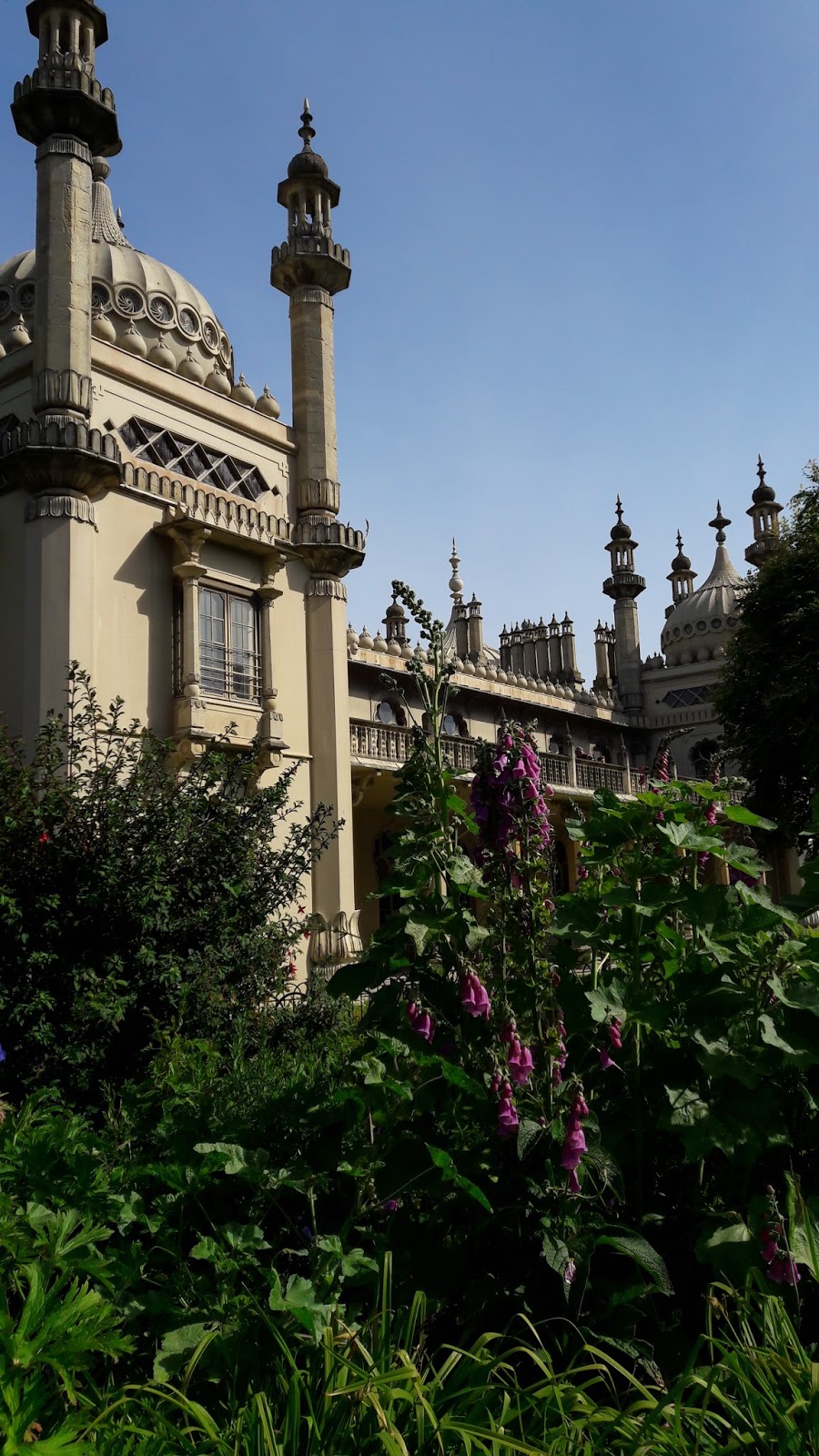
Brighton Pavilion - the regent's love nest with an Indian style
exterior, Chinese inside. Like me George IV hadn't visited either country.
For years I've wanted to go to India - via the famous Brighton Pavilion, in Brighton. I had no idea what was inside (and now I know why - it's because it's not a place that encourages photos or instagram feeds although the website has a fantastic intro video, see here). But I'd heard it was something special. So I abandoned the dog and took a late afternoon trip to Brighton. What an absolute treat awaits you just a 10 minute easy downhill stroll from the train station.... a glorious garden and an eye-popping building in Indo-Saracenic Revival style (get that!) with minarets, domes, bumpy things all in a beautiful pale quarry stone. 

Inside the decor is as over the top as is possible, and I loved it. There's a room which is full of dragons. Snakes are wriggling down the walls. Birds are captured in the hand-painted wallpaper and beautiful bamboo motifs keep repeating themselves on chairs, staircase balustrades and walls. It looks Indian outside, Chinese pagoda inside. And then there are the domes with incredible shiny scales, and lights that are as big as vast upturned umbrellas.

You can have a virtual tour of the banqueting room on this link  (but it's much better being in the room).

George IV was only king from 1830-37 but he was also Prince Regent before his coronation. The Brighton Pavilion was for lavish entertaining.  Eventually it was inherited by Queen Victoria who found it far too public and sold it. It's now owned by Brighton, but has had various uses including an Indian Hospital and a venue for baby shows, flower shows, tea rooms and even a flea circus...

Head down North Road past the Dome and turn right into the gardens. The Dome
used to be George IV's stables and there is a secret tunnel from here to the pavilion,
used by George when he felt too fat shamed by the ever-staring public.
As might be obvious I didn't take a guided tour, or buy the guide book so learnt minimal factual info. But who needs facts in a building that kick starts the senses? If you have a chance do go - and i think it would be a lovely visit with children too as there are so many animals, birds, reptiles and insects scattered in the pattern to distract (aka find) while you oh and ah over the decor. For example you can find moths motifs woven into the domed music room carpet. It is an expensive visit (approx £20 but that can give you a year's visiting rights) but clearly it's an expensive building to maintain. Apparently you often see conservators at work.

And if you do go, try getting a cup of tea in the upstairs cafe with it's lovely tile decor and beautiful rooftop balcony with views over the gardens.

I have to admit that i've always been a bit anti Brighton - it's a place that feels like it is permanently holiday time - but clearly I'm mellowing. Not only was the Brighton Pavilion a pleasure to visit, the locals were really helpful about pointing us in the correct direction. And as for this famous symbol of Brighton, well, I especially like the way George never visited India or China, despite Britain's huge Empire of the time. Instead he brought "exotic" versions of these two vast countries to the UK in the form of this pleasure palace - clearly he was also a fan of virtual travel.

  • Info about the Brighton Pavilion - a once royal palace - is on this website. Tickets bought on line are 10 per cheaper.

Friday, 19 May 2017

Breathe in, breathe out: from best to worst

This blog usually looks at ways of learning about the world without having to get on a plane. But this time let's compare air pollution in the world's cleanest country, Solomon Islands (once my home) and London (now my home). Words from Nicola Baird.

Guardian story here. The worst countries for toxic air were India,
with 133.7 deaths for every 100,000 people blamed on air pollution,
and Mynamar, where the rate is 230.6 deaths. 
From the Guardian:
People in the UK are 64 times as likely to die of air pollution as those in Sweden and twice as likely as those in the US, claims the World Health Organisation. 
 Britain, which has a mortality rate for air pollution of 25.7 for every 100,000 people, was also beaten by Brazil and Mexico – and it trailed far behind Sweden, the cleanest nation in the EU (a small irony as in Jan 2017 the Swedes were claiming that Stockholm's air pollution was as bad as Beijing). The US rate was 12.1 for every 100,000, Brazil’s was 15.8 and Mexico’s was 23.5, while Argentina was at 24.6.


This is my screensaver - a rural Solomon Island scene
about a 40 minute walk from the 
capital, Honiara's city
centre. Note that in the humid tropics even Londoners
like me walk slowly - and in the Solomons few people
can afford to own a vehicle (or are old enough to drive).
Good air v bad air
Years ago - when I was 26 - I spent two years working in the wonderful Pacific island country, Solomon Islands for Voluntary Service Overseas (the best thing I've ever done!). The country was gorgeous - dubbed "as beautiful above as it is below" thanks to its tropical forested islands, sunny skies, fresh trade winds by the coast, biodiversity and vibrant, fish-packed coral reefs. On working trips away from the capital, Honiara, I often saw dolphins, wild white cockatos, huge butterflies and flocks of fruit bats.

Solomon Islanders are rightly very proud of their country's bounty. I remember at one point the Prime Minister Solomon Mamaloni suggested bottling their tropical forest oxygen and selling it to richer countries. The idea never came off, because air is air...

See this piece in the New Scientist from 27 Jan 1996.

But 25 years or so have past and now everyone's talking about dirty air - even me on the Jerry Vine show when he did a special broadcast this week from the Nags Head Market, Islington. And I'm currently working on two clean air projects for clients. Dirty air talk is hard to avoid when you live in London which is packed with diesel vehicles emitting particulates that are damaging everyone's health. Killing us slowly...

So what's Solomon Islands like? Few people drive in the Solomons, and there aren't many roads. There are no trains and a rare haphazard (private) bus service (more like the occasional truck) on the country's main islands. This means that people tend to cram into vehicles, go by boat or - more likely - walk. As a result on 18 May, 2017 the local media were able to announce something amazing:
It’s official: Solomon Islands has the cleanest air in the world (SIBC, Solomon Islands Broadcasting Corporation)

The World Health Statistics 2017 report released by the World Health Organisation found the country has the lowest concentrations of “fine particular matter in urban areas” in its air in the world.

The Solomons had a rating of 5.0, ahead of New Zealand (5.2), New Brunei Darussalam (5.4) and Australia (5.8).

It's not all good news for the Solomons: SIBC's report added: "Despite having the cleanest air, the country still falls behind on other development indicators, particularly in areas such as life expectancy, improved access to proper sanitation and rates of cancer.
  • The average life expectancy of Solomon Islanders is 69.2 years, below the global average of 71.4 years. 
  • Out of every 1000 babies born, WHO said its data showed 114 would die –though it was better than the global average of 212 deaths per 1000 babies born.
  • The Hapi Isles has 22.1 health professionals for every 1000 people, well below the global average of 45.6 per 1000 people.
  • WHO estimates 26.4 per cent of Solomon Islanders aged between 30 and 70 will die from either cancer, diabetes, cardiovascular disease or respiratory disease, above the global average of 18.8 per cent.

And perhaps WHO should add thanks to climate change some of the country's 1,000 cays, atolls and islands are at risk of... disappearing. What will that mean for Solomon Islanders?

Stay calm
Learning to breathe calmly - smell the soup, cool the soup - is a central tenet of modern wellbeing gurus. Just as campaigning to clean up our air has become a key ingredient of modern town planning. And dare I say it, ignoring the consequences of climate change, sea level rise etc.

If there's a lesson from the Solomons then it's make your cities, towns and villages places where walkers rule. Except that's not quite how it felt even when I lived in Solomon Islands... Anyone who's ever been to Honiara recently will know that its one road along the seafront is completely traffic-choked, and not made easy for pedestrians to cross. But it's not a big country, or a big city, and it's only one road: and so the Solomons wins the clean air prize by default. It's fantastic the Solomns has the cleanest air in the world, but it's certainly not thanks to good city planning.

But here's hoping that crazy idea to bottle tropical forest oxygen might be suitable for gimmicky sales now. It's a lot better than selling natural sources like wildlife or trees. At least I think so - I'm slightly confused by the most recent episode of Dr Who which I watched last weekend which played around with this theme, and I don't want to ruin that plot twist.

When it comes to how to get clean air, what the Solomons does right (or not at all) is something we all need to start doing.

Lola (left) and Nell (right) with talented custom dancers
back in 2011 in Solomon Islands.
A little extra
"I can now picture the globe and all the countries and think about their different climates and realities. I learnt that in the Solomons the sky is much clearer, that might either be because of less pollution or where it is positioned. I found that it is a lot easier to breathe in a hotter place if you have asthma which is incredibly annoying as I do not like hot climates – they are too hot." Nell, 10 years after two months in Solomon Islands.
Because of climate change my family decided to stop flying. We decided that a return flight every 10 years would be a way of doing this. Our last flights were in 2011, when from June-September we took our daughters out of school and went to Solomon Islands for several months (via Australia). In the final post about that trip the girls summed up what they thought of that travel experience - lessons that have definitely taken them through GCSEs and A levels. The older, Lola, is now on a gap year learning French in Paris (reached by train) and plans to study politics at uni in September 2017. And over dinner it's not unusual for both girls to argue about who will be PM first: I don't think it's going to be a job share! Have a look at this post here, where Nell's quote above is taken from (clearly she figured out Honiara was less polluted than London).