A-Z activities

A-Z countries

What's this blog all about?

Hi, I'm Nicola - welcome to a blog begun in 2012 about family travel around the world, without leaving the UK.

I love travel adventures, but to save cash and keep my family's carbon footprint lower, I dreamt up a unique stay-at-home travel experience. So far I've visited 110 countries... without leaving the UK. Join me exploring the next 86! Or have a look at the "countries" you can discover within the UK by scrolling the labels (below right). Here's to happy travel from our doorsteps.

Around 2018 I tried a new way of writing my family's and my own UK travel adventures. Britain is a brilliant place for a staycation, mini-break and day trips. It's also a fantastic place to explore so I've begun to write up reports of places that are easy to reach by public transport. And when they are not that easy to reach I'll offer some tips on how to get there.

See www.nicolabaird.com for info about the seven books I've written, a link to my other blog on thrifty, creative childcare (homemadekids.wordpress.com) or to contact me.
Showing posts with label ethiopia. Show all posts

Tuesday, 9 May 2017

Trying to cook Ethiopian style

Learning to cook Ethiopian style at an evening session run at Central Street Cookery School was a fabulous treat. And then, no longer strangers, we ate together. This is a wonderful way to learn more about Ethiopia without having to get on a plane (because this blog is all about travelling without racking up a mega carbon footprint). Words from Nicola Baird.

Ethiopian cooking class at Central Street Cookery School, EC1
At Old Street (also known as Silicon Roundabout) there's a cooking school. It was set up five years ago for the EC1 community in London to learn about creating tasty meals. Sometimes this is for families, or for people with particular health conditions, like diabetes. Invariably it's about ways of avoiding food waste. It can also be hired and used by anyone - a wonderful way to team build.

In March 2017 I wrote up an interview with the lovely manager of the cooking school, Sofia Larrinua on Islington Faces. She then kindly invited me to join their April cooking club and learn to cook an Ethiopian meal. I had such a fun time in a packed kitchen. All the attendees were keen cooks, except me (I make a homecooked meal most nights for my family, but I'd never dare call myself a foodie). It was eye-opening watching our chef-host Tsigereda Tekletsadik show us how to create Ethiopian style cuisine - simply and efficiently. She also made it fun.

Cooking Ethiopian style
I've eaten Ethiopian food a few times and really enjoyed it but hadn't ever been able to cook something similar at home. Now I can do a couple of dishes - and all because of Tsigereda's skills and the discovery of a reddish spice called berbere. Berbere has a mix of chilli, garlic, ginger, nigella, fenugreek and other dried herbs/spices. It's quite powerful and works wonderfully with red lentils and yellow split peas.

What's in the pot? Foreground - the start of Ethiopian split pea stew
and the redder dish is  miser wot (spicy red lentils).
So what's different? I learnt to chop ingredients MUCH smaller and to cook everything a bit slower. It was a real lesson in patience equals better taste.

I'm a vegetarian so was happy to be assigned the chance to make miser wot. This is the spicy dollop of red lentils served on injera bread. It was easy to make with instructions and a real life Ethiopian chef to sort out any questions. My biggest problem was how to use the chopper to mince up the onions. At home we don't have a dish washer, blender or chopper o most cooking gadgets are quite hard for me to figure out!

After we'd cooked up a proper feast - which included meat for the non-veggie cooking club members (the majority!) of doro wat (Ethiopian spiced chicken) and minchet abish which is a beef and chickpea dish - we all ate together. People had brought wine to share but there was also real Ethiopian red wine (very nice) and the famous (and strong) Ethiopian honey wine, Tej. According to my brief research on the internet, Awash is the longest established Ethiopian vineyard.

Exploring the world via cuisine - ie, going out for a meal - is a super simple way to learn about another culture. The next stage is learning to cook a dish or two. I would love to go to Ethiopia and surprise someone there with my new cooking skills, but the next best thing is to invite around Ethiopian friends to my home in London and see if I can serve up a passable miser wat. I'll let you know how it goes...


Over to you?
Where's your favourite place to eat an Ethiopian meal?


Saturday, 6 May 2017

Zig-zagging along the River Lea or maybe the Nile

What is it about following a river from its start to end? Here's my first go at completing the  50-mile Lea Valley Walk. In two days I walk five miles and cycle 25. Not quite as impressive as Dr Livingstone of the Nile, but it feels like a huge achievement to have followed a path along a river. Words from Nicola Baird.
The Lea Valley Walk is well signposted. Here's
the entrance close to Tottenham Hale tube in London.
I'm clearly getting deluded by a combination of hot spring sun and heady distances, but on the first two days I've been on the Lea Valley Walk - which runs from Leagrave (the source of the River Lea) to the Thames - someone has stopped me going "Hello Nicola".  And now I think I'm Dr Livingstone charting the River Nile suddenly meeting Stanley...


Message to cyclists on the Lea Valley Walk.
Judith, the first, is with her two primary school aged daughters and husband. They are all on bikes and the plan is to cycle to Hertford. "How far is it?" I ask tentatively. "25 miles..." says Judith and laughs nervously. Turns out the family have done this before - and Judith has done it many times so knows it's a three hour off-road pedal. With the kids and the temptation of riverside pubs it may take longer, but what an adventure for them all. 

The next day I'm cycling the exact same route as Judith's family, having abandoned my dog and trainers in order to eat up the miles with my trusty bike. It's a quiet Monday so the riverside path is much less busy. There are no boat trainers shouting instructions from bikes at their skiffing crews. There are no squads of lycra-clad cyclists. There are only a couple of walkers to avoid. If you're going to enjoy walking this river then it's definitely calmer to do it on a weekday. 


Psychogeography heaven - that strange tension of rural idyll (otters?) and
yuck (pylons, river rubbish, flattened building sites).
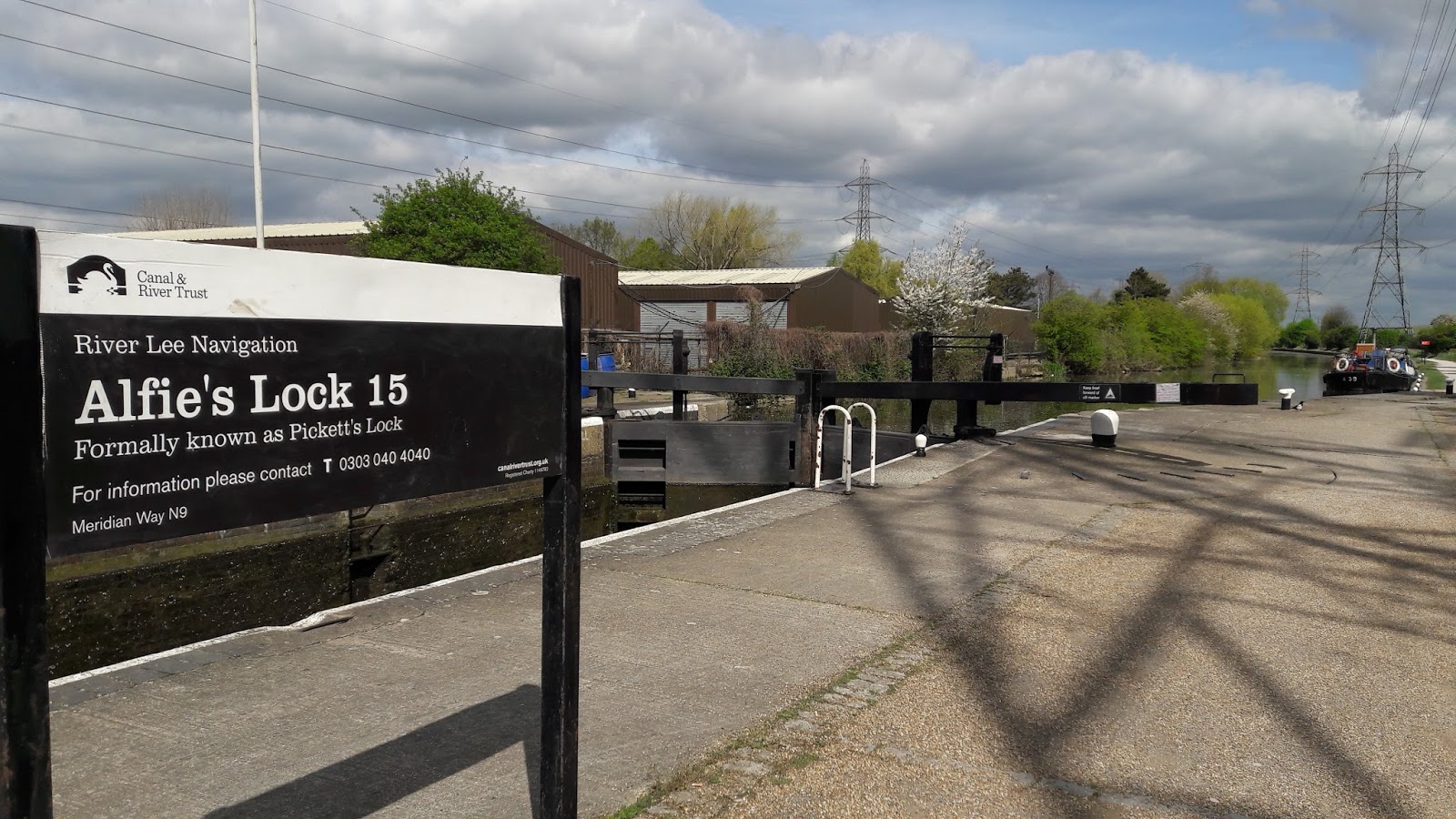
I pass Alfie's Lock (once called Pickett's Lock) and immediately it seems like I'm in the countryside. To my right is a reservoir bank with sheep grazing. There's a heron flying across. On the lock side are sign boards explaining that this is otter country. Apparently otters sleep in their holts for most of their day emerging in the evening to play. Clearly they are perpetual teenagers...

And then I reach Enfield Island where the path swaps sides and it happens again. "Hello Nicola". This time it's Nikki, whose child went to the same nursery as my youngest - 14 years ago!

I can imagine how dazed Dr Livingstone felt when he was tracked down. He'd been in the journeying zone for months, perhaps years. I was only one and a bit hours in, but following the River Lea was turning me into the most famous of all colonial explorers.

The Nile is a great deal longer than the modest River Lea.... it's 6,853km long (4.258 miles) and passes through 11 countries on its way to the Mediterranean - Tanzania, Uganda, Rwanda, Burundi, Congo, Kenya, Ethiopia, Eritrea, South Sudan, Sudan and Egypt.  

In contrast the River Lea is easy to follow. But the roads and towns that it runs close by certainly play a game of convergence...(town to town and road to road) just like the two Niles. In Khartoum, Sudan the Blue and White Nile meet - you can see the mix happening, and hear a local talking about this on the video here.


Signs to the narrow boat cafe. Ahead lies the M25
After about two hours from my door I stop at the friendly Narrow Boat cafe. It is a well signposted, family run cafe at Waltham Abeey, just off the River Lea, so I ignore the fact that it is close to the M25, creating a strange traffic hum. It also takes cards, has a toilet and rather sweetly the waitress heats up my brownie so it oozes deliciously across the plate. I wolf it up (along with my homemade sandwiches) while admiring their goats, assortment of dogs and interesting junk shop art. This is quite a find, and perfectly sited.


The pretty Fish & Eels pub at Dobb's Weir (for a moment it's Essex)
Next stop ought to be Hertford but first I've got a long cycle. I like the way my bike's tyres are now coated with a fine white towpath powder. I get confused by discovering Cheshunt is outside the M25 but enjoy cycling past boat centres, leisure centres, wooden chalets and caravan style holiday parks. This place is clearly not just London's lungs it's a lovely spot to recharge. 


Amwell Nature Reserve - so peaceful.
They even make it OK for the birds and beasts. At Amwell, quite near the start of the New River Canal which goes into Islington, the gravel pits have been filled to create the Amwell Nature Reserve. It's a beautiful spot.


Spot the gazebos of Ware
Pedalling on I arrive at Ware, the train station I use often to get to my mum's home in Hertfordshire. It's a real treat to see the famous Ware gazebos, built to offer a bit of quiet R&R by the merchants whose houses front the high street, which used to be the main route between London to Cambridge. Ware had such a reputation as a stop off point that there are many pubs (former B&Bs) and in the museum you can even see the Great Bed of Ware which travellers at the White Hart were obliged to share (four couples). I'm told this bed was moved from hostelry to hostelry but I can't vouch for the truth of this. It belongs to the Victoria & Albert museum but in 2012 it was on loan to the Museum of Ware and I was very happy to see this famous oak fourposter.
The River Lea gets very pretty between Ware and Hertford.
It's only a mile or so to Hertford from Ware and it's the first time the River Lea loses its wooden sides and is allowed to turn into a pretty country river with meadows on either side. I'm tired now so allow myself a break to watch the Canada geese fighting. It's a good decision as almost at once I spot the first swallow of summer fly down to the river surface to skim off insects.  I could watch all day... but somehow I remount, pedal on and take the turning off the path to Hertford East station. This isn't the train station I want (much easier to locate Hertford North) but it means i have to cross the busy county town and all its congested traffic. 


After the luxury of 25 miles off road the traffic seems quite challenging. Perhaps if you do this route with children it might be an idea to wheel the bikes through Hertford town centre - or possibly take the train from Ware back to Tottenham Hale where you can relocate  to the riverside path to pedal back into London and your start point without so much traffic stress.

Update
A few weeks later I walked from Hatfield to Hertford and after the idyllic 30 miles outlined above following the river was truly surprised to be on a section of the walk that is basically River Lea free until you get to Hertford. This is the Lea Valley Walk of course, but much of it is spent by the dismal A414, the outskirts of Welwyn Garden City and the Colne Valley cycle route along a former railway.


  • I used The Lea Valley Walk - a guide book from www.cicerone.co.uk  I'm using the 3rd edition (2015) with a brown and green cover. It's excellent. Bet Livingstone would have liked to write for them.
Over to you
Tell me your river walking stories. Do you enjoy pacing the river bank? Do you prefer to cycle? What's your favourite river route?

Monday, 27 March 2017

Where to go when you love coffee

What coffee do you drink? Here are some ways to enjoy coffee (and food) Ethiopian style near Shepherd's Bush. Words from Nicola Baird.

Coffee the Ethiopian way.
My friend, the incredible singer Hanisha Solomon, who was born in Ethiopia, suggested we try eating at Flamingo - one of London's excellent Ethiopian restaurants - for a half-term treat. As another close friend, Nicky, and I both find it difficult to get our exam-stressed teenagers out of bed in the morning we thought it an excellent choice of treat, knowing Nell and Xander would be persuaded to leave the house for an Ethiopian lunch.  Which is how we became a party of six sitting around two sharing plates of neatly rolled injera and various triangular piles of vegetables.

In case you don't know much about Ethiopian music - this is my favourite song by Hanisha Solomon (listen while you read, and ideally buy her albums).

https://youtu.be/8wdV6vv4xE4

Injera is the delicious Ethiopian bread that works as a plate and an eating utensil (use the right hand!), looks tricky to make. The teens - our meat eating quotient - also had a rather generous heap of lamb cooked in two different ways. They both preferred the spicy option.

At Flamingo there is also a mini booth at the back of the restaurant acting as a fresh butcher.  It was quite something to see meat being carved off a trio of haunches, handed to the chef and cooked up. I didn't take a photo as it felt rude, but I wish I had - will have to go back.

Ethiopians have a very generous culture. Hanisha begged us to eat more, drink more water, eat more injera and soon we all felt rollingly full. Which is when the roasted Ethiopian coffee beans were brought to our table for inspection. The coffee was made out of sight then brought back in an iron pot and served in handleless cups with popcorn. What a treat.

Since I saw the award-winning Sundance documentary, Black Gold about the struggle to grow Ethiopian coffee, I try to buy fair trade, and ideally, Ethiopian beans. It's even more important when you know that 15 million Ethiopians make a living related to coffee (equal to 67 per cent of the country's foreign exports). But the farmers producing the beans may only make 12-25 cents (per kilo picked) leaving many impoverished. Here's a trailer from the film to inspire, explaining why fair "trade is more important than aid."

https://youtu.be/uiWDjObe_fs

One of the lovely things about Flamingo is that it isn't just packed with Ethiopians wanting a taste of home. There were also plenty of lunchers enjoying a good value, tasty meal close to Goldhawk Road tube. London has quite a few Ethiopian restaurants, and I certainly hope to visit more. But when it comes to coffee, which I drink in bucket-loads, daily, picking fair-priced Ethiopian beans has become a habit I'm happy to have.
  • Have a meal at Flamingo, 31 Goldhawk Road, Shepherd's Bush, W12
  • Join an Ethiopian cookery class on Wednesday 19 April from 7-9.30pm with Ethiopian Master Chef Tsige. For EC1 residents it's £5, anyone else £30. To book contact Central Street Cookery School, 90 Central Steet, London, EC1 (near Old Street) on 020 7549 8176 or info@centralstreet.org or check their website.
  • More about Nicola Baird's books and blogs on  www.nicolabaird.com or www.islingtonfacesblog.com 

Monday, 22 April 2013

Running all over the world, via London

This blog is about family travel around the world without leaving the UK. Impossible? No. Setting yourself sporting challenges demands international conversations. Words from Nicola Baird (see www.nicolabaird.com for more info about my books and blogs).

Lola, my sporty 14-year-old has now run the Mini-Marathon - the last three miles from Blackfriars Bridge to the Mall - four times. Kids in London boroughs are really lucky to get this chance, especially as the other Mini Marathon race runners are already elite athletes (see pic caption)

Lola's learnt a lot about pacing herself, plus an A-Z reboot of her mental map of London during these races. And on her 2011 race she also raised a bit of cash for charity too - books and science equipment for students at Woodford School in Honiara, Solomon Islands.

In 2013 Lola's joined by our friend Lucas, who is 11, and  zipped around the 2013 course
in 21 mins 30 seconds. The winner of the under 17s managed to complete
the race in 12 minutes - that's three four minute miles!
Near the finish spot the race commentator explained that the Africans (Ethiopia and Kenya) would dominate the winners. He was right too - Kenya won the women's race; Ethiopia the men's. And though it wasn't easy to see, every Marathon competitor wore a small black ribbon in memory of the stupid attack on Boston, US competitors and spectators last week. As a result all three countries played a big role in conversation with my younger daughter, Nell, while we waited for the runners to pass near our watching spot opposite Buckingham Palace.

Paula, Nell and Pete framed by flags. We all agreed that one of the best parts of the Marathon
is being able to walk down a road that's normally a traffic jungle.
The Mall is often a sea of flags - it's the only place in the UK that seems to do this (unlike say the US where flag raising and saluting are big parts of formal life). I did my best to spot the Solomon Islands and Kenyan flag as we passed the Commonwealth building, and was suitably rewarded with a flutter through the cherry blossom.

Over to you
What sporting occasion makes you feel as if you are in another world?


Monday, 13 September 2010

Ethiopian bread and coffee

Pete, Nicola, Lola and Nell love to travel with the lightest of carbon footprints. Here's one way to get to Ethiopia. Post by Nicola (for more of her writing also see http://www.homemadekids.co.uk/)


Bread and coffee are my staples. But if I tweak the ingredients so it's a flat bread - injera - and add a bit of ceremony to the coffee, maybe with frankincense then it's easy to be transported to Ethiopia. It certainly helps if you add in the wonderful music of singer Honey Solomon at the 24th Gillespie Festival (held the 2nd Sunday every September) Ethiopia came to a pocket park in the shadow of Arsenal's football stadium.


The Gillespie Festival is a large fete with a cultural spin that reflects the area's unique mix of peoples. While the stalls are piled with secondhand or homemade creations. There's usually also a fast trade in homecooked or home grown produce (I bought rhubarb and plum tomatoes from the Quill Street Allotments and damson jam from Olden Community Garden's stall). Defying categories - a pedal bike that powered up a fruit smoothie maker being run by Finsbury Park Transition Town.


But the real pleasure of attending Gillespie Festival is its amazing multicultural mix of music and people.


Get up and dance
Honey Solomon
specialises in Ethiopian songs - and during her set a tower block version of the flatbread injera was passed around for sharing to everyone in the audience. This bread was delicious tasting (and is ideally eaten with the right hand).


To one side of the stage a coffee ceremony had been set up, beans roasted, frankincense flavoured the air. The hypnotic effect of Honey's music, food and scented smoke soon had the crowd dancing.


Today I was back in this little park walking my dog and there's barely a trace of the Magic Carpet trip the people of London, N4 and N5 took yesterday to Ethiopia. But it's not one I'm likely to forget if I can turn my coffee love into something with more ceremony and less addictive-behaviour.