A-Z activities

A-Z countries

What's this blog all about?

Hi, I'm Nicola - welcome to a blog begun in 2012 about family travel around the world, without leaving the UK.

I love travel adventures, but to save cash and keep my family's carbon footprint lower, I dreamt up a unique stay-at-home travel experience. So far I've visited 110 countries... without leaving the UK. Join me exploring the next 86! Or have a look at the "countries" you can discover within the UK by scrolling the labels (below right). Here's to happy travel from our doorsteps.

Around 2018 I tried a new way of writing my family's and my own UK travel adventures. Britain is a brilliant place for a staycation, mini-break and day trips. It's also a fantastic place to explore so I've begun to write up reports of places that are easy to reach by public transport. And when they are not that easy to reach I'll offer some tips on how to get there.

See www.nicolabaird.com for info about the seven books I've written, a link to my other blog on thrifty, creative childcare (homemadekids.wordpress.com) or to contact me.
Showing posts with label iceland. Show all posts

Wednesday, 14 February 2018

Shades of grey: Iceland via Leigh

This blog is about family travel around the world without leaving the UK in order to reduce our impact on climate change. A day out to the Essex coast - to the little former fishing village of Leigh-on-Sea, Essex gave us a taste of the big skies and sustainability skills you have to have to survive anywhere, including Iceland. Words by Nicola Baird (see www.nicolabaird.com for more info about my books and blogs).
When get and icy weather gives a little hint of spring - at Leigh on Sea, Essex
“An eye to the future and an ear to the past in the heart of Leigh.” That’s what Leigh Heritage centre calls Plumbs Cottage which sits close to the shore line, a little clapperboard fishing cottage, two up and two down. The Burders were the last family to live there. Amazingly they raised 10 children in their home despite the lack of space and a long list of Nos – no modern conveniences, no piped water, no electricity, no gas, no phone, no toilet inside the house, no fridge, no washing machine, no radio, no TV, no computers. Upstairs there were just two beds and a crib (the kids slept head to toe until they moved out) and downstairs it was just fishing kit (oars, nets, places to dry things off) and a basic kitchen range. Even so, it’s a lovely little home, recently restored thanks to the Heritage Lottery Fund.

There’s something so elemental about taking a day out to the seaside in winter. We love to do this because you can walk your dog on the beach, which is forbidden from May-October. But also there’s the amazing cloudscape and sand patterns to watch, the cry of oyster catchers, an army of winter waders and the chance to be buffeted by the wind as you storm along the sea front towards a warm pub. Add in a monster February hail storm and you can see what I mean about elemental.

Recovery in action - a walk by the sea.
Lola came to get over a broken heart; I wanted to forget work for just one weekend; Pete was upset about a book contract going wrong… but the excitement of a very easy journey and then seeing the sea just seemed to raise everyone’s spirits. We got excited about the beach – a swerve of pebbles, sand, mud and shells broken up by seaweed-covered groynes. We chased the dogs chasing each other and chatted as if we’d never stop. And then in Leigh we found a shed selling delicious fish and a plethora of pubs ensuring that we could find at least one that let us in with our two dogs, and had craft beer and sold fish & chips, and veggie stuff. The Crooked Billet is the last pub before the rail station (it’s a 10 minute walk) so the perfect stop-off point.

Leigh is a place of refuge. The current residents probably don’t think of it like that. But this is where many east enders went to in a bid to escape the dirty air and grim surroundings of industrial London, just two or three generations ago. Worldwide people have a tendency to be drawn to the city for work and lifestyle reasons. That’s one of the reasons more people now live in urban environments, rather than rural. But for many Londoners the journey has been the other way, at first to escape the dirt and poverty, and more recently in a search for more affordable housing.

It’s also a lovely day out. And as the visitors’ book at Plumbs Cottage reveals on the sunny Sunday we turned up, that most of us were day trippers from nearby – a lot of Essex addresses – plus a few down from London.

I wonder where those Burders are now? You get used to seeing grand National Trust stately homes and yet here’s a really very modest place that oozes with history, and stories of a bygone age, and yet there are no tales of what it was like to be growing up in such an idyllic place with plenty of access to food – fish and, at the right time of the years, scrumped and foraged fruit and leaves. On Islington Faces I often interview people who definitely knew hunger and neglect in childhood who have moved away and are now home owners. They often have one or more cars, regularly eat out and travel. When they tell me about their lives they so often have a grandchild’s voice of incredulity in their head. “You washed once a week!” “You played out with no adults!” “There was no wifi. Or phones!” Some also lived through the bombing of London during World War Two or were evacuated to a strangers’ house far from their family. It is extraordinary what the generation above me – my mum and dad – put up with or accepted as normal. 
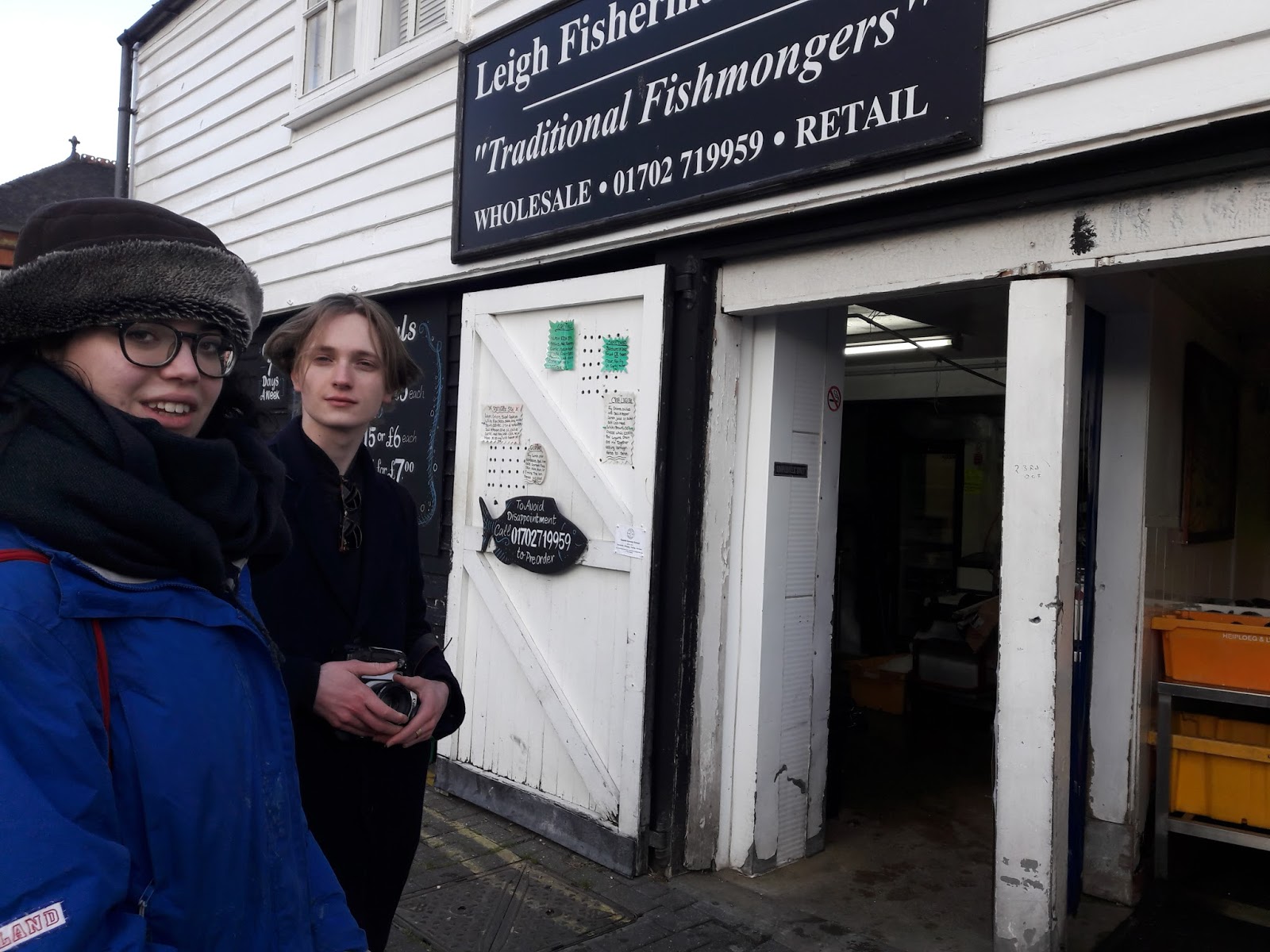
At Leigh Fishmongers fish is sold in a seafront shed and
recipes are pinned to the entrance door.
That said I am fascinated by the way there’s a new generation – and it’s not mine, it’s the millennials – who are challenging accepted norms. Good for them. 

But don’t let any of us forget that we’re only seven meals away from the need to be self-sufficient. All of us (including me) certainly could learn some lessons from the sort of skills the Burders would have known just to survive the everyday.  I think that’s why the next day I made up a fire and lit it – successfully – craving a refresher of the knowledge needed to live so simply. Let’s hope that won’t be needed to ensure we simply live. Like I said, I needed a break…

  • Leigh Heritage Centre and Plumbs Cottage, 13a High Street, Old Town, Leigh on Sea, Essex SS9 2EN
  • Read the interviews on Islington Faces at https://www.islingtonfacesblog.com


Friday, 26 February 2016

It's cold, wet and somehow I'm in New Caledonia (via London's old docklands)

This blog is about family travel around the world without leaving the UK. We do this in a bid to be less polluting and tackle climate change while at the same time keeping a global outlook. How a walk along the River Thames got me thinking about whaling and the South Pacific. Words by Nicola Baird


This area was known as Greenland Dock from 1763. But there must have been a strong
South Pacific link as nearby is South Seas Road.
New Caledonia (also known as Noumea) in the South Pacific is a tropical Pacific Island. So it's fun to walk along the south bank of the River Thames - using the Thames Path - and discover the many links this area had with the rest of the world.

There's a large block of City fabulous apartments on the spot where I took this photo, which were built on part of  a 10 acre dock where the whaling boats collected.  The unfortunate whales were caught for their meat, oil and blubber. But the huge whale bones have been put to all sorts of uses too - to shock and awe like the jawbones on Whitby cliff as well as more practical uses, like corsets (fashion) but also for chess pieces and dominoes.

Sperm oil was used when high quality lighting was needed, eg, for non-smokey light and even lighthouses - as well as for lubricating machinery and soap.

At the dock there used to be blubber boiling houses.

Whaling is an old, old trade, possibly dating back to 3,000BC - reaching a peak in the 1930s when the annual whale slaughter was around 50,000.  Since 1986 whaling has been banned, but some countries - Japan, Iceland, Norway and others - controversially persist. In other words it's still going on...

This part of Rotherhithe's original name was changed in 1763 to Greenland Dock, no doubt reflecting the location of where ships were chasing and catching the majority of their whales. You can find more about the history of New Caledonia Wharf and the luxury flats there now here or look at wikipedia for more about whales and whaling.

  • It was Captain James Cook who named New Caledonia - in 1774. Ships initially traded sandalwood (a rather poetic name for timber), and then blackbirding - illegal shipment of locals to work in slave-like conditions in the sugar cane fields of Queensland, Australia.
  • It became - and remains - a French possession, on order of Napoleon, in 1854. it was used as a penal colony for many years although discovering nickel seems to have helped give this small island country a little more status with Mother France.  Although no longer a colony it has been one of France's overseas territories since the end of the second world war. Be born there and you can take on French nationality, despite clearly being Melanesian.

I have such a soft spot for the South Pacific that even on a wet, cold February just seeing the words "New Caledonia" made me imagine tropical warmth. And when I peered through the entrance to the flats I could hear the music of running water - a fountain of course. The apartments also have an indoor swimming pool.

This area had been hugely pimped up. When Charles Dickens and Conan Doyle were writing they'd send their really bad characters to this area in search of R&R at an opium den. Now it seems squeaky clean behind the gated posh conversions. There's not even much graffiti, but there are still a few cranes and along the waterfront little wharves giving just a hint of the bustle, noise and trade this part of Docklands was so famous for.

Verdict: A fabulous way to get to know the Thames.


Tuesday, 18 August 2009

Hadrian's Wall: the end & haaf fishing

Pete, Nicola, Lola and Nell love to travel but stay off planes to keep their carbon footprint down. Here's how they satisfy their passion for travel

It's 84 miles (135km), was built in six years and the only World Heritage Site to have a long-distance footpath along it. So this is Hadrian's Wall – a 2,000 year old map route from Newcastle's Wallsend to Bowness-on-Solway. And as a family we have now managed 59 miles of it stretching from Chollerford (Hexham) over to the edge of the Solway Firth (Carlisle).

There was a tourist perfect end to the walk – a Roman(esque) recreation of an Edwardian viewing point at the Banks, just off the village, which offered a poetic view to Scotland. As we sat and half contemplated our as-good-as-finish of Hadrian's Wall a man walked out with his 18 foot Haaf net to fish the tides for salmon etc. Wading out he looked like Anthony Gormley's Angel of the North on the move. With the silvery light, our soon to be rested aching feet and this snapshot of a 1,000 year old fishing skill (brought here by the Vikings) it was the most atmospheric moment of the whole walk. And that includes meeting men dressed as centurions, the re-enactors at Halsteads Fort and even witnessing the Roman shoe dug out in front of us at Vindolanda.

Living history is not yet going into the supermarket and choosing our food, or for that matter tapping out blog entries. Living history feels like watching a fishermen with a weirdy net or retracing a Roman soldiers' path within earshot of a dual carriageway.

Admittedly I did rather turn the end of our epic journey into a shopping saga by stopping off at the King's Arms, 016973 51426, to buy sew on Hadrian's Wall badges and postcards. Pete can do celebrating fine with just a pint.**

I wanted to find out more about haff fishing but it was luck that we stopped off at the Highland Laddie pub in Glasson as this is were you can find Mark Messenger, highlandladdie@talktalk.net, who'll take you out to fish the age old way for salmon, grilse (young salmon), sea trout, grey mullet, bass and flounder. He's also the secretary of a new haaf fishing association - see more on page 5 of this document about the Solway Firth here, which explains why haaf fishing is endangered now it can only be practiced between 10am-10pm.

There's even a festival - the Haafest salmon and beer festival from 5-6 September 2009. Equipment is provided (you wear your own waterproof jacket) including the haafnet and waders, though you need to be fit enough to stand in cold water for a couple of hours. Or just enjoy Jennings beer and local bands.


Be tempted when you find out that “haaf net fishing is one of the best excuses there is to stand right in the middle of one of the last wildernesses in the British Isles and explore the magnetism of the Solway Firth.” You could even see seals and porpoises and of course the many migratory wading birds that stuff themselves on the rich tidal waters and marsh land.

**Useful guide for Hadrian's Wall is Hadrian's Wall Path by Anthony Burton (Aurum, £12.99) which makes the route incredibly clear though fails to do justice to the many contrasts of the walk, or name all the pubs and which stock the best ales.

Wednesday, 24 October 2007

Flying geese

Pete, Nicola, Lola, 9, and Nell, 6, spent three happy months during the summer of 2007 traveling around Britain. Now we’re home but the travel bug is still there. Join us for occasional sightseeing plus tips on how to shrink your carbon footprint… This post is from Nicola

It’s one of the best sights in the world – skein after skein of geese, some arrow-headed but all making that heart-stopping geese gaggle as they search for the best night time stop over. The pink-footed geese (with distinctive white bottoms and, obviously, pink feet) have been in Iceland all summer but in late September/October thousands appear around the shores, marshes and grass fields of Holkham, Norfolk swiftly followed by bird watchers with hefty binoculars (bins), tripods and industrial sized Thermoses for piping hot mugs of tea.

Seeing the geese is a small miracle - and even more so since the world's total breeding population of these birds (approx 100,000) has been under threat in Iceland as it is at the same spot as the proposed site of two hydro-electric dams. My details are not up to date, but it makes me giddy how easy it could be to destroy these birds' essential habitat for ostensibly a good, low carbon project. What a terrible loss the end of the geese would be.

If you are at Holkham when the geese come in at dusk (or maybe drinking tea or beer in the nearby Victoria Hotel – a Chelsea-on-sea style pub with wit, atmosphere, dogs, Rajasthan fittings and a hearty game menu) then it is easy to suggest the earlier part of your carbon-light day. Go for a cycle around the collection of villages prefixed Burnham so you can hero worship Nelson, enjoy village ponds, prowl around antique and boat yards, stop-off at Bircham Windmill on the B1153 and finally get to Holkham with its craft village, big house and shrine to agriculturalist Coke before going to see those honky tonk stars on the grassy side of the marshes near the pine-wood bordered dunes.