A-Z activities

A-Z countries

What's this blog all about?

Hi, I'm Nicola - welcome to a blog begun in 2012 about family travel around the world, without leaving the UK.

I love travel adventures, but to save cash and keep my family's carbon footprint lower, I dreamt up a unique stay-at-home travel experience. So far I've visited 110 countries... without leaving the UK. Join me exploring the next 86! Or have a look at the "countries" you can discover within the UK by scrolling the labels (below right). Here's to happy travel from our doorsteps.

Around 2018 I tried a new way of writing my family's and my own UK travel adventures. Britain is a brilliant place for a staycation, mini-break and day trips. It's also a fantastic place to explore so I've begun to write up reports of places that are easy to reach by public transport. And when they are not that easy to reach I'll offer some tips on how to get there.

See www.nicolabaird.com for info about the seven books I've written, a link to my other blog on thrifty, creative childcare (homemadekids.wordpress.com) or to contact me.
Showing posts with label walks. Show all posts

Friday, 25 February 2022

Law & order on the Thames Path: Runnymede and the Magna Carta

Public transport, decent walking boots and a map ensure endless opportunities to visit beautiful places, explore and build up memories. This post-Covid illness entry charts the joys of walking the Thames Path with a culture stop at Runnymede. Words by Nicola Baird (see www.nicolabaird.com for more info about my books and blogs). 
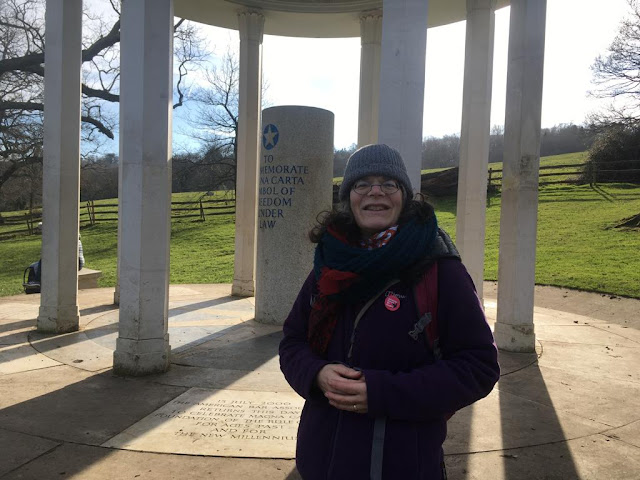

The Magna Carta was written in 1215 - and it's still important today
as this memorial at Runnymede rather proves.

It’s two years since I did things I used to take for granted, such as visit the cinema, or hopped on a train to walk another section of the Thames Path. As a result almost anything I do now – and especially since I’ve also recovered from covid recently - seems an incredible treat. That said, doing another section of the National Trail Thames Path would be fabulous at any time. A good map to make this easy to follow is The Thames Path by Cicerone

All about the Magna Carta: spotted along the Thames Path.

For years I’ve wanted to visit Runnymede where bad King John met the barons and was convinced he needed to sign the Magna Carta in 1215. This is still a famously beautiful meadow, just by the River Thames and not far from Windsor. The area is now managed by the National Trust, which means there’s a tea room, hurray, but trying to locate how to get there by public transport was tricky. Turns out it’s easy – a two or three mile walk from Staines train station. It’s also on the Thames Path so I figured we could walk on to Windsor, completing another seven miles of this 180 mile route. 

The Thames Path has so many different atmospheres, but around here in Berkshire/Surrey it is lined with posh bungalows, winter-sleeping smartypants motor cruisers and plenty of very used-to-people river wildlife. There are always coots, but we also saw five large black cormorants drying out on a weir parallel to the lock and, excitingly, a swan fight. It was more spring swan posturing as the larger bird flapped up to chase the smaller one off. Satisfied by his success the big winner then flew off (in a rather ungainly way, running his giant feet along the water) towards his mate where they very sweetly did the love heart with the neck shape. I’d never seen this in real life before, thank you swans! 
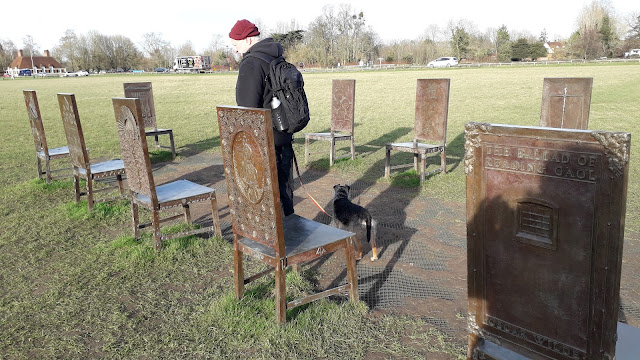
12 impressive chairs to help visitors take note of major legal changes.

Just before Runnymede, Pete and I found a bench and munched beigels bought from near our home. Fortified we then crossed the busy A308 road and thanks to dog walkers' directions managed to get to the Magna Carta Memorial, a cupola roofed monument in white stone which has a very Washington feel. In fact we missed the JFK Memorial which is just to the north of it. But we did discover several beautiful public art works including The Chairs (also known as the Jurors) and Writ in Water.  

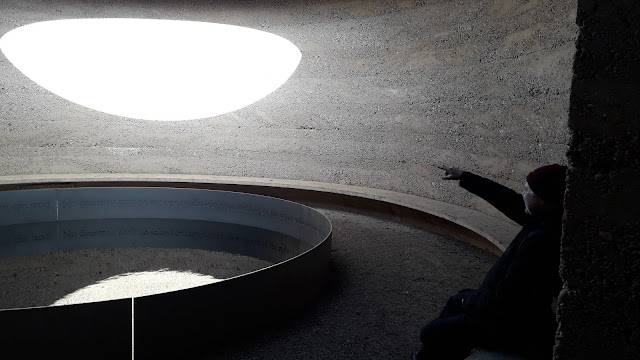
Beautiful Writ in Water at Runnymede.

Writ in Water
looks a bit like a circular barn, but you go into it, and find an inner roofless circle. At ground level is a pond of water which is so clear (this is not a wildlife pond or a cattle trough) that the words of the Magna Carta carved into the stone casing reflect in the water. The surprise is that it’s the watery view of Clause 39 that’s legible – the stone carving is mirror writing. On our trip the sky was a perfect winter spring blue, and windless which meant Writ in Water was at its most beautiful and easy to read. For me another surprise was that this was designed by artist Mark Wallinger. I love most of the work I’ve seen by him, especially horse-related, but clearly I haven’t made enough effort to look up his whole oeuvre. The words say: “No free man shall be seized, imprisoned, dispossessed, outlawed, exiled or ruined in any way, nor in any way proceeded against, except by the lawful judgement of his peers and the law of the land.” With Boris in power, and our threatening migrant policies this doesn’t really ring true, but it is an empowering vision, and one that has led to America’s constitution. 
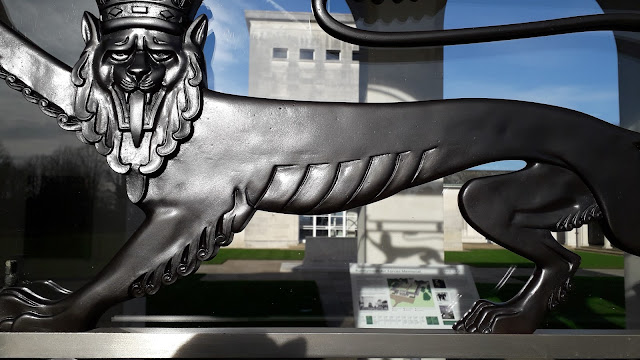
Gate at Runnymede Airforces Memorial.

Life and death

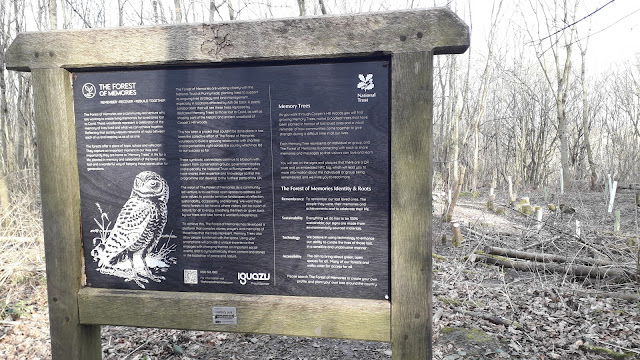
Talking about laws of the land we then followed the steps up through the wood by Cooper’s Hill – full of brambles, honeysuckle and big oak trees. It’s quite steep but a lovely place and at the top passes a growing Memorial Wood being replanted in memory of people who died following Covid-19. 
Young trees grow better and insects, birds and plants do better with a jumble of untidyness.
On the ridge of the hill there’s a campus for Royal Holloway university and then just round the corner Runnymede Air Forces Memorial. This sparkling white building, partly indoors, partly out, partly chapel, partly stunning viewpoint offers a memorial to the 20,275 military personnel – air force personnel – who died in the UK and Europe and whose bodies were not found during World War Two. 

It is chilling looking at column, after marble column of names from all around the world although predominantly the US, Canada, Australia and New Zealand. So many had very ordinary British sounding family names (including Pete’s - May - and my own - Baird) but came to fight for the 'motherland' and then were horribly killed. Curiously, and like most of the Commonwealth war grave sites it isn’t exactly a sad place, but it is one of reflection. Let there not be any more huge scale awfulness and yet turn on the news at the moment and it’s all about the escalation of tension in the Ukraine. 

We practically had this place to ourself, but I’m sure it will soon be busy again with overseas visitors paying respects to their lost relatives. 

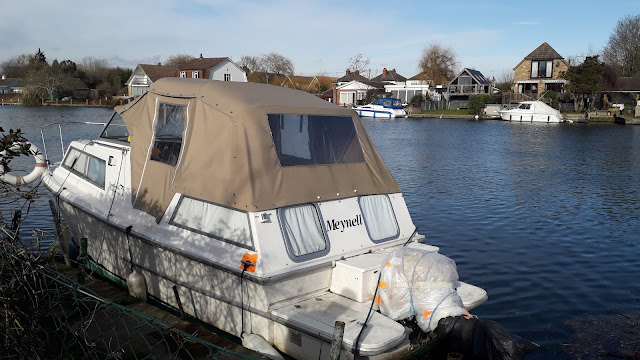
Joys of the Thames Path: very swish houses by the river and boats on the water.

Back in the meadow

By the time we retraced our steps back past the 12 big bronze chairs, The Jurors, I was hungering for cake but not so much that I didn’t note the jury experience idea of “12 good men and true”, or that each chair references a particular struggle for freedom and equality. You could guess this just by looking at individual chairs – all designed by Hew Locke – but the one for Oscar Wilde, in this legal setting, might be the biggest give away. 
It was only 3pm on a Saturday by the time we reached the Runnymede Magna Carter tea shop (designed by Lutyens) but the person in front of me managed to get the last freshly made piece of cake. That's almost panic making...

Fortunately, there were other delicious pre-wrapped choices. Fortified by this calorific National Trust moment and a cuppa we headed back to follow the Thames Path upstream. 

This involved re-crossing the road, and really the only safe way is by using the pedestrian crossing, it’s hugely fast and busy which the green-coloured National Trust map of the area does rather fail to identify. It did remind me how reliant everyone outside the big cities is on their personal vehicle – so much so that even the NT 2022 visitor book gives precise road directions for drivers but fails to include any public transport information. I think it would be good if people without cars, including tourists, were given some clues so they could then google their way there. So, nearest train station is either Staines or for a longer walk Datchet. You can walk along the Thames from Staines (as we did), or take a bus and disembark by the famous Bells of Ouse pub. 
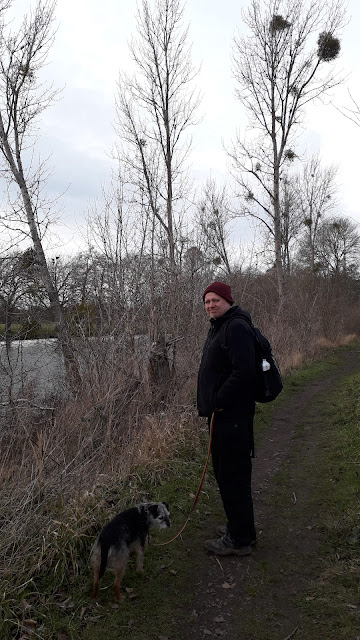
Pete on the Thames Path near Datchet. In this area many
of the trees have atmospheric bunches of mistletoe.

For this section of the Thames Path (runnymede and ankerwycke) we needed to speed walk in a bid to get to Windsor before the light failed – but just outside Datchet we stopped to watch a red kite circling completely engulfed by a flock of terns. All seemed to be eyes down looking at the grassy field we were walking through. It was another magical nature moment on this walk.

Despite the light failing we were still able to enjoy views of grand Windsor Castle and Eton College chapel across the flat water meadows where Windsor horse show is usually held in May. You hear so much about Eton, its playing fields and culture that it actually felt quite strange seeing this old stone building popping into view. 

Actually we didn’t see any Eton students. In fact we only saw one child on their own throughout the whole of this journey – bouncing on a creaky trampoline, invisible behind the dark black safety net. It cannot be right that so few children get to be outside. Even at the National Trust site there were very few kids. Ironically this was the one “culture spot” that I’d meant to take our daughters to as kids but completely failed to organise. 
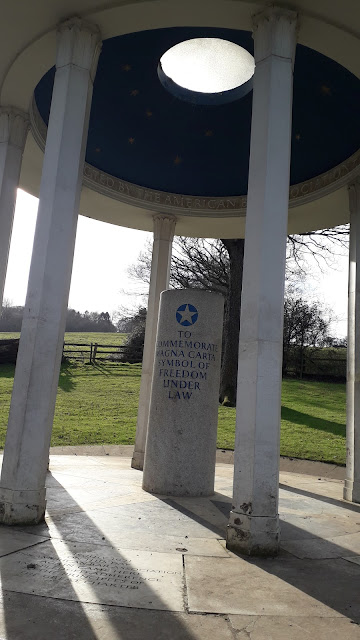
So pleased to have visited this Magna Carta monument.

Our walk ended at The Boatman pub which is literally beside the path, thank you pub gods, and so we staggered in, struck by how lovely it was, ordered wine and beer, fed the dog his dinner and then restored, went out of the pub’s back door to Windsor and Eton Riverside station – all of one minute – to take the train back to London. 

Verdict: time passes so fast whether you chat and walk and follow the river or stay at home running errands or in my case work from home. So it's definitely worth having experiences to enjoy in the moment and to remember!

Tuesday, 22 October 2019

How wild can you be?

Wilding: the return of nature to a British farm is an amazing book with the potential to change everything about the way we manage nature and it tackles climate change. Words by Nicola Baird (see www.nicolabaird.com for more info about my books and blogs). 

The very beautiful cover of Wilding. Now you know
what a turtle dove looks like.
Every now and then a book shakes up your comfy ideas. Rachel Carson's Silent Spring, of course; Frances More Lappe's Diet For A Small Planet, most things by Malcolm Gladwell (I know, sorry!) and more recently Robert Macfarlane's Lost Words. And now there's another: Wilding: the return of nature to a British farm by Isabella Tree.

This fantastic book starts with Isabella Tree and her husband Charlie Burrell being forced to sell the dairy herd and all the farm equipment to keep the Knepp estate, which is near Horsham, afloat. They were £1.5 million in debt and couldn't make a living on the clay soils around their castle. The soil fertility was so dire that expensive fertilisers were making little headway, other than harm the estate's old oak trees. In many ways this is an oddity of a book - it's by a very privileged woman who marries a castle (well a man with a castle) and then the couple work hard to convince various funding bodies to provide grants to fence the outer boundary so they can return the whole acreage - bar the Repton designed park - into a wild place.

There's still public access for paid-for events (in the Repton park) and also free routes for dog walkers and riders on footpaths/bridleways. As the wilding project develops safari tourism becomes possible - and how lovely. Few of us get access to a big set of fields or understand what the owners/managers are trying to do, other than National Trust properties, so it is exciting to be taken through the wilding approach.

For starters this old idea of doing nothing to manage your land turns out to be nail-bitingly complicated. There is a place in the Netherlands, Oostvaardensplassen, that has managed to do a more extreme version, where herds of horses and deer expand during glut months and literally starve to death in the winter, but in the south-east of England that's not going to be an option in 21st century Britain. See this article about the backlash to starving animals in the Netherlands.

Grazing power
Chapter by chapter Isabella Tree (yes, she's well-named) details how grazing animals can change habitats - actually bringing back soil fertility. At Knepp they've done this with Longhorn cattle and Exmoor ponies. She also discusses how original Britain was surely open grassland with some woodland not solid trees - a scene more familiar to Serengeti safari takers than those of us used to massive agricultural fields farmed by the barley barons. And then how de-canalising a river, basically letting it wiggle and pond and slowing the flow brings insects which bring birds and a great many bird watchers.

The cover has a secretive, zebra-striped bird I've never really considered before, the turtle dove - known to most of us from the gorgeous 12 Days of Christmas carol. And in serious danger of going extinct because its habitat has all but disappeared.

She takes on all the countryside taboos - removing fencing, leaving ragwort, letting Tamworth pigs roam on a walkers' path and, whisper it, wanting to reintroduce beavers. She's not frightened of suggesting that this leave-nature-to-do-its-thing produces better management results than just managing for a particular species. She's also clear that stopping ploughing is a good way to avoid releasing carbon which adds to climate change.

It was the chapter about rivers that made me think hard. As a stand up paddleboarder I'm accustomed to using canals which have straight concrete sides and controlled water flows. Increasingly there are loads of temptations to go out and paddle rivers which I doubt does wildlife much good (especially when birds are nesting or the young are just entering the water). But if rivers are left to be more natural (but not allowed to convert to woodland) they really aren't straight - they're an untidy mess which are no longer navigable. On the plus side this creates habitats, water storage and slows fast water flow averting flood risks. But they're no longer the rivers we know... In the same way that 3,500 acres of Knepp land is becoming a different landscape. It's a Serengeti under the Gatwick flight paths!

Isabella takes this idea of right and wrong landscape further pointing out that most British people think the yardstick for what's normal should be approximately dated from the time when they were studying. So todays' leaders (eg, Boris Johnson is 55) think of the good-old-days as the 1980s - a time when insect and bird populations were crashing. When she showed around older people they recognised the wild flowers, the birds and even some of the insects.

Me too
I would like to rewild, but how can I do this living in the middle of London? My small concession is very lax care of the tree pits along the road where I live. In fact they often win prizes for their summer appearance but the times people have said they look untidy because there's grass and other wild flowers growing at the base of the tree. My logic is that if they were weeded it would simply turn these tiny nature reserves into cat litter trays. And who wants that?

My bit for rewilding is focused on sharing the book with as many people as I can. I read a library copy. And so far have convinced one book club member to buy it, one friend to listen to a podcast about the Knepp project and given a copy to my brother for his birthday (happy birthday Drew!).  I look forward to finding out what these readers think about the ideas Isabella discusses and even more to seeing if this wilding idea gets a bigger grip on the public imagination. Maybe it already has - my first contact with Knepp Castle was on BBC's Countryfile. And wow it looked fun to explore. I can't wait to visit.


Monday, 20 March 2017

New ways to make a pilgrimage

Are you the pilgrim type? You might be as there's 100 million pilgrim journeys made each year alone. I think I could be... if I just pick the right attitude rather than a high profile route. Words from Nicola Baird  (see www.nicolabaird.com orwww.islingtonfacesblog.com for more info about my books and blogs).

The Lea Valley Walk finishes just after the Olympic Park at Stratford - so walk on
a West Ham home game and you'll get the added thrill of being with 57,000 football
fans. It's not as bad as it sounds - and the cheers of goals add to the celebration that
you've nearly finished a 50 mile walk. Or just started.
I’ve always assumed a pilgrimage isn’t right for me, even if 100 million people annually complete the 14 best known... according to the Huffington Post. These are:
  1. The Ganges River, India
  2. Mecca, Saudi Arabia
  3. Golden Temple, Amritsar, India
  4. Our Lady of Guadalupe, Mexico City
  5. Vaishno Devi Temple, India
  6. Lourdes, France
  7. Bahai Gardens, Israel
  8. Vatican, Rome
  9. Jerusalem, Israel
  10. Bethlehem, Israel
  11. Machu Picchu, Peru
  12. Rumi's Tomb, Turkey
  13. Bodi Tree (fig tree), India
  14. Stonehenge, Wiltshire * (I've been here, in fact cycled some of the way, see this post)

But the April 2017 issue of The Simple Things magazine has flipped my thinking. That’s because the criteria they set for a pilgrim fits beautifully into how I try and live (try, note). Here’s how to turn an ordinary walk into a pilgrimage (from the British Pilgrimage Trust )
  1. Go slowly
  2. Improve the way (pick up rubbish, shut gates, rescue what needs rescuing etc)
  3. Accept more, need less
  4. Pass the blessing on
==================================
REPORT CARD 2017

  • Well #1 is no problem. It took nearly five years to complete the NewRiver Path (see my blog post here) despite it being short and practically ending by my door. 
  • #2 is one I try and do, ideally by remembering to take a plastic bag for litter. Actually you don’t need to as I usually find at least one of the pieces of litter is an empty plastic bag - essentially offering itself to be filled with recyclables. 
  • I’m not really sure about #3 – I sometimes beg my husband, Pete, to carry my rucksack (but in exchange I'll carry the dog poos) 
  • #4 I’m useless at. But seems like a good new habit to make.
Judgment: Two out of four isn’t a bad start… I’m officially pilgrim-lite.
========================================

The next long walk starts here... The Lea
Valley Walk from Luton to the Thames.
Fortunately there’s a brand new journey - pilgrimage - to start. This time Pete and I are going to walk the Lea Valley Walk, using one of Cicerone’s handy guides. This one is written by Leigh Hatts (3rd edition came out in 2015 so doesn't include the news that West Ham is now based at the Olympic Stadium, which is now called the London Stadium). The River Lea starts unpromisingly in Leagrave (such a strange name for a birth) then wiggles 50 miles across Bedfordshire and through the Olympic parts of London to the East India Dock and out to the River Thames. The ambitious walker can zip down this practically flat, super-waymarked, mostly off road route in 2 days. I expect to take much longer (see pilgrim rule #1).

Reading the guide this walk is surprisingly exciting because it covers the vast Lea Valley - something all council-tax paying Londoners contribute towards maintaining. I’ve done some volunteering clearing soapwort out of ditches with BTCV, listened to nightingales near Cheshunt and I’ve enjoyed plenty of more random walks around the area. But now I’m set on selling this as a wonderful journey across “London’s playground” and “London’s wildlife reserve” (depends who you talk to) because the Lea Valley according to former Mayor Boris Johnson is “London’s Lake District”.

The walk starts in Luton – which apparently is worth exploring for a day or two, somewhere I’ve never considered visiting. And because it also goes through the rather lovely towns of Harpendon, Hatfield and Hertford there are some excellent old pubs to try out (maybe this is rule #4 if I buy a pint for Pete when he is in need!).

The ending is conveniently close to the new West Ham stadium, where Pete spends a great deal of time (see pic above). So I can imagine being able to walk several chunks of the final section of the Lea Valley Walk with him before or after home games. This will definitely offer litter-picking opportunities (see #2)

Lea Valley Park Authority HQ is based at
Myddleton House (a tiny but worthwhile detour
from the Lea Valley Walk.
Ready, steady, go
So in March 2017 we began our Lea Valley Walk with... a detour to Myddleton House which is the Lea Valley Park Authority HQ. It’s also a key detour for the New River Walk. 

Myddleton House has an exquisite spring garden – designed like an Alpine meadow by EA Bowles (1865-1954). It’s about the only place on the Lea Valley or New River walks that is vehemently anti-dog. But… you must go in the spring for a quick look at the blanket of daffodils planted near where the New River used to run and then try counting the bee hives (6+). There’s also a lovely tea room. Actually there’s another nice tea room at the next door estate, Forty Hall, which is about a 15 minute (slow) walk away. And here I met a school governing colleague who’d been on a mission to collect a bag of lion poo (as you do) at one of the many garden centres I'd never noticed in the area because they are just behind the A10.

The A10 is theoretically my road in and out of London. As a car owner (and even now occasionally when renting a car to visit my Herts-based family) I’ve driven along it many times… so it has been a real pleasure diving off the A10 on foot (via train stations like Turkey Street and dual carriage pedestrian underpasses) to discover that Enfield is big on ribbon development but behind the grim A10 (sorry road lovers) the countryside is old-fashioned idyllic, both on the west side around Myddleton House Gardens, Forty Hall and the horticultural training centre  Capel Manor, as well of course as the huge chunk of eastern wetlands that make up the 10,000 acre Lea Valley park.  I can see now why people really like living here. As ever a journey by foot tells you so much more than a journey by car. 

So far the Lea Valley Walk has been a 10/10. I just wonder how long it will take for me to complete it. Do you think the modern pilgrim-lite is allowed to start a sweepstake?


Tuesday, 14 March 2017

How the New River Path makes you think about... deserts

How well do you know where you live? I'm based in London so it's a pleasure to explore a little known path along a canal that runs from Hertford directly into Islington. Words from Nicola Baird  (see www.nicolabaird.com or www.islingtonfacesblog.com for more info about my books and blogs).

Pete on a section of the New River Path. "Water, water everywhere, and
not a drop to drink," - a famous line from The Rhyme of the Ancient Mariner.
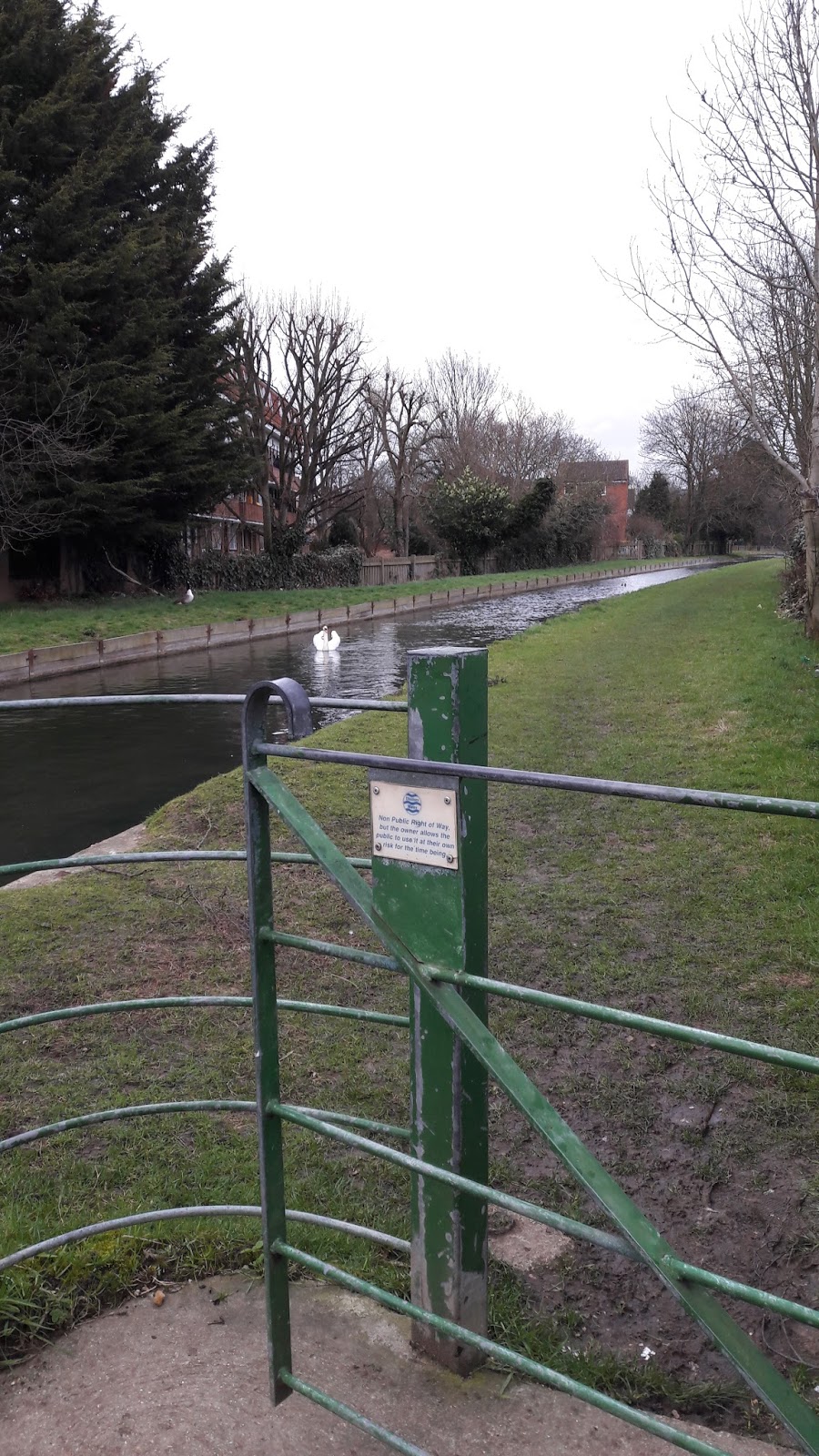
The New River Path is a 28 mile (45km) footpath which stays close to a canal, hand-dug back in 1613. It was built to bring fresh drinking water from the springs at Amwell, near Hertford into north London. Quite amazingly it's still doing this job. I know this because at the entrance to many of the grassy paths running on just one bank of each section of the New River (which as you've guessed now is neither new, nor a river) is a Thames Water notice saying that it brings fresh water to north London so no fishing or boating is allowed (and cyclists are definitely not welcome).

Here's a link to the map created by Thames Water which guides you along the whole of the New River Path.

The classic New River Path view
with swan, goose and kissing gate.
More friendly is the sign that says "non public right of way but the owner allows the public to use it at their own risk for the time being."

It is however a wonderful walk from or to the heart of Islington where I live. In fact the ending is at the old river head close to Sadler's Wells (the clue is in that name too). This is now super chic apartments (I know because i managed to slip into the building at the last September Open House) which has the old oak-panelled board room in situ which residents are allowed to hire this for dinner parties!

Real deserts
Do you take potable water for granted? I absolutely do. It is such luck to live in the UK and be able to moan about our crazy climate with its endless rain showers. We got wet plenty of times on our New River odyssey. And if we forgot water we just looked for a pub and asked for a free glass or for our water bottle to be topped up.

Food deserts
A lot of the New River takes the walker through suburbia - rows of Edwardian style villas adapted to make it easy to drive everywhere. As a result there are no corner shops and no cafes selling a nice cup of tea - unless you head to the centre of the area you are passing, or a cafe in a park. So many front gardens are paved over and crowded with cars - often there's space for three vehicles.

Cultural deserts
I really like Cheshunt - to the east of the railway station is an entrance to Lee Valley Park, designed both as a nature reserve and London's playground. I've been here to take a walk, to listen to nightingales and simply to escape the city. But to the west of the station Cheshunt is a good example of dreadful ribbon development. The houses are rarely above two-floors so they seem to spread out for miles. I'd thought of Cheshunt as the countryside, partly because it is not on the A-Z. But there is considerable new building going up - a lot of it daft executive style homes built in too grand a style, too close to each other. It's true that I'm used to the Victorian/Georgian streets of Islington but they are at least offer high density living. Although i guess that's why people move out too, to get more space. But "more space" is at the expense of green and brown belt.

Increasingly Cheshunt has become a London overflow. For example the lovely lady I've been mentoring through Migrants Organise was temporarily housed in Cheshunt, byTottenham Council - much to her distress. She knew it wasn't London where she wanted to be - in part because it lacks bus services (although there are some) and the sort of cheap food shop she needed to survive. It was also an exceedingly expensive journey to her children's school in inner London. I couldn't convince her to visit the New River Path as she felt it was too far for her and her little kids to walk. Sadly she was a little scared of the Lee Valley Country Park.

Map 1 of 5 which guide you along
the New River Path.
Memories from the New River Path
It's taken my family nine trips starting in October 2013 and finishing in March 2017...
  • Detouring in Ware to look at the famous gazebos built along the River Lea
  • Endless stopping for someone in the party to put on a hat, take off gloves, have a rest, need a drink, pick up the dog's poo etc. If you walk with others build in hours of wasted (quality) time. If you route march you can be sure your family and friends won't join you again.
  • Introducing our daughters' friends to the New River Path
  • Listening to more than 100 Canada and Egyptian geese on the fields near the Cheshunt section
  • Being surprised to find the New River was put into a double-tunnel above the traffic to cross the M25 motorway.
  • Watching a cormorant dive and catch a fish in Enfield.
  • Hearing a swan beat its wings as it flew down a section of New River, about 2 metres above the water.
  • Finding a surprise farmers' market in Palmer's Green and buying a tasty loaf of bread.
  • The New River Festival held in Finsbury Park to celebrate 400 years since the canal was built.
New River path is on the left of this shot at the London Wildlife Trust's
newest reserve in Hackney.
What's the best bit?
Recently the East Reservoir has become a stunning Wildlife Trust nature reserve - opened by David Attenborough and boasting all sorts of fantastic wildlife, including the occasional bittern. There's also a fab cafe, Lizzy's at the Coal House Cafe (open every day 9am-4pm, not long after the reserve is locked). A walk beside the reed beds is always a treat, even if there's plenty of noise from Purin or any other festival sounds floating from not-so-far away Clissold Park. This huge expanse of water is the opposite of a desert - we're lucky to have it in north London.

Over to you
Have you enjoyed a trip down the New River path? Let me know your favourite section.


Monday, 11 April 2016

Celebrating our National Trails: the joy of a long walk

This blog is about family travel around the world without leaving the UK. We do this in a bid to be less polluting and tackle climate change while at the same time keeping a global outlook. The world has many long walks - from the Great Wall of China to mega trips undertaken by adventurers who know it's all taking the first step. Pete May gets some tips from writer Paddy Dillon about where to go in the UK for his next big walk.

Pete May and dog tackle the Thames Path on a very wet day.
AroundBritain No Plane enjoyed celebrating Cicerone’s very useful guides to National Trails at Foyles Bookshop in London. Now the guides include an OS-style mapping booklet that gives you all the mapping you need for the Pennine Way, Coast to Coast, Cotswold Way, Hadrian’s Wall, Offa’s Dyke, Pembrokeshire Coast Path, Great Glen Way, Thames Path and West Highland Way. The dedicated route maps eliminate the need for buying lots of separate maps and can be used in either direction. They were praised by Kate Ashbrook, President of The Ramblers. And all the guides also have very useful accommodation sections and tips on who baggage carriers, if that's what you or your family need.

Cicerone writer Paddy Dillon gave an entertaining talk on walking all the long distance trails of Britain — and he’s now walking them again to revise his guides. Paddy, who grew up with Burnley, first walked the Pennine Way at 16, “when I did absolutely everything wrong, so I could only get better!” He showed pictures of his travels around the UK’s trails and introduced us to some of the more obscure but interesting paths such as the Yorkshire Wolds Way, Peddars Way and North Norfolk Coastal Path, the Pennine Bridleway, the Speyside Way and Glyndŵr’s Way.

By this time I was tempted to tackle the North Norfolk Coastal Path or the Yorkshire Wolds Way this summer.

The next speaker, Ursula Martin of OneWomanWalksWales, got me thinking about how to walk across Wales.

After being diagnosed with ovarian cancer Ursula decided to walk 400 miles to her next hospital appointment in Bristol to raise money for cancer charities. She eventually completed 3000 miles along trails like Offa’s Dyke, the Cistercian Way, the Severn Way, the high-level Cambrian Way (“which almost broke me”) and the Pembrokeshire Coastal Path (“my favourite”). “People’s kindness was overwhelming. I planned to rough camp, but I was given so much stuff, tea, meals, and beds for the night. There was a lot of serendipity.” 

Initially she planned to walk 19 miles a day but then suffered a tendon injury. “In the end I let go of time and distance and just walked.” After her treatment Ursula has been clear of cancer for four years and is now writing a book about her journey. Her next project is to walk and sail through Europe.

A morning spent talking national trails can’t help but inspire some wanderlust for Britain’s vast array of walkways and Cicerone’s very thorough guides are the ideal way to plan your route. 
Over to you
Do share your best long distance routes - have you tried doing a long walk on your own or do you have any tips to tempt your family along?

Wednesday, 4 April 2012

At last we've walked 75 miles round London


This blog is about family travel around the world without leaving the UK. Impossible? No. Here are some thoughts on the joys of walking in the city (any city). This post was made in April 2012 by Nicola Baird (see www.nicolabaird.com for more info about books and blogs).  
Pix above offer a taste of London views for walkers - sublime, chilly, fingerpost marked and a successful bench hunt to rest those weary legs... The last three pix show Nell and Lola reading, Pete and the girls looking at the dinosaurs at Crystal Palace and the last pic is me, Vulcan and the girls celebrating our very last Capital Ring fingerpost!
It's taken us nearly six years - from autumn 2006 to April 2012 - but at last we've completed the Capital Ring, a 75 mile (120km) walk around London. It was dreamt up in the year 2000 and then signposted around the capital in 2003. On our walks we've rarely met anyone else pounding the route, although I know another local family who impressively finished it during a three-month weekend of walks. Turns out 1000s have completed it - some in less than a week -according to the route maestro and Capital Ring guide book author Colin Saunders:  
"Sales of the book have now passed 11,000 since it was first published in 2003. Of course not all who buy it will complete or even walk the route; on the other hand many who walk it won’t have the book.  Completers are encouraged to contact Walk London for a certificate."
On our final hike - eight miles from Grove Place to Crystal Palace - both Lola and Nell were desperate to take short breaks so they could go back to the Harry Potter adventures they were reading. But on other routes they've looked up and seen herons, squirrels, wild flowers, stunning views of London and all sorts of pubs. There's been something of note everywhere - old houses, litter, multicultural shops, religious festivals, chalked pavement notes, football crowds and often in the far horizon Wembley Stadium's arches, a plane circling for Heathrow and the hills that spread out of London away to the downs beyond Croydon, and the chalk hills of Buckinghamshire. Even when the walk is bad (through boring suburban homes), it usually means it is just about to get better.


Circling London on foot has certainly helped all of us learn how vast our home town is (well, there are 7 million  plus Londoners) and how green (and underused) parts of it is. It's true that we will happily walk in rain, but the only time we've really seen children out and about (besides supervised play in parks) has been in Beckenham.


More about the Capital Ring here.

Over to you
How many big walks can you name - or have you done? Ideas from anywhere in the world please!