A-Z activities

A-Z countries

What's this blog all about?

Hi, I'm Nicola - welcome to a blog begun in 2012 about family travel around the world, without leaving the UK.

I love travel adventures, but to save cash and keep my family's carbon footprint lower, I dreamt up a unique stay-at-home travel experience. So far I've visited 110 countries... without leaving the UK. Join me exploring the next 86! Or have a look at the "countries" you can discover within the UK by scrolling the labels (below right). Here's to happy travel from our doorsteps.

Around 2018 I tried a new way of writing my family's and my own UK travel adventures. Britain is a brilliant place for a staycation, mini-break and day trips. It's also a fantastic place to explore so I've begun to write up reports of places that are easy to reach by public transport. And when they are not that easy to reach I'll offer some tips on how to get there.

See www.nicolabaird.com for info about the seven books I've written, a link to my other blog on thrifty, creative childcare (homemadekids.wordpress.com) or to contact me.
Showing posts with label south africa. Show all posts

Monday, 30 January 2017

Distance learning alumni from Mauritius to Malet Street, WC1

How long has distance learning been possible? It still feels like a modern option, but you may be surprised. Words from Nicola Baird  (see www.nicolabaird.com for more info about my books and blogs).

Inside the University of London's Senate House.

1865 is the year that Alice in Wonderland is published – and Rudyard Kipling was born in Bombay. Queen Victoria is on the throne and Lord Palmerston is Prime Minister. It’s also the date that the first distance learners, based in Mauritius, began studying with the University of London. Surprised? I was.

Fast forward to 2017 and the University of London has more than 50,000 distance learners living in 180 countries in the world. They can choose from 84 courses and are working for every level - BAs, Masters and PhDs, see more here.

Distance learning was never an easy option. Back in the 1990s there were missives arriving in the sluggish post and annual exams. Now it is fantastic with on-line discussions, downloadable course packs, an online library and a way of talking to both your tutor and other students. Of course you may be doing this for three or more years, often while working a full-time job, which is why it is a learning method as ideal for people who cannot abandon their job as well as the super-isolated. Former students include scientists based in Antarctica and even Nelson Mandela while he was imprisoned. “Our records show that it took Nelson Mandela three attempts to be allowed to take his exams,” says Ali Chapman who recently joined the university’s fundraising department and is enjoying researching through alumni records.

Ali clearly also loves the Senate House atmosphere and is offering to show past distance learners around – which is why she contacted me.

I did an MSc in Environmental Management through the University of London, graduating in 1995. It’s a long time ago, and I still haven’t forgiven the weather for producing four consecutive Indian summer Octobers (when we revised, then took exams). More importantly I remember how rigorous and interesting the course was as it steered students through international environmental law, ecofeminism, the precautionary principle and the 2nd law of thermodynamics (which roughly translates as ‘there is no away’).

LibrariesUntil they were recycled, my MSc course’s green spiral course readers were the star of my bookshelves. Twenty years on the shelves now house a large collection of eco-thinkers from George Monbiot to Noreena Hertz and, cheekily nestled beside them, my own books such as The Estate We’re In which looks at car culture, Save Cash & Save the Planet (co-written for my former employer Friends of the Earth) and Homemade Kids: thrifty, creative and eco-friendly ways to raisechildren. It’s clear that the MSc I did worked its magic.

And now its Ali’s job to tempt distance learners like me to be as supportive of the university – via legacy and other tax-efficient gifts - as those students who still know their way around the magnificent rooms and library towering above Senate House. To do this she offers me a tour of the building.

This is a real treat, as the closest I’ve got to the real University of London – if that’s what Charles Holden’s Portland stone monolith should be called – is an exam hall a couple of streets away.

Was this the Room 101 which inspired George
Orwell when he worked at the Ministry of
Information?
Visiting now, the marble clad 1930s interior hints at Great Gatsby glamour, but between 1939 and 1945 Senate House was used by the Ministry of Information. There were nearly 3,000 staff put to work on wartime propaganda which helped spawn the famous “Keep Calm & Carry On” poster as well as hundreds of propaganda leaflets and radio programmes. Famous Ministry of Information employees include George Orwell who clearly used his experience to create the Ministry of Truth in his novel Nineteen Eighty-Four (more about this here). On the way to her office Ali shows me the double wooden doors of Room 101, but, perhaps fortunately, the room is locked (although as air pollution and climate change share equal top spots for my Room 101 both are no doubt leaching out...)

Ali Chapman with honey from the
University of London's legal bees.
Navigating
We look at an exquisite map in the Chancellor’s Hall showing the University of London’s many satellite colleges (the Courtauld, the School of Hygiene & Tropical Medicine, London School of Dental Surgery etc) – it’s clearly had a huge impact on the UK’s STEM graduates, as well as humanities’ specialists. Then we cross to the Senate Room arranged like a court, with a semi-circle of green leather seats facing a staged platform which would surely only look complete with a Chancellor, or Judge in place. This is a regular spot for filming so you’re sure to have seen it too. It also boasts a secret oak panel large enough for even a stout lady or gentleman to safely disappear. Ali is slim, but even she hasn’t yet vanished on a tour.

University of London honey. 
Student no more
Finally Ali sits us down in a cosy nook with cake and herbal tea and offers me a tiny jar of honey made by the bees which have hives on the roof of the Institute of the Advanced Legal Studies building over in Russell Square. I think that might be where I used to sit exams, so it’s a perfect sweetener. See more about the University of London’s legal bees – and the people who help looking after their hives – on the BBC here

Wouldn't it be interesting to find some of the oldest distance learners from Mauritius? I bet they'd have some stories... Thinking about studying a long, long way from home makes me remember how as a VSO volunteer I once fried the mother board on the essential printer at the Solomon Islands Development Trust by accidentally clicking yes when a ghekko was exploring it. Horrible mess. Or the time I was looking for a book and shown the empty husk of the the KG6 secondary school library which had been totally consumed by white ants. That was my first taste of distance learning - completing a TEFL (Teach English As A Foreign Language) certificate - but the combo of climate and self-discipline made me realise how very challenging it can be. Which makes the rewards even better.

Surely this explains why when I left Senate House with a new and delicious sense of belonging. I know this potentially comes with a price – universities are extraordinarily proactive at trying to eek donations from past students for good reasons. But thanks to Ali what fascinating discoveries I’ve made about the University of London, more than 20 years after I received my MSc. As even eco-bunnies say, 'Better late than never'.

  • Join the University of London's Being Human Festival 2017 from 17-25 November. See more here 
  • Studied with University of London? Then you need to use their alumni pages, see www.london.ac.uk/alumni
  • What's happening at University of London is on facebook.com/UniofLondon, twitter @UoLondon, insta @unioflondon

Tuesday, 30 June 2015

How to go on safari in the UK & find the big 5


This blog is about family travel around the world without leaving the UK. We do this in a bid to be less polluting and tackle climate change while at the same time keeping a global outlook. How about going on safari and looking for the Big 5. I've offered a few choices below (six!) plus some places you might find them. But you could create your own Big 5 list... Words from Nicola Baird (see www.nicolabaird.com for more info about my books and blogs).


Safari lodges for glamping on the Isle of Wight at Node's Point. The Isle of Wight
is a good place to see red squirrels and seals. (c) Park Resorts
If you ever imagine a safari in South Africa, Kenya, Tanzania, Botswana or Namibia you'll know that soon you will be looking for the "Big Five" by day. By night you'll be back at your tent sipping sundowners discussing the ones that got away, or planning the next day's sightseeing. The original Big 5 list was for big game hunters armed with a rifle not a camera. The popularity of big game hunting has meant that grand old homes in the UK invariably have some forgotten ancestors' big game trophies attached to the wall. Strange to hang a decapitated animal hung on the wall for generations.

I also puzzle about why those five choices.

Lions make sense, so does an elephant, leopard and rhinoceros but how come a buffalo is on the list? Surely a buffalo is just a big sort of cow?

Of course hunting the big five has changed. It's mostly done with binoculars and a camera. If you spot them all you have boasting rights, for ever. But you don't need to trek around the world to try and find impressive, elusive animals.

In Scotland people reckon the big five to spot are red squirrel, red deer (stag), grey seal, otter and golden eagle.

My own Big 5 list is reasonably tough to complete - but not only do you get to look for interesting British wildlife, you also start to think about healthy habitats as you visit beautiful places in the UK.

Here's some help below to get you spotting the British Big 5. Please let me know what you've seen, and where to find them.

On the hunt for hedgehogs along a Yorkshire lane Nell finds a huge puff ball mushroom.
HEDGEHOG (our lion)

  • Critically endangered
  • Squashed hedgehogs on the road indicates a population boom, and bust

Spotting a hedgehog is harder if you live in a town or city as they tend to be lined with solid fencing. But at St Tiggywinkles in Haddenham, Buckinghamshire you can see recovering hedgehogs and listen to hedgehog talks the whole year round.

Hedgehogs hibernate when it gets colder - so in the autumn be sure to leave undisturbed cosy piles of leaves where a hedgehog could warmly over-winter.

My friend Hugh Warwick is Britain's hedgehog expert. He wants us to rip out garden walls and other solid fencing and to pay far more attention to these utterly cute beasties, pointing out that they do good stuff for us too by eating up garden pests (so there's no need to use chemicals). His first book was called A Prickly Affair, and one of the next was Hedgehog. Have a look at his website, and if you meet him, insist on seeing his hedgehog tattoo.

SEALS (our elephant)
  • grey seals have a double chin
  • harbour seals look as if their head has been flattened (if you are looking at them head on)

There used to be an old bloke selling fish at Eyemouth, a fishing town just on the Scottish/English border. Tourists would buy a fish and then dunk it into the harbour where it was eaten by a spectacularly lucky, rather chubby seal.

In Norfolk at Blakeney Point you can take a boat trip to see a colony of seals. Several companies run these trips, leaving from Morston Quay.

There's also a small population of harbour seals in the Eastern Solent which can be spotted between Southampton and the Isle of Wight (see the report here).

It is a joy to see living seals - like all wildlife, look well but don't touch.

A safari tent at Node's Point holiday resort on the Isle of Wight.
You could structure your holiday around a Big 5 animal hunt on the
island - it's got seals and red squirrels, plus beautiful woods and beaches. (c) Park Resorts
RED SQUIRRELS (our leopard)

  • grey squirrels are non-native and seem to be everywhere (foresters and some gardeners find them very annoying)
  • red squirrels are native and rare

Our dog really dislikes grey squirrels
(this is his 'I've seen a squirrel face', now I will bark)
which may be why our family Big 5  list
is still missing a red squirrel.
I love the way grey squirrels chirrup, jump from tree to tree and are still crazy enough to be hand fed by people in city parks. But red squirrels are rather different, almost mythical creatures that revel in their secret hidey-holes. The best way to spot a red squirrel is to find a place where there aren't any grey squirrels - like the Isle of Wight. The National Trust woodland of oak and beech trees at Borthwood Copse has a red squirrel hide

A few years ago my family spent a day looking for red squirrels at Cragside, the huge Victorian pile in Northumberland. The estate is vast but there are meant to be lots of red squirrels here, even when it's raining.

However we couldn't find them and the website says if you are in the hide near the formal gardens and do see a red squirrel please tell the staff - so I guess it's pretty unusual.


Nell (left) isn't as keen on cows as her sister, Lola, or Dad.
POSH COWS (our buffalo)


  • Worldwide there are 800 breeds of cattle
  • Most dairy cows in the UK are Holstein-Friesian crosses
  • Native cows suit particular areas best - Aberdeen Angus (Scotland), Dexter (SW Ireland), Jersey, Guernsey

Talking to cows at an ice cream parlour
and tea shop in Yorkshire.
The Dinefwr white cattle have been at Dinefwr Castle, Wales for more than 1,000 years. With their long horns they look very different to the sweet-faced Jersey cows who are so good at creating cream - and they inspired novelist Eva Ibbotstone's wonderful children's story The Beasts of Clawstone Castle.

Visiting a farm that's set up for visitors is a great way for young children to see cows up close. Try seeing how many cow breeds you can identify if you are driving through farmland, or on a train.

Stumps arranged to encourage stag beetles to breed.
This is in a London park near Arsenal tube.
STAG BEETLES (our rhinoceros)

  • The vegan king of the mini-beast world (and able to fly, just)
  • People's Trust for Endangered Species (PTES) is asking the public to join their national great stag hunt, see how here.

In the south of England, especially in cities you can find stag beetles - as long as there is standing, rotting wood (stumps or piles) where they can oh-so-slowly metamorphosise from larvae into stag beetle and emerge above ground to look for a mate. I've spotted them in Brockwell Park, Lambeth. They may be living very close to you, so long as you aren't a compulsively tidy gardener. Allowing things to rot, and having wood and leaf piles helps wildlife so much. Ask your local nature park if they have a stag beetle site and if you do see one, take a photo on your mobile and send it the PTES.

Read a cute encounter with stag beetles here  and an informative one here

WOODPECKERS (our eagle)

  • All answer to the name Woody.
  • Boasting rights if you find a greater spotted woodpecker's feather (black, white & red).

Here the rat-tat-tat or the wah-wah-wah-wah cry in a wood and you need to look towards the sounds until you spot your woodpecker. There seem to be many more green woodpeckers, perhaps because these are often seen feeding on the ground where they will be looking for ants. Here's an ID guide to the three native woodpeckers.


WHERE TO STAY on a British Big 5 trip
Traditionally safari goers stay in a very posh tent - in the UK this is now known as glamping. And it's fantastic. Look around on the web to find places that offer glamping.  Of course you can still camp with a tent, but as Lola, now 17, explains, we don't camp much any more:

"When I was seven years old my parents took me on a camping holiday in the Lake District. That was camping with a C not a glamping trip. Whilst we had a very good time, every morning when we woke up it seemed as if the lake we were camping beside had got a little closer. And it had - we eventually had to abandon our tent! That's why I'd like to go glamping in the Isle of Wight - no lakes creeping into your tent, running water and comfortable beds without rocks under your sleeping bag. In fact it is the only way I'd consent to go on safari again!" Lola, 17

SPONSORED: Lola and Nicola were guests of Park Resorts on a day trip to see the new glamping facilities at their holiday resorts on the Isle of Wight:
  • The Isle of Wight can be reached in about two hours from Waterloo station, then take an Wight Link ferry at Portsmouth to Ryde (with its long sandy beach) or Fishbourne. http://www.wightlink.co.uk/iow/
  • Park Resorts has 48 UK holiday parks including the Lake District, three on the Isle of Wight and also along the Essex and Norfolk coasts. www.park-resorts.com

Over to you
Do share your family's big 5 adventures - and also any suggestions on where to find the animals, and where to stay. Thank you.


Monday, 6 January 2014

Just imagine if Mary Kingsley joined us on a dog walk...

This blog is about family travel around the world without leaving the UK. Impossible? No. Here we go for a London walk imagining how the famous explorer Mary Kingsley would experience 2014. Words from Nicola Baird (see www.nicolabaird.com for more info about my books and blogs). I also publish an interview every week with people who live or work in Islington at islingtonfacesblog.com - there's a prize for the 100th follower.

Mary Kingsley is famous for being a Victorian woman who travelled hugely, from her 30s onwards, around west Africa including Sierra Leone, Angola, Cameroon and South Africa. Here's the link to the wikipedia page. Mary was born in Islington in 1862 - though I recently found a plaque marking one of the homes she'd lived at in Hampstead, north London.

Islington and Hampstead have many lovely places to go, eat, drink etc - but they are also some of the best boroughs for people spotting. So, as Nell, 12, and I walked by with the dog we tried to imagine what Mary - the famous adventurer, ethnographer and travel writer - would see on our walk back to Islington in the rain.

Nell sets off on an explorer's journey.
Mary Kingsley had strong views about polygamy (ok in the context of wives have a lot of work so could do with some help & it ensured no woman was unmarried which meant they were given proper support not treated like outcasts); no killing of twins (a common practice when she was travelling in Africa) and also women having their own independent life (but not to the extent of being called a feminist, that made her very ratty). What would she see now besides more cars and less people walking than in her day? What else would she think curious? We reckon:
  • Mini portaloos parked in gardens so the builders can take a loo break
  • Garages for cars that look as if the owners park their car in the kitchen
  • Joggers
  • Fancy dogs in fancy coats
  • The choice of recycling or rubbish bins
  • Drinks cans thrown down
  • Arsenal and Tottenham football fans in jeans
  • 2-D statues at Finsbury Park train/tube station
  • The lack of kids out (especially unsupervised)
Tree covered in old man's beard (wild clematis) - could it be hiding a medicine man?
We did find a bearded tree though - and wondered if it would remind Mary Kingsley of something she'd seen on her travels?

Over to you
Is there anywhere you go all the time that someone from another century probably just wouldn't believe - either how much it had changed, or how little?

Sunday, 10 June 2012

What's so special about the ExCeL venue?


Landed, SS Robin and the final view of Tate & Lyle  from the Docklands Light Railway.
This blog is about family travel around the world without leaving the UK. Impossible? No. This post has a look at the area around the ExCeL centre, one of the Olympic venues - which offers a mishmash of world experience. Words from Nicola Baird (see www.nicolabaird.com for more info about my books and blogs).    

Perhaps this title is misleading? At the weekend we stumbled on the ExCeL as a result of joining a madcap musical improvising jam set up by the team at SS Robin. SS Robin is a wonderful, old steam ship built in this area at the old Thames Ironworks (at the top of the River Lea) - and the birthplace of West Ham football club. Robin is now on a vast pontoon in Royal Victoria Dock awaiting some interesting changes to make her into an exhibition space before she is relocated a little way upstream.

Royal Victoria Dock is opposite the ExCeL Centre (a company with direct links to Abu Dhabi as in ExCeL: ADNEC). We thought we were going to hear the Grand Union Orchestra - but it turned out we were to be part of the orchestra which is famous for it's rhythms and diaspora players. At the SS Robin workshop there was Claude from South Africa who used a violent whistle to keep all the percussion players in time. He was phenomenal and managed to help both Pete and I (absolute tuneless wonders) find some kind of musical mojo through beating out a rhythm of "co-ca, co-la" and for 3:2 "we are the cham-pions". Seeing Pete perform a triangle solo was quite something! Although I was unable to laugh seeing as I'd tried to hide myself - and my bell and stick - behind a pillar in a bid to avoid such scarey attention... Other music trainers included Yusuf from Bangladesh and the very talented, friendly Lily from Bulgaria.

It's big
After the music jamboree we clambered up the stairs that take you over the Victoria Dock footbridge to the Western Gateway Dock (with the ExCeL, Ibis hotel etc). It has a remarkable view across to the Thames/Emirates cable car one way - and the good ship SS Robin the other way. Everything is on such a scale in this area - the old warehouses, the much-reduced Tate & Lyle factory with it's iconic Golden Syrup can on one side of the building, the new builds, the old cranes along the dock, even the water - that it's hard not to make a big thing look small. Or to feel like a dwarf.

Opposite - or over the footbridge - is the Excel centre where some of the Olympic Games will take place including tae kwondo (to which my family has tickets!). Beside ExCeL are restaurants that aim to cater for huge crowds - although there were only a few people around during our visit. There are two Indians, one Italian and a pub called Fox@excel. We ended up at the Fox which is strewn with TV screens and has a sports ambience to it. It's a vast brick space which is clearly going to fill up during the Olympics - the Ladies had a row of 10 loos which felt profligate given the smallish collection of Saturday night pub goers.

All change
Obviously this part of London, a dock sandwiched between Canning Town and west Silvertown - is all the old East End. But it feels so strange compared to the crampedness of up town living.

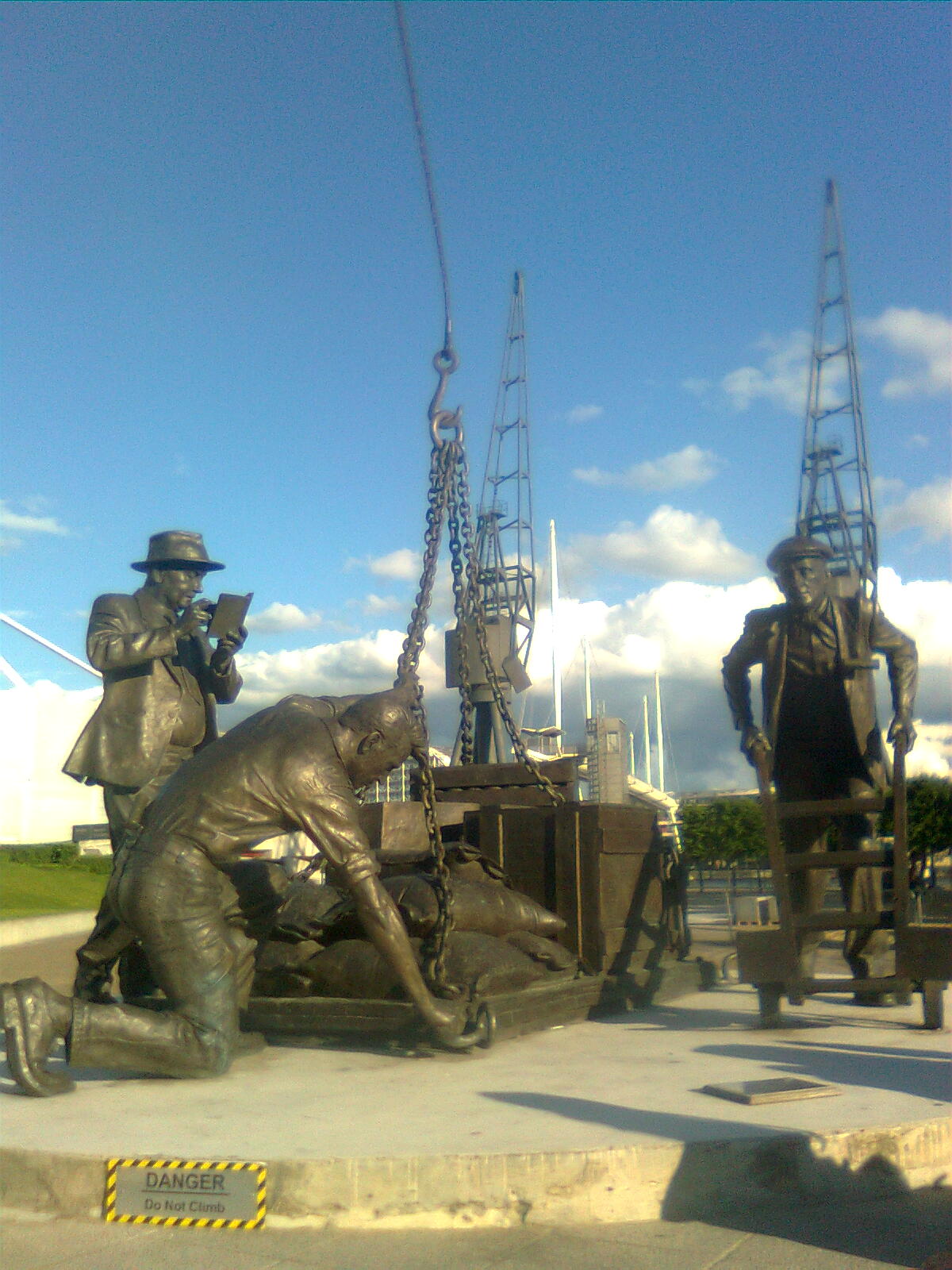
There are surprising clues to the extraordinary story of how this area has gone from marsh to dockland to bombsite, to sport and leisure venue over the centuries thanks to a life-size sculpture. In Brisbane we were much impressed by the street sculptures that brought history right into the shopping centres. The same's been done by the ExCeL at this once crazily-busy dockside. There's a bronze sculpture by Les Johnson, unveiled in 2009, called Landed with three portraits of workers - one young man, one fatter manger reading a docket slip beside a large package just unloaded from the spice (and slavery) island of Zanzibar, and the other older with a flat cap and a sack hook over his shoulder. Above them is a large hook, who knows how it stays up, but clearly representing the cranes used to unload all the cargo in what was then known as the Royal Docks. I believe there's a crate labelled Hong Kong too, but I managed to miss this... The problem with round the world travel is it's not long before your brain is over-loaded with information, and that's even when you are pacing a 500m route across a dock!

See the Grand Union Orchestra perform on 18 July 2012 at the Hackney Empire.


Over to you
Just two questions: what do you know about the Olympic venues? Do you think music or food is a better route into new cultures?

Friday, 9 December 2011

Lisbon 1 Durban 0

This blog is about family travel around the world without leaving the UK. Impossible? No. Here is a short news report on which gets more news coverage: the ministers meeting at Durban (on climate) or squabbling over the Lisbon Treaty (money). This post is by Nicola Baird 

I've been a poor sleeper for years, ever since I had children really. So this morning about 6am - after finishing the novel I was reading and messing on Facebook - I started looking on the web for info about the COP17 talks at Durban. These are important climate talks, not unlike the ones that hogged the world's attention when they were in Copenhagen. There is so little to find, although I did uncover a shocking post from Reuters about how the failure of these talks looks set to drown island states, with first on the list being Tokelau. In contrast the meltdown of the Eurozone (thanks again Cameron for messing things up) had headline after headline. 

In a contest of Durban v Lisbon, the latter is clearly the outright winner. Money drives news agenda a zillion times over attempts to save the world.

And yet there is some good news around. For instance I found this news item below on the ecogeek website. It's from the LA Times. I think it is good news that investments in renewable energy topped fossil fuels last year - although as the UK isn't exactly doing this, who on earth is? There's another glitch: the enormous sum of $157 billion was also invested in new natural gas, oil and coal plants - the fossil fuels that are causing climate change... 

Really you couldn't make this skewed understanding up - as I read in Rosamund Urwin's Evening Standard column yesterday we'd rather see our great grandchildren swim to school than pay just a tad more tax to try and tackle the problems of climate change now, when we actually still might be able to do something.
Investments in Renewable Energy Topped Fossil Fuels Last YearWritten by Megan Treacy on 29/11/11 For the first time, investments in renewable energy projects surpassed those in fossil fuel power plants, according to Bloomberg New Energy Finance.  Last year, $187 billion was invested in renewable energy installations, while $157 billion was invested in new natural gas, oil and coal plants. The increase in investments in the sector, even while in a down economy, has led to price drops in equipment and renewable energy power, making solar and wind power far more competitive with coal power. Renewable energy subsidies deserve a lot of credit for the spending increase:  about $66 billion in subsidies were handed out last year. It's a great bit of news as another round of global talks on the climate crisis is likely heading nowhere as we speak. via LA Times

Tuesday, 6 April 2010

Essex discoveries part 1


Nicola, Pete, Lola and Nell love travelling around the UK. Here's some ideas to fill your holidays and keep your carbon footprint low. This post about Essex is by Nicola

It's a swap thing: Pete was born in Herts, and I was born in Essex. But he's all Essex humour and I'm the posh bird from Hertfordshire. Although we didn't meet until I was 29 years old for a time we'd both lived pretty much equi-distance from Bishop's Stortford, the Hertfordshire market town that protects us from Essex. Or vice versa. Anyway, ahhh.

Nell, 9, is intrigued by Essex, she's hardly ever been there and yet there's a map on our corridor wall with rings around all the places that are family important (and yes, Nasty and Ugley, High Easter and Cold Christmas - we lost control of the highlighter pen!). And so the plan is get-to-know Essex better. It also means we've got a travel theme and Nell hopefully won't feel so cheated by her friends and their climate-bashing tales of "when I was at the airport...".


We've started well this Essex-themed Easter holidays well with a quick walk through Hatfield Forest, just outside Bishop's Stortford. Hatfield Forest is a remnant of the Great Essex Forest, mimics a medieval working woodland and is now run by the National Trust. As an added bonus it's opposite Stansted Airport working as a seriously green lung by the bypass and perimeter fence. Using a very easy to follow map we walked around the lake created by the one-time owner, a Hugenot refugee, who built a shell house for picnics - the shells (see pic left) are from the Caribbean and Africa, brought to the UK in the ballast of the ships that created such wealth for some of the old families (there's clearly a link to slavery here). The nice volunteer guide inside the Shell House encouraged the girls to play with these shells... And I swear I spotted the shells of African land snails too...

A family hunt
Next stop was just outside Great Dunmow (a place Pete could remember his Dad recalling the Saracen's Head and his mum rolling her eyes at the metropolis) for Great Garnetts farm by Barnston. This is where his dad, Denis May, had his first tenancy farm, eventually moving to the other side of Essex when offered more land for his dairy herd.


The big house at Great Garnetts was Elizabethan, with tall chimneys. There's still an interesting arch in or out of the stable yard and we hope to find out more when we go to the farmers' market held just about once a month (except August when everyone's too busy harvesting) - in 2010 they are on the 2nd Saturday of each month so try 10 April, 8 May, 12 June, 10 July, 11 Sep, 9 Oct and 13 Nov.
When Pete's mum, Sheila, moved in to the semi-detached farm cottage (see pic above) there was no heating except wood fires. I think she said there was no water as well. It must have been terrible for her especially looking after a four year old and Pete for his first eight months. No wonder he puts up with the cold... The farm cottages look picture perfect now and I think Lola and Nell were a tad jealous of the three children rolling outside with a pack of black labradors.

We also went to the pub that Denis used to walk to after his chores were finished. Lucky for us The Spotted Dog, in Bishop's Green (tel: 01245 231598), a lovely old thatched place, had just been redone and opened on 1 April (five days ago) as a gastro pub which still served real ale. We had our dog, so we ate on a bench outside, thinking about Denis all those years ago propping up the bar with a few old farmer friends. Maybe.
It's an irony that Denis felt so strongly that organic was a fad, and now even the old pubs are going all foodie and his old farm has recreated itself as a farmers' market. Obviously it's not all organic, but the locally grown element - pork and turkey - is key to this farming renaissance.

Friday, 12 March 2010

Where to watch the World Cup 2010?

Pete, Nicola, Lola and Nell spent the summer of 2007 travelling around Britain without resorting to planes (simple!). Now they're home and keep up the carbon-lite world travel habit in all sorts of ways. This post is by Nicola

So where's the best place to watch the World Cup this July? I'm asking this less for myself, more as a puzzle. I know one sports writer/lecturer who is taking her toddler to South Africa for the full atmosphere (but worrying as much about which malaria tablets to take as how to get tickets). My Brazilian-based friend plans to come back "home" to London just in case England does really well - I also happen to know he likes being around the UK for the soft fruits season, so that's two draws. Meanwhile his wife thinks it might be more fun in Brazil, just in case her team does really well. While the Dads group from Nell's school look set to fall back on a CAMRA (ie, real) pub near Baker Street that serves Abbot Ale and when they drank there last undoubtedly set up England's recent victory in the friendly against Egypt. A winning ritual should not be broken they claim.

Where you watch and how you get to that place can be a brilliant way of sharing the joys and blows of being a football follower, or it can be rubbish (yes, that's why there's a picture of the rat infested rubbish truck from the recent Rio carnival!). I'm guessing I'll see some of the games with friends and family on outdoor screens, walkable distances from my home.

It's been 10 years - this coming April - since Lola and I took our last flights (first as well in her case as she was not quite two years). Nell is nine years and still hasn't gone on a plane. Pete has flown in the past 10 years but only twice, once for fun and once for work, so our family footprint has stayed low for a significant length of time compared to our friends.

Our no-plane boast is not so great if we compare with our own childhoods - Pete never took a plane journey with his family, it wasn't until he was 18 that he set off for an airport check-in. I think I made one return flight to Northern Ireland as a toddler (apparently noisily confusing nuns with Father Christmas) and then another aged 15 when my Dad suddenly took us all to Paxos, a Greek island.

Our family's experience shows you can have fun at home in the World Cup (why, even Lola was born at the start of the 1998 kickathon), in fact home is probably the only place you can watch every game, keep up to date with every bit of information and still keep that carbon footprint a blistering zero. Here's to an England win...

Wednesday, 10 February 2010

Out of Africa

Pete, Nicola, Lola, now 11, and Nell, a just-turned-nine, spent summer 2007 travelling around Britian. They're back home now (not so far from Tower Bridge) but still trying to find ways to see the world without racking up their carbon footprint. This post is by Nicola.

Thanks to my friend Nicky, who I met at university, I've been to many places in the world I would have thought weren't for me - starting with Chitral in the North West Frontier Province of Pakistan, which borders Afghanistan. This was back in 1987 and my first trip to Asia. I really enjoyed it thanks mostly to Nicky who was living with her family there. Another summer we trained it around Europe (1984) - eurorailing was a belated right of passage for us both.

Nicky is a menace with the air miles (although I get to benefit and stay in touch as she comes by London Heathrow frequently as does 10-year-old Xander, see pic below with Lola and Nell). But last year, after nearly 10 years based in Zimbabwe, she and husband Robert (another uni friend) took their kids out of school and on to the dirt roads of Africa so that they could drive north-south from Cairo to the Cape and back again to Zim - a 25,000 mile road trip.

Robert is a fabulous photographer (that pic of Tower Bridge is his), films anything, and a good writer too so the blog entries on his trip, enlivened by the kids' entries, have been great. I loved popping to their blog between cups of tea and dull tasks, and now their route and adventures have also been poured over by Saturday Guardian readers - see here.

Six months cost their family £12,500, which sounds a hideous amount, but for an adventure fo a lifetime in which their children learnt so much - and not just how to use sand ladders to escape out of sand dunes and a combination of GPS and stars to navigate - it seems to me money well spent. Here at Baird Towers it would have gone on wine, bike services and energy efficiency which is nothing to write about... except that I do, see here.

If all of us could just take longer to get to places, perhaps we'd reduce the amount of mini trips made. Robert says there's a Swahili* word for this - mahali - the place that becomes a journey. That's exactly what this blog attempts to do as we wander around the world without ever needing to leave Britain.

*Swahili is spoken throughout east africa, including Kenya, Uganda and Tanzania.

Thursday, 3 December 2009

It's time to party

Pete, Nicola, Lola, 11, and Nell, 8, spent three happy months during summer travelling around Britain. Now we're home but the travel bug is still there. Join us for the occasional sightseeing plus tips on how to shrink your carbon footprint.

In the run up to the Copenhagen meeting next week there seems to be a sense of great sadness. See here at the Guardian. We did all this to the world. We made October the hottest, November the wettest, Sydney the dustiest, etc. And at night I am conscious that my bedtime reading, Notes from Walnut Farm - a collection of Roger Deakin's writing during the six years before he died - is imbued with sadness. Even the frothy spring cow parsley is berated for replacing rarer, and arguably more lovely, violets. See the cover here.

Which is why it is lovely to sometime crash a party and cheer the hell up. December is the best time to do this, but last month the highlight near home was when Algeria qualified for the World Cup. The guys in Little Algeria (an area around Finsbury Park) were able to celebrate qualifying for the first time in 21 years. They bounced up and down, they drove around the block hooting horns. They marched back and forth the zebra crossing. And they waved flags, smiled and gathered together (yes,blocking the buses) conscious of just how far their team had come in order to make the slot for South Africa in July 2010.

It was like a flashmob, but less contrived. You could smell the happiness.

Having fun doesn't make me forget climate change, but it does remind me how important it is to avoid the tendency for humans to look on the dark side. Yes the world is in a bad, bad place. But without hope it really is hard to summon creativity. And creativity is what we all need, and especially the journalists writing up the story and those world leaders whose job it is to get a deal.