A-Z activities

A-Z countries

What's this blog all about?

Hi, I'm Nicola - welcome to a blog begun in 2012 about family travel around the world, without leaving the UK.

I love travel adventures, but to save cash and keep my family's carbon footprint lower, I dreamt up a unique stay-at-home travel experience. So far I've visited 110 countries... without leaving the UK. Join me exploring the next 86! Or have a look at the "countries" you can discover within the UK by scrolling the labels (below right). Here's to happy travel from our doorsteps.

Around 2018 I tried a new way of writing my family's and my own UK travel adventures. Britain is a brilliant place for a staycation, mini-break and day trips. It's also a fantastic place to explore so I've begun to write up reports of places that are easy to reach by public transport. And when they are not that easy to reach I'll offer some tips on how to get there.

See www.nicolabaird.com for info about the seven books I've written, a link to my other blog on thrifty, creative childcare (homemadekids.wordpress.com) or to contact me.

Friday, 21 June 2013

Fish and flowers at the seaside

This blog is about family travel around the world without leaving the UK. Impossible? No. This post takes a look at Whitstable, taking in quick Ozzie seaside tours of food and flora.  Words from Nicola Baird (see www.nicolabaird.com for more info about my books and blogs).


"Britain is really an island!" said my daughters, almost in unison as we sat on the shingle at Whitstable and looked across the estuary. Living in London it doesn't feel like an island at all. But once you hit the coast - and our's is pretty long - you start to feel it.

We hardly ever go to the sea so it was fun to watch my 14 and 12 year old creep up on a tiny olive green-carapace of a Shore Crab. Even when they worked out it was dead they were frightened of picking it up in case they were nipped... clearly city kids! The dog was just as bad, lapping up the sea water in puzzlement and then rubbing his furry face into the sand in an attempt to rid himself of the saltyness.


Shingle, blue skies and beach huts. Ahh.

Seaside houses painted ice cream shades
by an upturned blue boat.
Whitstable is a Kent gem. You can reach it by train (approx 90 mins from London's Cannon Street). The beaches are mostly shingle, but in June they are covered in wild flowers - ranging from sea cabbage to my favourite garden escapee, red valerian, gorgeous. And dogs are allowed on the beach all year around.  The vistas give you plenty to think about: we imagined being back in Freemantle , Perth, Australia as we wandered over to the Whitstable Brewery so Pete could have a pint of native and we could ogle the oysters on offer.


Oyster shells waiting to be re-used
 (so don't take them home)
In fact the food all around the seaside part of town was amazing - ranging from oyster shacks to little fish stalls. Certain views give a sense of the pretty Byron Bay coastline along Sydney Harbour. But sitting at the Forge with fish and chips was lovely too. Then finish off at the Old Neptune pub with live music on Friday, Saturday and Sunday nights, or park yourself on a bench outside and stare out to sea as the sun goes down.

If you've never explored our 11,000 mile (17,000 km) coastline, promise yourself a few days to have a good look (maybe check the weather first...).

Great spots for a seaside day out:

  • Eyemouth, Scotland (to feed the harbour seals)
  • Leigh-on-Sea, Esssex (for the food sheds)
  • Whitby, Yorks (to hunt for Dracula)
  • St Bees, Cumbria (to start the Coast to Coast walk)
  • Margate, Kent (for art, windfarms and a sandy beach)

Friday, 7 June 2013

Famous spits: Ukraine, NZ or Devon


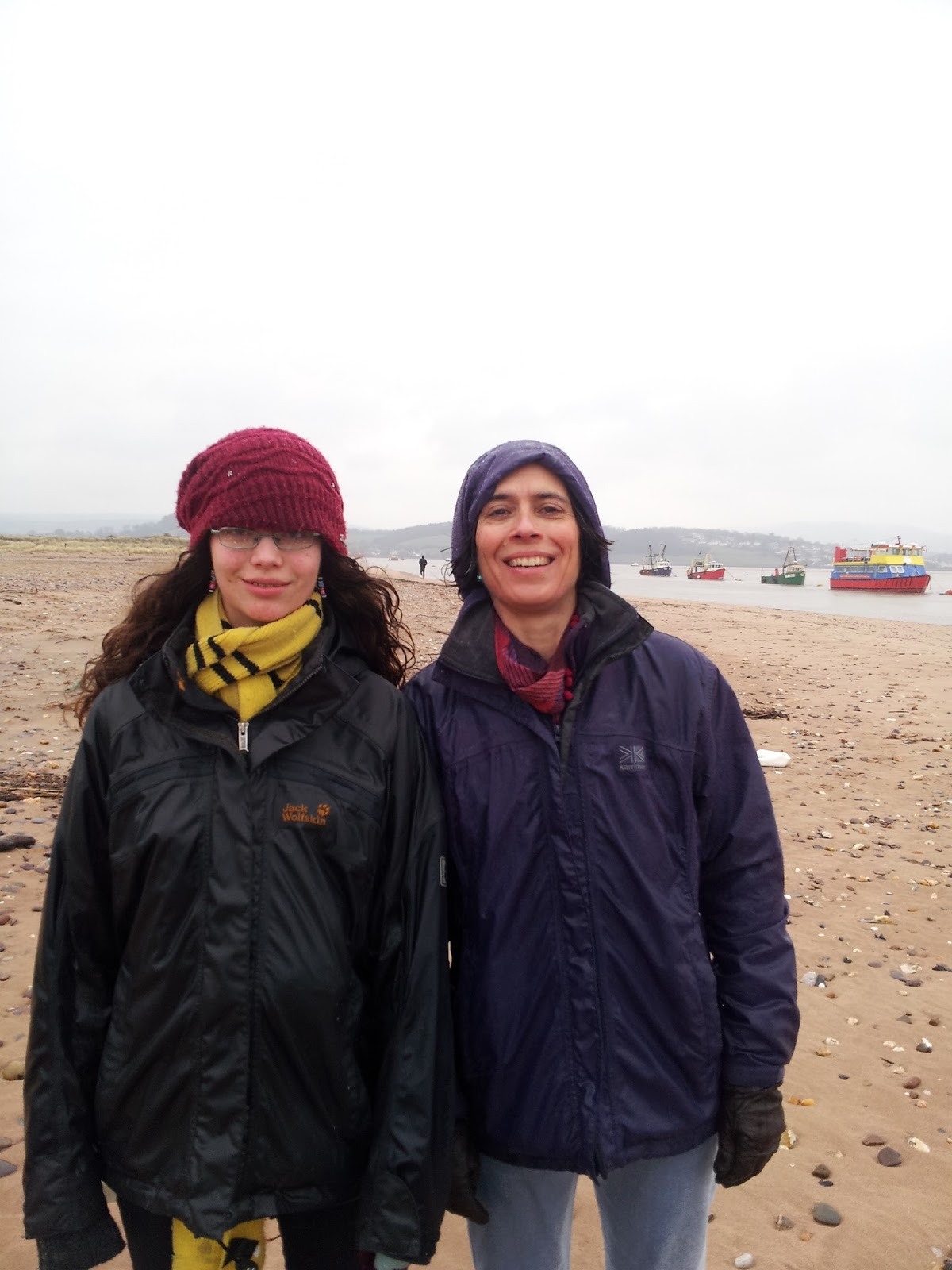
Mother's day 2013 - me and Lola spit
visiting in the rain.

Lola with my friend Sally. Count those boats.
This blog is about family travel around the world without leaving the UK. Impossible? No. This post takes a look at the world's best spits - thanks to a trip to Dawlish Warren in DevonWords from Nicola Baird (see www.nicolabaird.com for more info about my books and blogs).

Dawlish Warren is famous for its spit. Well famous if you are doing a GCSE in geography.  The rest of us know it's got a world-reknowned SSSI bird reserve and lots of sandy beach space. Two long beaches actually back-to-back, thanks to being a spit...

It takes about an hour to walk the length of the spit - although this shouldn't be done in bird nesting season, or with a dog on a lead longer than 2m, or possibly when a severe gale is blowing in spear-sharp hail (see pix right).  But if you do have a go the reward is seeing a spit (land eroding on one side and forming on the other, see more here) and as many as 8,000 resting birds at high tide - depending on the season.


  • Spits can be huge - the longest in the world is Arabat Spit, in the Ukraine, around 110km. It's easily visible from space claims this group of spit-afficanados.
  • New Zealand's Farewell Spit is 32km. It's often described as the "fish hook pinned to the top of NZ's South Island". 
  • Other famous UK spits are Chesil Beach (which is 189 miles long) and Spurn Point on the Humber, Yorkshire which is 4.8miles long.


Read more posts about Devon, here

Over to you
Where else can I go in the UK that offers a taste of  the Ukraine or NZ?

Tuesday, 21 May 2013

Biomechanics - easy exercise?

This blog is about family travel around the world without leaving the UK. Impossible? No. This post takes a look at an ever so simple way to make muscles work betterWords from Nicola Baird (see www.nicolabaird.com for more info about my books and blogs).

A slightly strange post showing a series of pix of me (and others) resisting movement in the style that I think is approved of by biomechanic advocates. It's all about resistance... recommended if you have a leg that is longer than the other, or you want to ride horses better (why do these two possibilities seem so strange?).

I suppose people in Herculaneum and Pompeii were doing something like this before their terrible ordeal with Mount Vesuvius.
push thigh up as you force the leg down.

lift


slump (yes I am wearing an outfit that was passed on by one of Lola's friends for my  12 year old).

slump and point toes


loosen the shoulder - keeping the hips still

my hands are holding an imaginary iron pole, so there.

now swing the hips

michael jackson pose

trainer claire resists a coat (this picture is screaming for a better caption!)


put a glove under your arm and bend ze elbows

I think this is the penguin pose  - it felt good, why doesn't it look cool?

Can all planes turn right here

using a filing cabinet/wall/door frame to resist movement

another penguin

Friday, 17 May 2013

Where can I be happy?

This blog is about family travel around the world without leaving the UK. Impossible? No. This post takes a look at what it means to be happy - on holiday or at homeWords from Nicola Baird (see www.nicolabaird.com for more info about my books and blogs).

Horse chestnuts in flower (look for the white candles).
"Does Japan have cherry blossom trees?" asks Nell, 12. This seems left-field but she explains that she's been playing Subway Surfer with a new background of blossom to make it seem more like Tokyo...

These days it's easy to travel without leaving your mobile.

Springtime - ideally outside away from screens - is wonderful in a country like the UK with four seasons. At least that's what the dog and I think as we walk around London (see photos). The dog enjoys sniffing and running - he's a lesson in how to be in-the-moment and happy.

But is happiness a choice? Can you feel happiness on demand, say by taking a holiday or being generous? I don't think so - although it's lovely to break routines, the pressure of keeping a family all happy (let alone a large family) for 24 hours a day for a week or more sounds terrifying. Creating a calm environment - with the opportunity to have many happy moments - is another option.

Wanting to be happy (and solvent) are two closely linked aspirations. As I meet more teenagers - my daughters' friends and the university students I teach - I do wonder about their resilience levels. It feels as if inner-toughness is being eroded at quite a speed. 

So what's happened in four years that's changed? Possibly far greater reliance on mini-screens for entertainment? Here's where I have to reel in an interview in the Guardian with 15-year-old Alice Carruthers talking about her perfect (or possibly typical) weekend, see here. In brief her main external experience appears to be from watching old episodes of Friends on YouTube. I am sure Alice has zillions of strengths but I was shocked to read her summary of typical weekend. She doesn't seem to move around, do anything for anyone else, of have many domestic tasks - other than homework. She's never asked to solve problems.
Circus ponies graze near tower blocks in spring sunshine.
"I want to get off"
Teaching riding I often find kids reach a point they can do most things (eg, steer and rise to the trot), but are quite unable to cope with a horse or pony resisting their requests. It can be frightening riding a horse but if a child - or an adult - can find the inner resilience to cope with the unpredictable, stop the tears and maybe to learn to love an animal that is as likely to stand on their foot as nicker at them over the stable door - I think they are lucky indeed. Not only will they be able to ride (a rare skill), they'll also have mined a strength of character that I am sure helps people to cope with problems.

Oh yes, and climate change...
In St James' Park on a spring evening with deck chair, book & picnic rug.

Cow parsley and hawthorn blossom-lined walk along a former railway.
For rather more cerebral insights about happiness have a look at Mattieu Ricard, a Buddhist monk, who links science and meditation with a certain amount of joy, see here. With thanks to my friend ML for passing this on (via Melbourne/Honiara and Facebook).

Over to you?
Any ideas for developing our resilience levels? Is there something that can be done at school or uni with students or is it something families need to work on?

Saturday, 11 May 2013

400ppm - sad statistic

This blog is about family travel around the world without leaving the UK. Impossible? No. This post takes a sad look at another record breaking statisticWords from Nicola Baird (see www.nicolabaird.com for more info about my books and blogs).

It's happened: the world's atmospheric carbon dioxide has hit  a historic high, 400ppm . This level was last calculated long before humans flew and drove the Earth. It's a totem figure of course, one many of us dreaded. 

I add this cliche message on my office poster as I guess that's exactly what's going to happen.

I notice I've used electric lights less today, but it feels rather pointless. Most of us use too much carbon and far too much of the world's resources.  I do anyway: according to WWF's info my carbon footprint is 6.74 tonnes per annum. Turns out I use 1.88 planet's worth of resources. These statistics do not make comfortable reading either.

I wonder how other countries are marking this?

Monday, 22 April 2013

Running all over the world, via London

This blog is about family travel around the world without leaving the UK. Impossible? No. Setting yourself sporting challenges demands international conversations. Words from Nicola Baird (see www.nicolabaird.com for more info about my books and blogs).

Lola, my sporty 14-year-old has now run the Mini-Marathon - the last three miles from Blackfriars Bridge to the Mall - four times. Kids in London boroughs are really lucky to get this chance, especially as the other Mini Marathon race runners are already elite athletes (see pic caption)

Lola's learnt a lot about pacing herself, plus an A-Z reboot of her mental map of London during these races. And on her 2011 race she also raised a bit of cash for charity too - books and science equipment for students at Woodford School in Honiara, Solomon Islands.

In 2013 Lola's joined by our friend Lucas, who is 11, and  zipped around the 2013 course
in 21 mins 30 seconds. The winner of the under 17s managed to complete
the race in 12 minutes - that's three four minute miles!
Near the finish spot the race commentator explained that the Africans (Ethiopia and Kenya) would dominate the winners. He was right too - Kenya won the women's race; Ethiopia the men's. And though it wasn't easy to see, every Marathon competitor wore a small black ribbon in memory of the stupid attack on Boston, US competitors and spectators last week. As a result all three countries played a big role in conversation with my younger daughter, Nell, while we waited for the runners to pass near our watching spot opposite Buckingham Palace.

Paula, Nell and Pete framed by flags. We all agreed that one of the best parts of the Marathon
is being able to walk down a road that's normally a traffic jungle.
The Mall is often a sea of flags - it's the only place in the UK that seems to do this (unlike say the US where flag raising and saluting are big parts of formal life). I did my best to spot the Solomon Islands and Kenyan flag as we passed the Commonwealth building, and was suitably rewarded with a flutter through the cherry blossom.

Over to you
What sporting occasion makes you feel as if you are in another world?


Sunday, 14 April 2013

Keeping it clean with tweed and soap

This blog is about family travel around the world without leaving the UK. Impossible? No. On a short Saturday city stroll we met anachronistic cyclists, a Korean soap sculpture and a Madagascan rafia hat collector. Words from Nicola Baird (see www.nicolabaird.com for more info about my books and blogs).

At the weekend Nell, 12, and I went for a wander around London - bits we didn't know to cheer up some rather dull chores. Living in London it's easy to find new places to discover but we lucked out when 500 tweedy looking folk, some on Penny Farthing bikes, came to a halt beside us before commencing a parade around London.

Turns out they were on the Tweed Run - a celebration of well-attired gentlemen and ladies who raise a lot for charity. It looked a lot of fun wearing what is conventionally traditional clothing (and very beautiful) on a bike - a sartorially startling contrast to the luminous lycra most London cyclists wear.

This sculpture is made from soap by a Korean artist.
Bubbles
In Cavendish Square behind department store John Lewis there is a statue of the Butcher of Cumberland. It looks like marble, but on close inspection we discovered it is made from 2.7 tonnes of Honey I Washed The Kids soap. The idea is that it crumbles away releasing a Lush-like smell. It's made by Korean sculptor Meekyoung Shin, see a short video here. Disappointingly we couldn't smell anything, maybe it needs more sun and less rain.

Later that day we went to tea with a woman who has collected hats from all over Madagascar. There were baby hats, dating hats, keeping the sun off hats and purse hats - all whipped up with dried materials. Her hats were the real McCoy, collected 30 years ago, but on the web I found the Madagascan Hat Company, a Fair Trade outfit that makes amazing raffia hats using traditional skills but with a twist that makes them more suitable for modern, tourist heads, see here.

Not bad for a short day's city stroll!